On October 13th local time, Indian Prime Minister Modi attended the Bloomberg New Economy Forum held in New Delhi and delivered a speech.
According to Bloomberg, Modi positioned India as a "reliable partner and leader of the global South" at the meeting. He stated that supply chains, trade, and technology once connected countries, but now they have been militarized.
"The world is facing a fundamental issue—trust," Modi said, "Trust ensures that supplies are delivered in time of need, that promises made are kept, and that partner countries stand with you during emergencies."
He said, “It is because of this that today’s India stands before you with a different mindset and a different way of thinking.”
Reports indicate that India’s economy is one of the fastest-growing economies in the world. However, it has faced numerous challenges over the past year, ranging from energy disruptions related to the war with Iran, to the unpredictable trade policies of US President Trump, and even issues related to the supply of critical minerals.
Among these, the instability in the Middle East has dealt a particularly severe blow to India. This has highlighted India's dependence on imported oil and natural gas, increasing inflationary pressures in India, which has led to a record decline in the value of the rupee.
During this period, Modi also emphasized the challenges brought about by artificial intelligence, while strongly promoting that India's economy offers opportunities for global investors.
Modi said: “Things that once connected the world are now militarized. In a world full of uncertainties, India offers a guarantee of reliability and stability.”
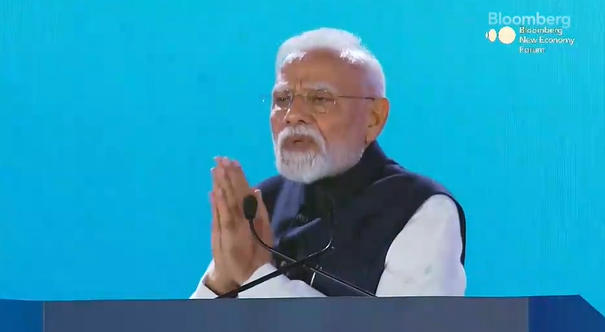
Screenshot of Modi's speech video on the 13th
Bloomberg reported that as Modi delivered his speech at the rally, the Indian government was trying to address the new wave of political unrest on the streets of New Delhi.
On the 10th local time, the police in Delhi, the capital of India, detained more than 2,000 protesters. At the same time, thousands of security forces blocked parts of New Delhi to prevent a gathering demanding the resignation of the chairman of India's electoral committee.
The core of this protest activity was the “special enhancement amendment” by the Indian Election Commission. The opposition claimed that this amendment deprived millions of eligible voters of their right to vote, and benefited the ruling party led by Modi. Protesters demanded that Chief Election Commissioner Jai Annash Kumar resign, and that this reform be stopped, as it has so far removed over 130 million names from the voter lists.
Indian police stated on the 9th that they refused to approve the protest event due to the application being submitted too late.
Before the protest began, the Indian police were on high alert and took strict security measures to prevent the protest from escalating. Earlier on the 10th, the Indian police boarded an airplane and detained Abhijit Dipak, the founder of the ‘Cockroach People’s Party’.
According to the Associated Press, the scale of the Indian police's restriction measures is ‘unusual’, highlighting the Indian government’s determination to stop this rapidly growing protest movement. This movement has mobilized thousands of young people, garnered support from opposition parties, and increased scrutiny of the Modi government.
So far, Modi has not made any public comments regarding the protests, and did not mention this matter in his speech on the 13th.

