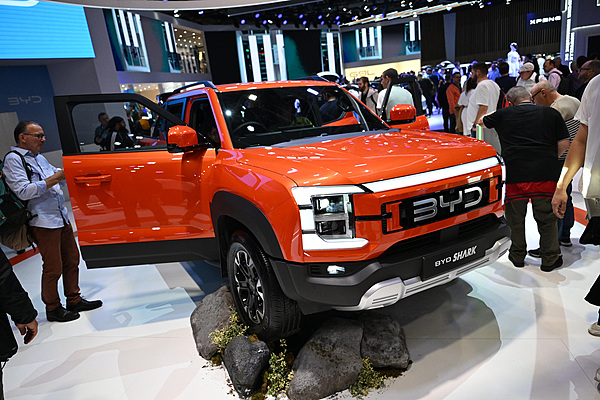
China-Europe has just reached a consensus on issues such as hybrid vehicle trade, and French President Emmanuel Macron publicly welcomed this. At the same time, Chinese automakers also made a concentrated appearance at the Paris Motor Show, continuing to expand their presence in the European market.
According to AFP and Reuters reports on October 12, during his visit to the Paris International Motor Show that day, Macron praised the economic and trade agreement reached between China and Europe last week. He believed that the arrangement helps Europe better protect its markets and deal with what he termed 'unfair competition'.
Macron stated that this agreement is the result of years of effort by both parties and is what European automakers have been hoping for.
This statement comes at a time when there are positive developments in China-EU economic and trade relations.
From October 8th to 9th, Wang Wentao, Minister of the Ministry of Commerce of China, and Jochen Stossmann, Commissioner for Trade and Economic Affairs of the European Commission, held the second regular meeting of the China-EU Trade and Investment Consultation Mechanism in Beijing. Both sides reached a consensus on 16 issues, including trade and investment balance, market access, supply chain cooperation, and risk management of disputes.
Among them, hybrid vehicle trade is one of the most concerning issues in this negotiation.
According to the Financial Times of the UK, the EU plans to impose safeguard measures on the import of hybrid cars from China for a period of four years. Two EU officials revealed that the relevant arrangements may set the import volume at 350,000 units by 2027, with an annual increase of 6% over the next three years.
However, these specific figures have not yet been officially confirmed by the Chinese side.
On October 12, the Ministry of Commerce of China provided further explanations regarding the results of the negotiations, emphasizing that both parties agreed on three fundamental principles for hybrid vehicle trade: respect for facts, non-discrimination, and compliance with the rules of the World Trade Organization.
The Ministry of Commerce pointed out that according to data from the European Union Statistical Office, the EU imported 107,000 hybrid vehicles from China in 2024, and this number increased to 302,000 in 2025. The two parties reached an agreement to “increase the quota” based on 2025, in order to ensure a stable growth in exports for Chinese companies.
The Chinese side also emphasized that no measures should target Chinese products specifically, and certainly no discrimination should be applied to Chinese enterprises. The quotas available to China will not be lower than those available for any other import source in the EU.
The Ministry of Commerce stated that this consensus safeguarded the actual interests of Chinese enterprises, prevented the escalation of Sino-European trade tensions, and provided a more stable and predictable trading and investment environment for both parties.
While welcoming the progress made in Sino-European economic and trade consultations, Macron also continues to promote efforts by Europe to enhance the competitiveness of its own automobile industry.
According to a report by the British 'Financial Times' on October 12, France and Germany are close to reaching an important agreement on EU automotive policies. The agreement involves adjusting the policy for the withdrawal of fuel vehicles, as well as supporting domestic car production through 'European Manufacturing' rules.
Mark Ronson announced at the Paris Motor Show that the agreement between France and Germany is “about to be signed.”
We are finalizing an agreement with German partners to push Europe forward, better protect our industries, while also upholding the carbon neutrality goal, enhancing competitiveness and strengthening sovereignty." Macron said.
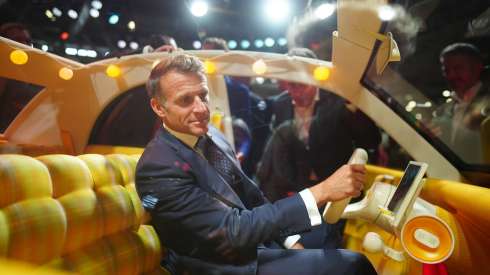
French President Emmanuel Macron said at the Paris auto show that the Franco-German agreement aims to "promote" Europe's "competitiveness and strengthen sovereignty."
He stated that the specific details of the agreement cannot be announced at present, but he hopes that both parties will complete the negotiations in the next few hours or days.
The Financial Times notes that France and Germany have been seeking compromises since this summer, attempting to resolve their differences in automotive policy.
Germany hopes to further relax the EU’s policy of phasing out fuel-powered vehicles by 2035, providing traditional car manufacturers with more room for transformation. According to two people familiar with the matter, Germany wishes to allow fuel-powered vehicles to still account for 10% of new vehicle sales after 2035, without having to meet additional requirements regarding the use of low-carbon fuels or materials.
France hopes that Germany will support stricter requirements for 'European manufacturing', so that EU public procurement and subsidies can benefit more cars, batteries, and components produced in Europe.
According to the proposed scheme, some public funding may be linked to whether the product is manufactured within the EU.
However, there is still controversy regarding the specific scope of application of these rules. For example, it is currently unclear whether countries like the UK and Japan, which have a close connection to the European automotive industry, should be included in the definition of “European manufacturing”.
This issue is also of concern to European car manufacturers. Companies like Renault and Ford have production bases in non-EU countries such as Turkey. Therefore, they hope that the new rules will provide exceptions for some trading partners.
The French newspaper Le Monde previously reported that Macron also invited executives from Michelin and BMW to participate in the coordination efforts, aiming to reduce the differences between the French and German automotive industries regarding localization requirements.
It should be noted that the final agreement between France and Germany has not yet been officially announced. Even if the two sides reach an agreement, the policies still need to gain support from other EU member states and the European Parliament before they can become official rules at the EU level.
EU Climate Affairs Commissioner Hulke also reminded that the relevant decisions cannot be made solely by France and Germany, two member states.
While Europe is discussing ways to enhance the competitiveness of its domestic automotive industry, Chinese automakers are accelerating their entry into European markets and actively promoting localized production.
According to a report by Reuters on October 12, this Paris auto show attracted approximately 20 Chinese car brands, including BYD and Chery. The number of Chinese brands participating in the show has doubled compared to 2024. Chinese automakers are expected to introduce up to 60 new models at this auto show.
Bloomberg reported on the same day that although the EU plans to restrict the import of Chinese hybrid vehicles, this is not expected to stop Chinese automakers from continuing to expand their business in Europe. On the contrary, companies like BYD and Leapmotor may accelerate the establishment of local production capabilities in Europe to adapt to the new market environment.
Bloomberg Industry Research analysts Joanna Chen and Jason Zhao believe that the new restrictions on hybrid car imports may have an impact on the growth of Chinese automakers. However, companies that can achieve faster localization production in Europe will be better equipped to handle these risks.
China Automobile Circulation Association expert Li Yanwei also told Bloomberg that the relevant restrictions will accelerate the process of Chinese automakers promoting localization of production in Europe.
In fact, Chinese automakers have already taken action.
BYD Vice President Li Ke revealed during the Paris Auto Show that France has been added to BYD's shortlist of locations under consideration for new factory construction. Meanwhile, BYD's car manufacturing facility in Hungary is making progress in preparation for production, and Spain is also a potential destination for future expansion in Europe.
Li Ke also told Bloomberg that by 2030, BYD will have more than 40,000 employees in Europe, and currently the company’s workforce in Europe is about to exceed 10,000.
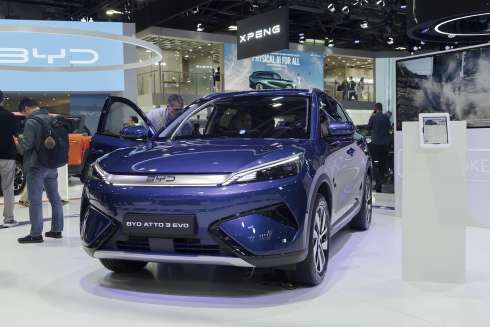
On October 12th, during the opening ceremony of the Paris Motor Show in Paris, France, a BYD Atto 3 EVO electric vehicle was unveiled. Bloomberg
Chery Automobile has started its automobile assembly operations in Barcelona, Spain. Geely is also promoting plans to produce cars using Ford's factory located in Spain.
Chang'an Automobile President Zhao Fei said during the Paris Auto Show that he is not very concerned about the new hybrid vehicle trade arrangements between China and Europe. In his view, the requirement for local production that Europe may introduce in the future also provides new development opportunities for Chinese companies to enter the European market.
Changan Automobile is discussing production plans in Europe with relevant manufacturers, aiming to launch models manufactured locally in Europe as early as the beginning of 2027.
These trends indicate that Chinese automakers are shifting from simply exporting cars to Europe to a development model where exports and localized production go hand in hand.
European automakers have also responded to the hybrid car trade agreement just reached between China and Europe.
Renault CEO Franck Provost said that while Chinese plug-in hybrid car imports are growing rapidly in Europe, bringing competition to the automotive industry, negotiations have been reached and "it's better than a trade war."
As Chinese automakers further expand their investment and localized production in Europe, the connection between the Chinese and European automotive industries will become even closer.
Through consultations, both parties have reached a consensus on issues such as hybrid vehicle trade, providing enterprises with more stable expectations. In the future, both parties will continue to communicate on topics such as market access, industrial policies, and supply chain cooperation. While properly managing differences, they will also continue to expand areas of mutually beneficial cooperation.