In October, Iceland was already showing signs of winter. This year's Arctic Circle Assembly continued to be held at the Hapag Hall in Reykjavik. Over the three days, more than 200 events were scheduled, attracting over 2,000 participants from about 70 countries, including more than 700 speakers.
The participants came from a wide range of backgrounds and levels. This included Iceland's President Halldór Thorgeirsson, as well as ministerial-level officials from Arctic countries and other relevant nations, parliamentarians, and local government leaders. There were also representatives from international organizations and institutions such as the EU and NATO, as well as representatives from indigenous organizations, research institutions, think tanks, and business sectors.
Security, shipping, critical minerals, scientific cooperation, climate change, indigenous peoples, community development, artificial intelligence, and submarine infrastructure are among the topics discussed in different venues simultaneously. Almost every hour, a completely different approach is used to discuss the Arctic. Such a highly diverse platform also provides a window through which we can observe the current trends in Arctic policy and the concerns of various parties.
After participating in several Arctic Conferences, I have increasingly noticed changes in the focus of the agendas. Climate change and scientific cooperation still hold significant importance, but the weight of security, geopolitical issues, and strategic competition has increased compared to previous years. At the same time, China's voice has become more active. In discussions about the Arctic, the United States tends to emphasize alliances and existing cooperative mechanisms, while Greenland continues to stress its own agency. The European Union is also very active, with security, investment, sustainable development, and Arctic partnerships being several of the key points in its statements this year. These developments are also some of the most noteworthy changes at this year's conferences.
At this year's conference, there were a large number of discussions on related topics in China, and these topics were highly visible. Fu Ying, former Vice Minister of Foreign Affairs, delivered a speech at the plenary session titled "Understanding China". Subsequently, at the Arctic Circle Conference, Iceland's former President Jónas Fríðisson hosted a panel discussion titled "Dialogue with China". The conference also featured thematic discussions such as "China in Arctic Science: Strengthening Trust and Cooperation", which focused on China's participation in Arctic scientific research and the issues of scientific cooperation and trust in the current context. Our China-U.S. Research Center, in collaboration with Tufts University's Fletcher School of Law and Diplomacy, organized a sub-panel discussion titled "Competitive Narratives of the Arctic".
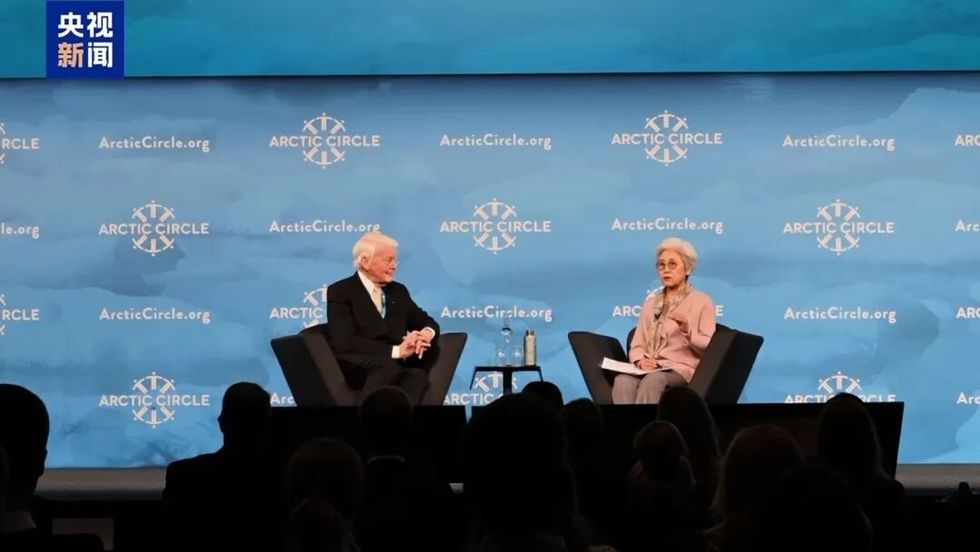
During the plenary session with the theme of "How to Understand China," the Chairman of the Arctic Circle Forum, Iceland's former President Grymson, had a dialogue with China's former Vice Minister of Foreign Affairs Fu Ying.
Over the past few days, I have observed a change in China's role at the conference. In the past, many discussions about China in the Arctic context often centered on questions like "Why does China come to the Arctic?" "What are China's long-term goals?" and "Do China's scientific research, investment, and shipping activities have strategic intentions?" China was more often in a position of being observed and analyzed. Now, Chinese scholars and research institutions are more involved in setting the agenda and are also more proactive in responding to specific issues. In discussions on scientific research, Arctic shipping, marine governance, Sino-Russian cooperation, and climate change, one can hear the voice of China.
Meanwhile, there is no consensus among various parties regarding China's involvement in Arctic affairs. Some scholars and research institutions in Northern Europe still value cooperation with China in areas such as sea ice, climate, remote sensing, and marine science. They are also more willing to discuss China's participation based on specific projects and research needs. The United States, along with some of the scholars attending the conference, tend to view China's involvement in the Arctic from the perspectives of Sino-Russian relations, strategic competition, and military-civilian capabilities. They pay particular attention to China's scientific research vessels, key infrastructure, maritime activities, and their potential long-term strategic impacts. Greenland and some Arctic communities have different views on China's involvement in the Arctic. They are more concerned about whether specific projects will bring benefits to local communities, whether local governments and communities can truly participate, and whether power competition will affect local decision-making space.
Over the past few years, I have continuously participated in Arctic conferences. It has become increasingly clear to me that long-term involvement is changing the way we communicate. It may not be possible to eliminate doubts, as some disagreements stem from real strategic conflicts of interest. However, when Chinese scholars and institutions continue to participate and directly address concerns, more attendees are willing to first listen to the Chinese side's explanations regarding policies and specific activities before making judgments. Arctic issues are highly specialized; each research project, shipping route, or investment has its own background and conditions. Face-to-face communication allows discussions to focus more on concrete facts and issues.
Just two days after the Arctic Circle Conference, on October 12th, Foreign Minister Wang Yi met with Russian President's Assistant and Chairman of the Maritime Committee, Pataluev. He mentioned that "China's initiative to build the 'Ice Silk Road' coincides with Russia's efforts to develop the Arctic shipping route. Cooperation in maritime affairs is becoming increasingly important within China-Russia comprehensive strategic cooperation." This announcement also indicates that there will be more cooperation between China and Russia in the Arctic region in the future.
On the other hand, the United States played a prominent role in the Arctic Council summit this year. Before the meeting, U.S. Secretary of State Blinken visited Iceland to emphasize Iceland's strategic role in Northern Atlantic and Arctic security, linking regional security, key infrastructure, and allied cooperation. After entering the meeting, US-related topics continued to appear prominently on the main stage and specialized discussions.
The main sessions of "America in the Arctic" featured Governor Mike Dunleavy of Alaska and Thomas Deans, chairman of the U.S. Arctic Research Committee. The discussions focused on Alaska's development, energy, defense, infrastructure, and the United States' own Arctic capabilities. The conference also addressed issues related to U.S. Arctic policy, Greenland, and NATO cohesion. Terms like "allies" and "coalitions" appeared frequently in several discussions regarding U.S. interests in the Arctic region.
But the Greenland issue is almost unavoidable. A series of policies and statements regarding Greenland by the United States over the past year have frequently been the focus of discussion at the meeting. Participants were particularly concerned about the new arrangements between the United States, Denmark, and Greenland, as well as how these changes might affect other countries in the Arctic region and existing cooperative relationships. It was evident from the attendees that those from Greenland, Canada, and some European countries still harbored dissatisfaction and doubts regarding these issues. Some Canadian participants even said that the actions of the United States over the past year had given some traditional allies the feeling of being “betrayed.” In response to these issues, U.S. representatives were relatively cautious in their responses, focusing more on alliance relationships, mutual trust, and existing cooperation frameworks.
On the last day of the conference, Alaska's U.S. Senator Lisa Murkowski also took the stage. When asked about the impact of sanctions on Russian oil and gas exports and the potential impact on international oil prices and energy supplies, she quickly shifted the conversation to Alaska, emphasizing its abundant oil and gas resources and the potential for further development. During the conference, there was also a special event called "Alaska Night". From speeches by governors and senators to related activities and supporting events, Alaska had a strong presence at this conference. Energy development, infrastructure construction, and economic development within the state were key themes during the conference.
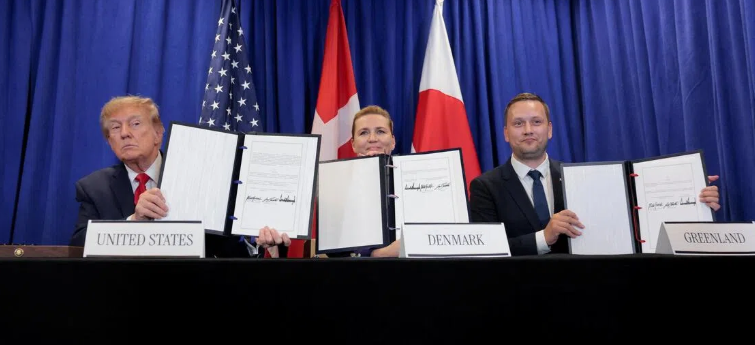
On September 22, 2026, local time, United States President Donald Trump (from left), Danish Prime Minister Frederik Andersen, and Greenland's autonomous government Premier Nelson signed the Greenland Security Agreement at the United Nations building. Reuters
Greenland has a very strong presence at this conference. Greenland's Foreign Minister Møtte Eged had a very straightforward statement at the opening plenary session: "Without Greenland's participation, there should be no discussions about Greenland." This statement almost encapsulates the message that Greenland's representatives have been repeatedly conveying over the past few days.
Over the past year, Greenland has frequently appeared in discussions related to security, military bases, critical minerals, shipping, and relations with the United States. Its strategic importance has received significant attention. At the conference, representatives from Greenland emphasized their role in these matters. From diplomacy and security to mineral development and local governance, many discussions ultimately revolve around one question: how much say Greenland should have in matters concerning its future.
Key minerals are a very concrete example. The related discussions involve not only resource reserves and development prospects, but also issues such as local ownership, employment opportunities, community impact, and benefit distribution. As external interest in Greenland’s resources continues to grow, local concerns about how development is carried out, how benefits are distributed, and whether communities can truly participate in decision-making become even more prominent.
The issue of indigenous peoples has also been discussed in many sessions. Traditional knowledge, local communities, generational heritage, and youth participation are increasingly being brought into discussions about climate change, resource development, and governance. The younger generation is also given more opportunities to express themselves, from student projects to dialogues with Arctic youths. It is evident that young representatives are involved in discussions related to climate, ecology, community development, and future governance. While voices concerning security and geopolitics are gaining prominence, these issues also remind us to look back at the Arctic societies themselves: how policies affect local communities, and in what ways do those living there want to participate in determining their own futures.
During this year's conference discussing Arctic shipping, a realistic context is the situation in the Strait of Hormuz and the risks faced by important global maritime routes. During the conference, a question was also raised in media interviews: If the Strait of Hormuz, the Red Sea, or other traditional shipping routes continue to face challenges, could the Arctic route become a new alternative route.
This issue has received attention, which is also related to the changes in Arctic shipping in recent years. Shipping activities on the northern routes have continued to increase, with Russian vessels still accounting for a large proportion, while the use of Chinese vessels has also become more active. This year, South Korea has accelerated its layout of Arctic routes, incorporating them into its maritime industry and logistics strategies. They have already completed trials using the route from Busan through the Arctic to Europe. The geopolitical risks faced by traditional routes, along with changes in navigational conditions caused by ice conditions, are driving more countries to re-evaluate the commercial and strategic value of Arctic routes.
However, considering the actual conditions, the Arctic route is still more suitable as a supplement to the global shipping system in the short term. The Northern Sea Route is limited by seasons, ice conditions, and the type of ships that can navigate there. It also involves issues related to permits, ice-breaking services, insurance, ports, communication, and search and rescue capabilities. The commercialization level of the Northwest Sea Route is much lower. For the global supply chain, it is more important whether the routes can be stable, predictable, and scalable rather than simply having the possibility of navigation.
The tensions in the Hormuz Strait and the Red Sea will further increase companies' focus on supply chain resilience and diversification of routes. It will also enhance the strategic value of Arctic routes as alternative pathways. However, in the foreseeable future, they remain unlikely to replace the existing major maritime routes.
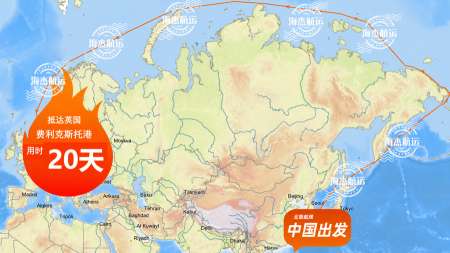
Schematic diagram of the Arctic shipping route between China and Europe in 2025. On the evening of October 13, 2025, local time, the cargo ship “Istanbul Bridge”, which set sail from Ningbo Zhoushan Port on September 23, and carrying over 1,000 standard containers, successfully arrived at Felixstowe Port, the largest container port in the UK, via the Arctic route. This marks the successful opening of the world’s first container shipping route between China and Europe via the Arctic. Shangguan News
The importance of safety issues has clearly increased, but climate change remains a significant topic at the conference. Topics such as the Atlantic Meridional Overturning Circulation (AMOC), changes in sea ice, climate interventions, marine ecology, and the resilience of coastal communities were discussed in several sessions.
This kind of juxtaposition within a meeting venue is quite intuitive. One meeting may discuss NATO, military deployments, key minerals, and infrastructure, while the next meeting might be discussing sea ice, marine ecosystems, or the survival and development of Arctic communities over the next few decades. Changes in sea ice are already directly affecting shipping, ecology, and coastal community life. Many issues that were once discussed separately are becoming increasingly difficult to separate completely.
This year's conference also featured some topics and formats that were not common in the past. On the second day, a “concert talk” on artificial intelligence attracted considerable attention. Artificial intelligence is not a traditional Arctic topic, but the presence of such sessions at the Arctic Circle Conference indicates that the discussions have expanded from traditional issues like security, climate, and resources to broader global issues such as artificial intelligence.
After attending the three-day conference, my most direct impression of this year's Arctic Council is "reshuffling". The importance of security and geopolitics has significantly increased, while issues related to climate, scientific research, local communities, and Arctic governance still hold important positions. In the coming years, how these topics affect each other may continue to shape the focus of the Arctic agenda.
This is also why the Arctic Circle Conference still deserves to be held in Reykjavik every year.