The interaction between Russia and the United States is heating up in a way that many people did not anticipate.
On October 9th, U.S. President Donald Trump announced on social media that he had just spoken with Russian President Vladimir Putin. Both parties reached an agreement regarding a so-called “energy deal”. Russia will immediately supply over 300,000 tons of diesel to the United States and global markets. In November, another 500,000 tons will be supplied, followed by an additional 1 million tons. Further supplies of 3 million tons are expected in the short term, depending on the condition of Russian refineries.
On the same day, the Office of Foreign Asset Control of the U.S. Treasury issued General License No. 135, authorizing Russian-origin diesel products that had been banned due to sanctions against Russia. This includes direct imports into the United States. The license is valid until April 7, 2027. This is the first time in 2022, since the outbreak of the Russo-Ukrainian conflict, that the U.S. has granted a sanctions exemption for Russian diesel products with a duration exceeding the usual 30-day period.
Ukraine's reaction was extremely strong. Ukrainian President Zelenskyy described this as "a weak decision made by a powerful partner," and said he felt "betrayed." He condemned the US for allowing Russia to sell petroleum products, calling it an "investment in war" and a "gift to Putin." It was also reported that Ukraine terminated the originally scheduled two-day talks between the US, Ukraine, and Europe in Miami ahead of schedule.
A seemingly simple energy transaction, why has it caused such anger among Ukrainian authorities? What impact will this intense interaction between Russia and the United States have on the Russian-Ukrainian conflict that has been ongoing for over four years? To answer these questions, we need to return to the starting point of this interaction.
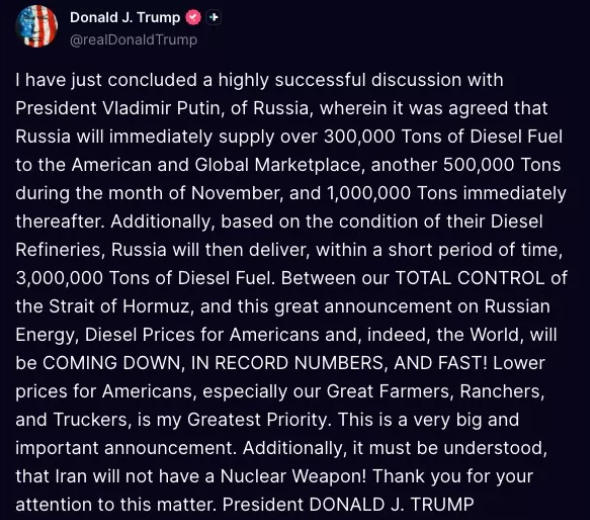
On October 9, 2026, United States President Donald Trump stated that after a conversation with Russian President Vladimir Putin, Russia had agreed to immediately supply over 300,000 tons of diesel to the United States and global markets. (Truthsocial@realDonaldTrump)
The renewed warming of relations between Russia and the United States is not surprising. Unlike the Biden administration, which adhered to Atlanticism and saw countering Russia as the cornerstone of transatlantic relations, the Trump administration always had a conservative "America first" approach in its foreign policy. Within this logic, European mainstream establishment actors are more of "free riders" who need to pay for their own defense. Ukrainian authorities were also frequently targeted by Trump, who even described them as "thieves." The potential for improving relations between Russia and the United States is greatly expanded within this context.
As the US diplomatic environment changes, the logic behind improving relations between Russia and the United States becomes increasingly clear. Since the beginning of this year, with the US-Israel war against Iran and the disruption to shipping in the Strait of Hormuz, the price of diesel in the United States has risen by about 70% compared to the same period last year.
Facing inflation pressures, the United States issued General Licenses No. 133 and No. 134 in March this year, allowing the shipment of Russian crude oil and petroleum products. At the end of September, it threatened to restrict diesel exports, demanding that France and Germany promote the release of approximately 120 million barrels of emergency diesel reserves by the European Union within six months.
On October 8th, Russian President's press secretary Peskov confirmed that Russia and the United States were discussing joint economic projects. The following day, Trump and Putin had a conversation that lasted one and a half hours. As a result, the Russian-American diesel deal was finalized. Russian President's special representative Dmitriev immediately stated that Russia and the United States' energy cooperation would continue, and it would benefit the global market.
From applying pressure on Europe to release reserves, to directly reaching an agreement with Russia, it was always the United States that set the agenda, initiated contacts, and announced results. It is clear that this new development in Russian-American relations was initiated by the United States.
Of course, what is 'not unexpected' is just the direction. What truly catches people off guard is the extremely rapid pace.
Of course, this is not the first time Trump has taken steps to improve relations with Russia. After the Russian-American summit in Anchorage, he tried to promote his vision for resolving conflicts, but his efforts were largely unsuccessful. The resistance from American domestic politics and the firm stance taken by Russia made Trump's attitude towards Russia increasingly tough. Therefore, what distinguishes this round of 'relations improvement' between Russia and the United States from previous attempts is Trump's almost 180-degree shift in position.
Just a month ago, Trump signed a comprehensive sanctions bill against Russia, authorizing the United States to impose up to 100% tariffs on countries that purchase Russian energy. The aim was to cut off Russia’s economic lifeline—its energy exports. By passing this legislation, the U.S. sought to further isolate Russia economically. At that time, members of both parties were urging the U.S. government to use these tools as soon as possible “to help Ukraine.”
However, the following month, the United States itself became a buyer of Russian diesel fuel. This dramatic 180-degree turn, which occurred almost overnight, is quite rare even under Trump’s unpredictable leadership.
The international community and the media were generally shocked by this situation. The outrage among Ukrainian authorities is, of course, obvious. The European Union and the United States have also reacted negatively to this situation, to varying degrees. European Union High Representative for Foreign Affairs and Security Policy Josep Borrell sharply criticized the decision, saying “this is not the time to ease pressure on Russia.” American Congressmen, including four Republican senators, jointly asked the government to “immediately change its approach,” stating that Trump’s decision contradicts the Russian energy import ban passed by Congress in 2022.
After Trump took office, his style of governance was unpredictable. His policies were made on a whimsical basis, and his foreign policy changes frequently from day to night, showing great unpredictability. However, it's not entirely true that Trump's actions are impossible to predict. Trump is a unconventional populist politician, but he has his own principles and values that he follows. He operates in a bold and conspicuous manner, sometimes even absurdly, and his statements often become effective only at the moment they are made. But behind this usually lies a relatively clear goal (of course, whether these goals are wise is another matter). The policy of "energy trading" that he pushed under pressure from the EU and within his own country is a manifestation of his distinct style of governance. To understand the current state of U.S. policy, including relations with Russia and the United States, one cannot just focus on his bizarre public behavior; one must also consider his goals.
At this moment, Trump’s priority list includes two things: the mid-term elections and oil prices. These are urgent issues for Trump, ones that concern his governance performance and even directly affect his power.
Currently, there is less than a month left until the mid-term elections in the United States on November 3rd. The Republican Party’s situation is not optimistic. Energy prices in the United States have a significant impact on election outcomes, directly affecting the costs of farmers, ranchers, and truck drivers in agricultural states, who are key supporters of the Republican Party. When announcing the Russo-American deal, Trump explicitly stated that reducing the fuel costs of “our great farmers, ranchers, and truck drivers” was his “number one priority,” clearly indicating his targeted approach. At the same time, “ resolving the Russia-Ukraine issue” is a campaign promise he has repeatedly emphasized. The “results” achieved with Putin clearly could significantly accelerate his efforts to solve problems.
As for oil prices, since the US-Israel war and the facto blockade of the Strait of Hormuz, the price of US diesel has increased by about 70%. It is impossible to fundamentally improve supply before the voting day. What Trump values most is, obviously, the psychological impact that policies can have.
In this sense, the political significance of this deal is much greater than its practical value.
Russia supplied 300,000 tons of diesel in October, equivalent to approximately 2.25 million barrels. The daily consumption of diesel in the United States is slightly higher than 4 million barrels. This supply, which Trump described as “very significant,” amounts to only a little more than half of America’s daily consumption needs. Even if all of the announced 4.8 million tons are included, it will only last for eight or nine days of consumption in the United States.
In contrast, the emergency reserves that the United States previously requested from Europe amounted to 120 million barrels. In terms of alleviating the oil inflation caused by the crisis in the Strait of Hormuz, Russian-produced diesel is not even a trivial solution; it is far from being a lasting remedy. Moreover, the White House has yet to clarify who funded this shipment of diesel and when it will be delivered. The Kremlin has also declined to comment on the exact quantity.
However, if we look at the concept of “winning education” that has emerged on the Chinese internet in recent years, the actual results may not be the focus. The core of “winning education” is to “make voters believe that they can and are already solving problems”. This is becoming an increasingly prominent feature of Western democratic systems. The populist and extreme tendencies in electoral politics, as well as the solidification of voter groups, are occurring in different Western countries.
For politicians, convincing voters that “I am winning” is more politically rewarding than actually solving problems. The value of symbolic actions is thus magnified. Trump, as a typical populist politician and even the "founder" of this approach, surely understands this well. Therefore, every additional “deal” announced gives him more grounds to claim that “the White House is doing its utmost to protect ordinary people.” Whether voters will remember that a significant part of the current difficulties stems from his actions in the Persian Gulf is another matter.