From Kaongai Old Street on the Shan State plateau in northern Myanmar to Sihanoukville on the southwest coast of Cambodia, a vast black network of telecom fraud has enveloped the Southeast Asian countries.
According to a report published by the United Nations Office on Drugs and Crime in 2026, telecom fraud in Southeast Asia caused economic losses of approximately $83.9 billion to $114.1 billion for East Asia, Southeast Asia, Australia, and New Zealand in 2025. Anti-fraud measures have become an important issue in this region.
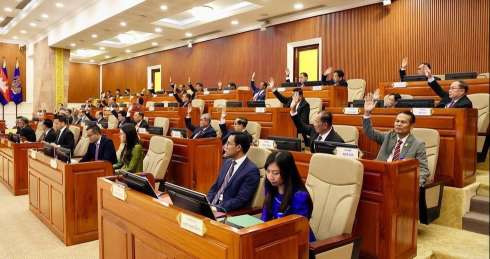
The Cambodian Senate unanimously passed the draft Anti-Telecom Scam Law (Source: https://cc-times.com)
In early February this year, Cambodia, which has long had problems with online fraud, announced its determination to "eradicate online fraud" completely. It demonstrated strong resolve and execution in both the legal framework and the eradication efforts. The Anti-Online Fraud Act was passed by the National Assembly unanimously on March 30th, and it officially came into effect on April 6th. In March, the Cambodian government stated that it had closed 80% of its online fraud centers, and it plans to completely shut down all such centers by the end of April.
However, a report released by Amnesty International on June 8 questioned the success of anti-fraud efforts in Cambodia. The report indicated that as of April this year, 86 fraud dens had been discovered in Cambodia, up from 53 the previous year. Among these, only 24 showed signs of government intervention. Many key individuals were not being dealt with, and those who were rescued found no place to go and returned to their dens. The actual effectiveness of these efforts is not as “successful” as the Cambodian government claims. Experts believe that the efforts to combat fraud are essentially a form of showmanship.
In response to this, Cambodian State Minister Chea Sim expressed his views on June 10, by showcasing Cambodia’s achievements in cracking down on online fraud cases, eliminating gambling dens, and handling suspects. At the beginning of September, the Special Committee for Combating Online Fraud in Cambodia announced that from July 2025 to August 31, 2026, law enforcement agencies investigated a total of 832 locations suspected of engaging in fraud. Actions were taken at 663 of these locations, and 3927 suspects were transferred to courts for processing. On September 23, Cambodian Prime Minister Hun Sen announced solemnly at the International Conference on Combating Online Fraud that no more fraud operations exist within Cambodia’s territory.
In recent months, Cambodia has been constantly announcing its achievements in anti-fraud efforts, but these claims have continued to be questioned by external observers. Is Cambodia's "thorough" anti-fraud campaign just a show of strength or a bold decision? Why choose this time to take strong measures against online fraud?
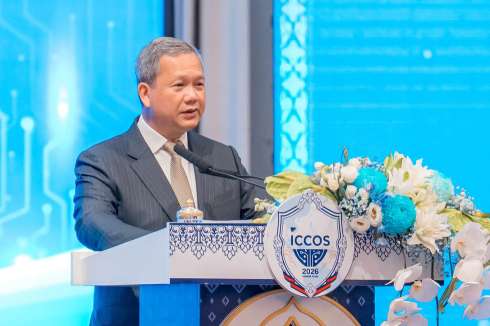
Cambodian Prime Minister Hun Manet delivered a speech at the opening ceremony of the International Anti-Scam Conference (Source: https://ccos.gov.kh/en/)
The root of fraud activities in Southeast Asia can be traced back to the rise of casinos and online gambling networks in the 1990s, which then developed rapidly. During this period, the Chinese-language telecommunications fraud networks were closely linked to cross-border criminal networks in Taiwan, Fujian, and Southeast Asia. As anti-fraud laws were strengthened in some areas, the fraud networks shifted to regions with weaker regulations in Southeast Asia.
In the 2010s, the scam industry gradually took root in the border regions of Southeast Asia. The legal gambling economy in Cambodia provided a fertile ground for the rapid development of telecom fraud. Scam centers were highly intertwined with illegal online markets, underground banks, and money laundering networks.
On August 18, 2019, the Cambodian government issued a “gambling ban”, suspending the issuance of licenses for online gambling activities both domestically and abroad. This has had a negative impact on the revenues of casinos, hotels, and related properties. Some criminal groups have begun shifting their operations, personnel, and technology to online fraud, and have combined this with human trafficking and forced labor.
As a result, the gambling ban not only failed to terminate the gray economy, but also led to a certain degree of reorganization of related networks. Some smaller groups or those that rely solely on gambling activities were either disbanded or moved away. Organizations with more resources, venues, and cross-border network capabilities may instead turn to more concealed activities such as online fraud, money laundering, and human trafficking.
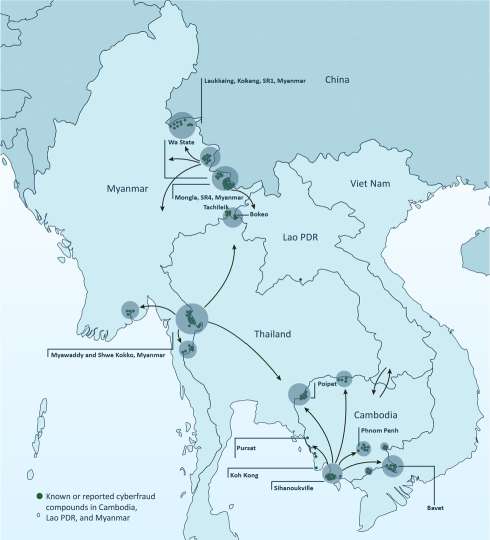
2023-2025 Annual Known or Reported Fraud Hotspots in the Mekong Region (Source: https://track.unodc.org)
After COVID-19, fraud centers increasingly rely on false recruitment, debt control, confiscation of documents, and violent detention to maintain the supply of labor. In addition, online fraud has become more closely associated with human trafficking, forced labor, and torture issues.
From 2022 to 2024, the Cambodian government carried out several campaigns against online fraud centers. However, these efforts were merely a drop in the bucket compared to the challenges faced by the online fraud syndicates, who benefited from their solid infrastructure and extensive networks, allowing them to grow stronger. In February 2025, the Cambodian government established the "Anti-Online Fraud Committee," with Prime Minister Hun Manet personally leading the effort to eradicate online fraud crimes through tough measures. In July of that same year, Hun Manet issued a nationwide eradication order, threatening officials who failed to act with dismissal from their positions.
On December 7, 2025, during the Cambodia-Thailand conflict, Thailand used F-16 fighter jets and drones to destroy at least six casinos and hotel complexes in border areas of Cambodia. The Thai military stated that these facilities were previously used as hubs for transnational fraud, and later taken over by the Cambodian military for military purposes. The Cambodian side denied this claim entirely.
However, what is interesting is that this event has brought telecommunications fraud into the narrative of border sovereignty and national security.
Three months later, Cambodia announced the “completely eradicated of telecommunications fraud”, and continued to advance its eradication efforts. The Anti-Telecommunications Network Fraud Act was also officially implemented, marking a new stage in Cambodia’s anti-fraud efforts, with specialized legal protection in place.
From a timeline perspective, the Cambodian-Thailand conflict has brought the issue of fraud into the realm of sovereignty and security. This seems to have motivated Cambodia to finally decide to take drastic measures against fraud. But if this is just one key event, and if the Cambodian government lacks the appropriate political climate and sufficient policy preparations, then can its "drastic" anti-fraud measures really be implemented?
According to the 'multisource theory' proposed by American policy scholar John W. Kingdon, a topic does not typically enter the policy agenda because the problem itself suddenly emerges. Instead, it is when the political climate becomes favorable, policy tools are ready, and the problem is re-named that all three factors converge in a certain 'policy window'. This appropriate moment is the 'policy window', which arises from changes in the problem stream or the political stream.
Cambodia's comprehensive anti-corruption efforts can be understood from these three aspects.
Political Streams: Collaboration between Inside and Outside
Firstly, changes in political circumstances arise from changes in key government officials and shifts in public sentiment. These changes influence policy-making by shaping either favorable or unfavorable political climates. How does this manifest within Cambodia?
From the perspective of domestic political climate, Prime Minister Hun Manet proposed the 'Five-Prong Strategy' after taking office in August 2023. The new government will complete the first phase of its mission within a five-year period, focusing on governance related to growth, employment, equality, efficiency, and sustainability. At the same time, he stated that Cambodia will continue to promote regional and global integration, explore new opportunities for international trade and investment, enhance Cambodia's international competitiveness, and promote sustainable socio-economic development.
However, in reality, the rampant electricity fraud has significantly hindered the achievement of these goals. According to data, the Cambodian Ministry of Tourism expects to attract 7.2 million to 7.5 million foreign tourists in 2025, but the actual number is only 5.57 million, a decrease of nearly 17% compared to 2024. While Cambodian foreign direct investment (FDI) continued to grow in 2025, it mainly relied on investments in the manufacturing sector. Investments in the hospitality and entertainment industries, as well as the financial sector, decreased by 28.8% and 12.8%, respectively.
The industries involved in the latter are all sectors that are closely related to a country’s image and reputation. If the Cambodian government wants to improve its tourism and investment environment, it must address the damage to its reputation caused by money laundering. In February this year, Heng Maen explicitly stated in an interview that money laundering, as a form of illegal economy, is destroying the legal economy.
It is clear that anti-corruption measures are an essential step in achieving the first goal of the ‘Five-Prong Strategy’. They are crucial for the economic recovery of the tourism industry and the restoration of the country’s reputation.

