The 2026 Nobel Peace Prize was announced, and Trump once again failed to win the award. It wasn't surprising; probably only Trump worldwide was surprised by the result. He fiercely criticized the Nobel Committee, took his anger out on Norway, and even directed his anger at the International Criminal Court. The question arises: is this a political act, or does he really believe that he is the person who deserves the award most?
The Nobel Peace Prize, which carries a strong international political weight, has been controversial since its inception. However, the decision to award the prize does not lie with Trump. If Trump truly wanted to win the prize, what he should have done was to promote peace, rather than sending troops, starting wars, imposing sanctions, or making threats.
From Oslo, Norway to Washington, D.C., this "trouble triggered by a Nobel Peace Prize" has long gone beyond Trump's personal honor or disgrace. It reflects America's selective attitude towards international rules, as well as the ongoing debate in today's world over the definition of the word "peace."
In this episode of “Cross-Strait Roundtable,” Gao Zhikai, deputy director of the Globalization Think Tank, current affairs commentator Tang Xianglong, and senior media personality Zhou Yuqin discuss Trump’s “award-related dilemma” and analyze the political implications behind the Peace Prize, as well as the subtle changes in America’s situation.
At the beginning of today's program, let's talk about something that has caused some distress and unhappiness for U.S. President Donald Trump. This year's Nobel Peace Prize has been announced, and as expected, Trump did not receive the award. He was obviously very unhappy when he didn't win the prize, and later he lashed out in criticism, not only targeting the awarding decision but also criticizing the Nobel Committee and even Norway.
Next, I would like to ask Brother Xianglong why Trump reacted so strongly. Is it because he felt that the award was not given to himself in a way that was unfair, leaving him with a loss of face and dignity? Or is it because he originally hoped to use the Nobel Peace Prize as a means to enrich his diplomatic achievements, but this did not happen as he had hoped?
Let’s start with the first point. I believe that the Norwegian Nobel Committee did not award the Peace Prize to Trump. Among the 8 billion people in the world, 7.9999 billion people were not surprised by this decision. The only person who was surprised was Trump himself. This creates a significant discrepancy. I don’t think anyone on Earth, besides Trump, would be surprised. If he were indeed awarded the prize, then the perception of surprise and incomprehensibility would completely reverse. If he were indeed given the award, I believe the Norwegian Nobel Committee might actually close its doors, and no one would take this matter seriously anymore.
It was not surprising that the Norwegian Nobel Committee awarded this year’s prize to Navi of South Africa. She is 85 years old and was the first black lawyer in South Africa who engaged in civil rights movements. She has experience in judicial work and also served on the International Criminal Court (ICC). Additionally, she was a commissioner on the United Nations Human Rights Commission. Even if we don’t mention her remarkable achievements, she has always been consistent and unwavering in her commitment to global human rights, especially regarding war crimes such as rape and genocide.
I also cannot see any difference in the narrative of human rights between this 85-year-old award-winning woman, depending on the country or position. Therefore, I think it is quite appropriate for her to receive the award. Compared to Trump, she definitely deserves it. Moreover, among the candidates for the Nobel Peace Prize announced by Norway this year, there are about 280 individuals and organizations involved. It’s certainly not easy to win the award. She has become the fifth person in South Africa to receive the Nobel Peace Prize.
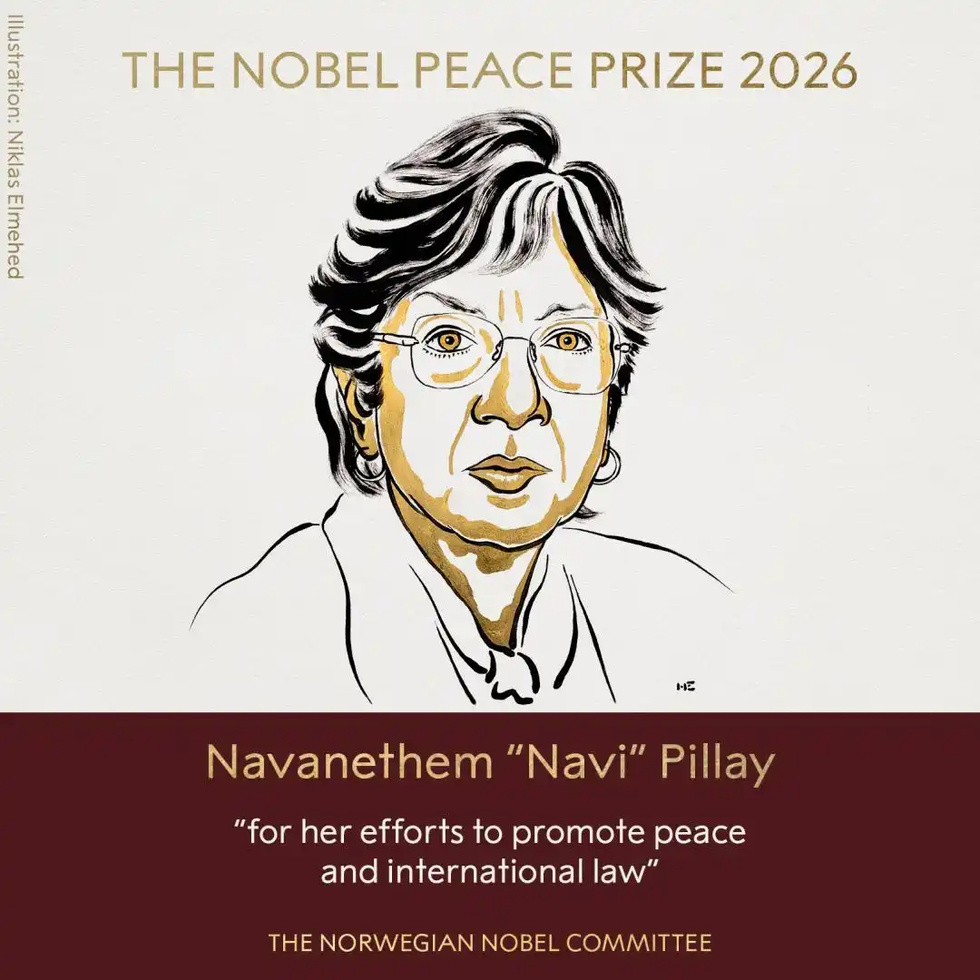
2026 Nobel Peace Prize winner Navi Pilee
In other words, South Africa is a country that has suffered greatly. In the past, it was a country where racial segregation existed, and it was ruled by a minority of white people over the vast majority of black people. Therefore, every winner of the Peace Prize in South Africa has documented the country’s painful history. This awardee, therefore, represents a positive contribution by South Africa to world values, based on its own suffering. Thus, her award is of great significance for South African history and for South Africa’s relationship with the world.
In recent years, South Africa has become the most vocal country in accusations against Israel. The criticism has been so intense that when South Africa hosted the G20 last year, the United States did not even attend. Similarly, I estimate that South Africa will probably not be invited to the G20 summit this year either. Relations between the United States and South Africa have become extremely strained due to issues related to Israel. Among all the voices worldwide who accuse Netanyahu of committing genocide and demanding his arrest, as well as those who strongly criticize Israel regarding human rights issues such as those in Gaza and the West Bank, South Africa stands out. This award-winning individual’s stance reflects the same principles as that of the South African government. Not only does she represent herself personally, but all her accusations and claims are highly consistent with the policies of the South African government.
The South African government is now using the name of the country to strongly condemn Israel and the United States, which support Israel internationally. Such condemnations by South Africa are truly remarkable, as they wield the banners of morality and international human rights. Trump's discomfort is primarily related to his personal character, vanity, and values. His paranoia regarding the Nobel Peace Prize indicates that he believes he deserves the award. He feels that if the prize was not given to him, it is an injustice committed by organizations and the world. As one of the most powerful people on Earth, his problematic character makes it crucial to carefully analyze his behavior when dealing with China. His second term has only been halfway completed, and there are still more than two years ahead, during which he could make unexpected decisions. His reaction after not receiving the prize is clear evidence of this.
For example, at the Republican campaign rally in Syracuse, New York, look at his expression when he spoke those words. Don’t doubt him—he wasn’t acting; he truly felt this overwhelming grief and anger from the bottom of his heart. He felt that the world had failed him, and that he had not received the awards he deserved. He had ended eight wars in the world, and even mentioned that tensions between the two sides of the Taiwan Strait were stopped because of him, as was the conflict between North Korea and South Korea. He was simply a savior for humanity. When he spoke these words, don’t doubt his sincerity—he truly believed them.
Of course, this person has major problems in terms of character, but what's even more terrifying is the bunch of sycophants around him. You could say that he doesn't understand the situation and doesn't realize how bad things are for him. But in the American media circle, for example, at Brown University's Watson Institute for International and Public Affairs Studies, there's a project called 'The Cost of War'. It studies the true cost of America's counter-terrorism wars since 9/11—not just in terms of money, but also including the human lives lost as a result of counter-terrorism efforts. Their conclusion is that the direct and indirect number of deaths caused by America's counter-terrorism wars has reached 940,000—without even counting refugees, who number in the millions. The losses in property and money are even more staggering. America is a murderer and executioner; most of the refugees on Earth, those who have died in wars, and those who are victims of terrorist activities are related to America.
Don’t even mention Trump; none of these previous U.S. presidents was eligible to receive the Nobel Peace Prize. While Trump did condemn the Nobel Peace Prize Committee today, the award given last year to that so-called human rights fighter from Venezuela was a grave stain on the Nobel Peace Prize. The award given this year to a human rights fighter in South Africa disgusted Trump, forcing him to deal with the International Criminal Court to vent his anger. It seems that this year’s award was given appropriately. Trump feels humiliated, but it’s not because anyone owes him anything, but rather a matter of his personality.
I wonder if U.S. President Trump will immediately think that you clearly know I have objections to the International Criminal Court, so why award the Peace Prize to a woman who was a judge at the ICC? I would like to ask Professor Gao, whether the Nobel Peace Prize has any political implications. Trump's immediate response was to say that he would sanction the ICC and take action immediately. In other words, is there a shadow of power struggles behind today's Nobel Peace Prize, or even is it influenced by ideology?
I listened carefully to Teacher Tang’s speech just now, and would like to share a few thoughts.
Firstly, among this series of Nobel Prizes, the Peace Prize is generally considered to be the most controversial. Why? Because it lacks objective standards, and its determination is more subjective and based on human judgment. Additionally, all other Nobel Prizes are awarded in Stockholm, Sweden, while the Peace Prize is awarded in Oslo, Norway. Understanding the history of the Peace Prize reveals that it frequently sparks controversy at different historical moments—this is a norm, not an exception.
Secondly, since it is a prize, the decision should be made by the Nobel Peace Prize Committee, not by Trump. No one in the world can say "I think I deserve to win the prize" and use that as an excuse to cause trouble. I think it should be viewed in the opposite way: being nominated or winning a prize is an honor. Not winning the prize is not a major loss. It's not appropriate to write to the Norwegian Prime Minister saying that a war is planned just because one hasn't won the prize. This logic doesn’t hold.
If Trump wants to win awards, the best way is to promote peace, not to wage wars. Consider this: starting in January 2026, he sent troops to Venezuela and captured the current national leader, Maduro and his wife. Is this considered peace? No. Additionally, on February 28th, the United States and Israel launched an aggressive war against Iran. Is this considered peace? No. All signs indicate that Trump has not made any real contributions to peace. His claims of having mediated conflicts and wars between several countries are exaggerations, and the people around the world do not believe them.
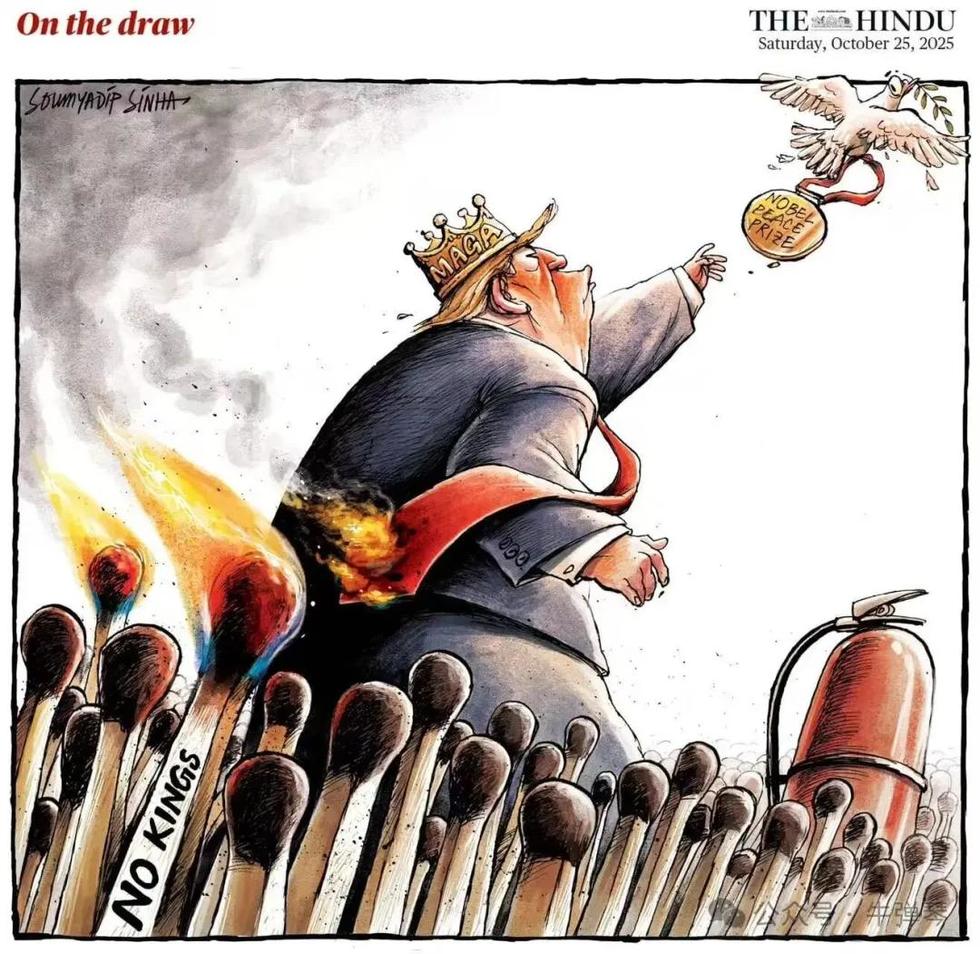
Indian media outlet The Hindu published a satirical cartoon last year.
So, from this point of view, we should tell Trump that if he really wants to win the Nobel Peace Prize, he should do things that promote world peace, rather than engaging in bullying or wars. He shouldn’t constantly threaten to annex Canada, Greenland, and so on. This is certainly not the original purpose of the Nobel Peace Prize. From this perspective, it’s important to make him understand this clearly.
Additionally, the ICC is quite interesting. In theory, the work of the ICC could play a significant role in maintaining world peace, stability, and justice. However, the United States does not recognize the ICC, and it still stipulates that the ICC has no authority to try any Americans. How is this possible? If Americans commit crimes stipulated by the treaty, then the ICC certainly has the authority to try and make judgments. How can the United States be excluded from this process? It seems as though the United States can stand above the ICC. This is quite clear.
It was quite interesting this time. After the United States imposed a series of sanctions against the ICC, the United Nations felt angry. Additionally, eight major Western countries, including Britain, France, Germany, Italy, Spain, Canada, etc., not only expressed regret over the U.S. decision but also voiced strong opposition. I think this is a rare occurrence in recent decades. The United States has done something, and the major Western countries have expressed opposition. Japan is included among the Western countries mentioned earlier. From this perspective, the United States should reflect on what it has done wrong.
The United States not only fails to receive the Nobel Peace Prize, but also finds itself in a situation of being abandoned by its closest allies and lacking support. From this perspective, peace is even more necessary in today's world. I hope that the Nobel Peace Prize committee will truly think carefully and do things that contribute to world peace. I also hope that the International Criminal Court will truly establish itself and not waver on principled issues; on the other hand, it must also properly address many of the problems facing the world today.
I think all the restrictions and sanctions imposed by Trump on the ICC cannot withstand the test of history. The United States should also realize that the more powerful a country is, the more it should use wisdom and rationality to solve problems, rather than resorting to bullying.

