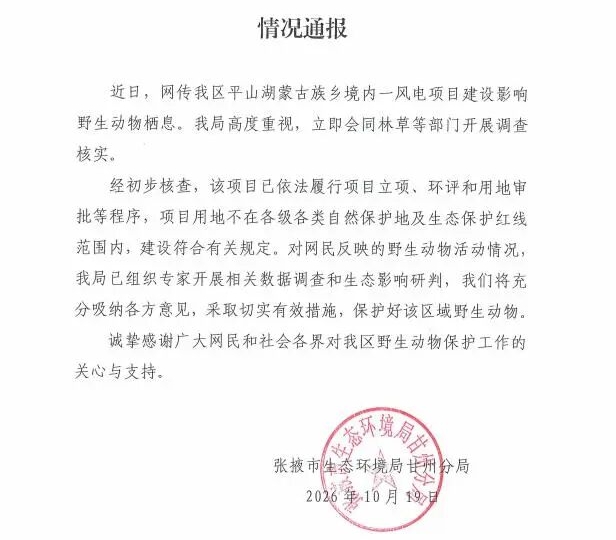
On October 19th, the Ganzhou Branch of the Zhangye City Ecological Environment Bureau in Gansu Province issued a notice regarding the situation:
Recently, there were rumors on the internet that the construction of a wind power project in Pingshan Lake Mongolian Township in our district is affecting the habitat of wild animals. Our bureau has attached great importance to this issue and has immediately joined hands with departments such as forestry and grassland to conduct an investigation and verification.
After preliminary verification, the project has followed all legal procedures for project establishment, environmental impact assessment, and land use approval. The project's land location is not within any nature reserves or ecological protection zones at all levels, and the construction complies with relevant regulations. Regarding the reports of wildlife activities by netizens, our agency has organized experts to conduct data surveys and assessments of ecological impacts. We will fully consider opinions from all parties and take practical measures to protect the wildlife in this area.
According to the Science and Technology Daily, a wind power project located in Cailongling, Zhangye, Gansu has drawn attention recently. It is understood that the environmental impact assessment for this project was approved in March 2025, and construction will begin in July 2026. The environmental impact assessment report states that there are no key protected wild animals in the project area.
However, ecological protection organizations have been setting up infrared cameras for a long time, and the area has been photographed multiple times by rabbit dogs, a national second-class protected animal. This proves that this area is a stable habitat for rabbit dogs.
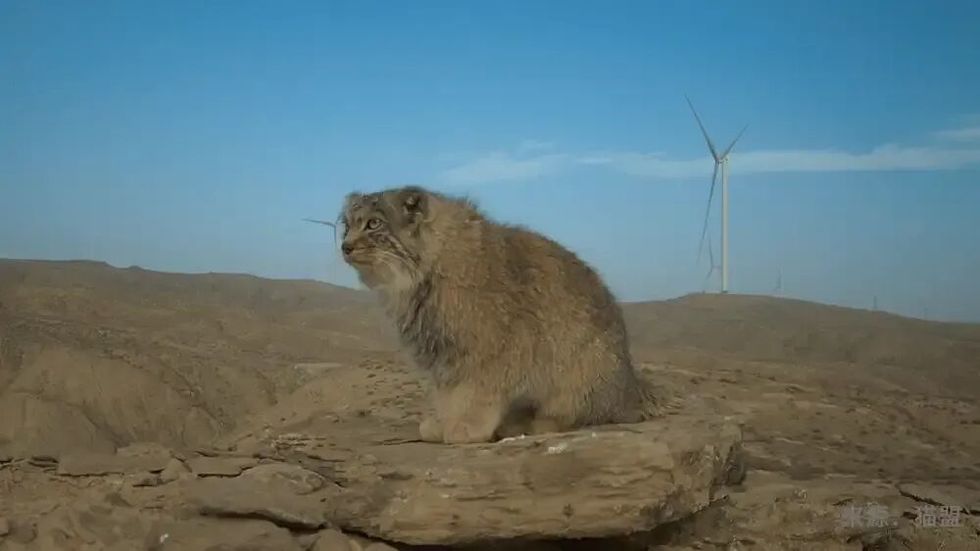
The infrared camera captured the jerboa living in the desert north of Zhangye.
According to an article published in the Guangming Daily on the 19th, the Infrared Camera installed at the Mao Meng Ecological Science Popularization and Protection Center in Jiangbei, Chongqing, has captured images of the Rottweiler, a national second-class protected animal, for 12 consecutive months.
