(Text by Guoyuanghao of Observer Network)
Recently, the commander of U.S. military forces in South Korea, Brigadier General Breunson, made controversial remarks during a public event in Washington regarding the transfer of South Korea’s territorial sovereignty and wartime command authority. This caused strong backlash in South Korean politics. Members of South Korea's ruling party accused him of denying South Korea’s territorial sovereignty and even demanded his dismissal from his position. The South Korean Ministry of National Defense protested to the U.S. side, stating that South Korea’s territorial sovereignty cannot be questioned.
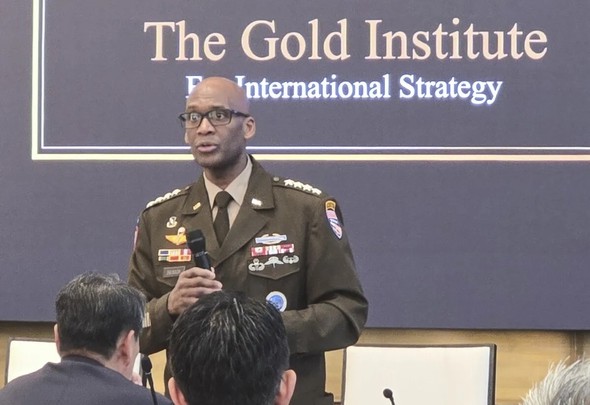
On October 14th, local time, Blunsen attended the Second Indo-Pacific Summit hosted by the Golder Institute for Strategic Studies in Washington, D.C., and delivered a keynote speech.
When talking about the Military Demarcation Line (MDL) and the Demilitarized Zone (DMZ) between North and South Korea, Blunsen said that there is a wire fence on each side of the Military Demarcation Line, and he is in charge of the area in between.
"We have been discussing sovereignty issues and what sovereignty actually means." He said.
Then, he asked a question: "Where does the Republic of Korea begin, and where does it end?"
Brunsen himself gave the answer: 'From the perspective of the United Nations military command, I believe that South Korea started from the south side of the wire fence. This is because, in order to maintain the ceasefire, I was responsible for managing that area.'
The “south side wire fence” he mentioned refers to the southern boundary line of the demilitarized zone, located about two kilometers south of the military demarcation line.
According to Article 3 of the South Korean Constitution, “The territory of the Republic of Korea shall include the Korean Peninsula and its affiliated islands.” Under this provision, the territorial scope defined by the South Korean Constitution does not stop at the southern boundary line; it also includes the area north of the Military Demarcation Line, which is currently under the actual control of North Korea. Therefore, Brunnen’s statement directly linking the armistice management authority of the United Nations Command to the starting point of South Korean territory quickly sparked controversy.
In addition to territorial issues, Breunis also expressed his views on the transfer of wartime command authority between South Korea and the United States on that day.
He said: "I am a supporter of transferring the wartime command authority to the alliance's modern transformation."
However, he immediately emphasized that what he opposed was the violation of the transfer conditions agreed upon by both parties many years ago.
"We have been dealing with this issue since 2015. None of us can say that the conditions have not changed. Just by glancing through the newspapers, it's clear that the conditions have indeed changed. This week, North Korea conducted another missile launch."
Brunsen concluded that: 'Since the conditions have changed, our combat plans have also changed. Therefore, there are new standards that must be followed now.'
Transferring the command of wartime operations is an important defense policy that the Lee Jae-ming government is currently promoting.
Although Breunis did not explicitly announce his opposition, his statement regarding the “new standards” was interpreted by the Korean side as possibly increasing the threshold for handover.
The 61-year-old General Blunsen is an American Army general who served in the United States Army Special Operations Forces and was deployed to combat zones such as Iraq and Afghanistan on multiple occasions. In 2024, he became the commander of U.S. military forces in Korea, while also serving as the commander of the Korean-American Joint Command and the United Nations Command.
This means that he is both the supreme commander of U.S. forces in Korea and a key figure in the Korean-American joint defense system as well as the ceasefire management mechanism on the Korean Peninsula.
It is worth noting that Brunson has made controversial statements regarding the strategic positioning of U.S. forces in South Korea in recent years, especially when it comes to issues involving China.
In 2025, Brunson compared South Korea's strategic position to an “aircraft carrier fixed between Japan and the Chinese mainland”, emphasizing the value of South Korea's geographical location for the United States' military operations in the Indo-Pacific region.
In May this year, Blunsen further discussed the so-called "dagger theory" in a podcast program at the United States Army War College.
He said that if one looks from the eastern coast of China, South Korea appears as a ‘dagger inserted into the heart of Asia’, while Japan serves as a ‘shield’ behind it. This restricts China’s expansion activities towards the South China Sea and other directions.
On October 14th, during the Washington event that triggered this storm, Brennan remained unacknowledged regarding Chinese factors.
According to the 'Korean Daily News', when discussing the South Korea-US alliance, he said: 'There are forces everywhere who try to undermine and divide the alliance whenever they have the opportunity.'
He immediately named specific individuals, saying: “It must be remembered that the South-Korean-US alliance is a ‘structure’ that neither China nor North Korea likes.”
For Korean public opinion, what really caused strong reactions was that phrase: “South Korea starts from the southern wire fence.”
On October 16th, Chen Seong-jun, the Chairman of the National Defense Committee of the South Korean Parliament and a member of the Common Democratic Party, was the first to publicly express criticism.
He referred to Blunsen as a “commander who denies the territorial sovereignty of the Republic of Korea” on social media, pointing out that South Korea’s constitution clearly stipulates that its territory includes the Korean Peninsula and its affiliated islands. Blunsen’s statement is clearly contrary to the constitution.
Chen Shengzhun emphasized that the person who made these remarks also served as the commander of the United Nations forces, the commander of the South Korean-US joint command, and the commander of the U.S. military stationed in Korea, which he found 'shocking and distressing'.
He also questioned whether it would be possible for South Korea and the United States to reach a substantive agreement on the transfer of wartime operational command in such circumstances.
As a Democratic Party member and special advisor on national defense policy for President Biden, Jin Bingzhou also criticized Brennan "crossing the line" on the 17th.
Kim Byung-jo pointed out that the Armistice Agreement only grants the UN Command authority over matters related to permits for access to the demilitarized zone and civil administrative affairs. It does not grant them the power to define South Korea's territorial sovereignty. He demanded that Blunsen immediately withdraw his statements and apologize to the Korean people.
On the 19th, the criticism from the ruling faction in South Korea continued to intensify.
Common Democratic Party's highest committee member Park Sun-eun directly addressed Blunshen at the party's highest council meeting that day: "If you are a general, then you must have the demeanor of a general."
He questioned, "Where does the territory of the Republic of Korea begin? Why should it be decided by the commander of the U.S. troops stationed in Korea?"
Park Sanyuan believes that Brunsen's performance has already raised doubts about his suitability to continue serving as commander of the Allied Forces, and emphasized: "We respect the alliance, but we will never make concessions on sovereignty issues."
Jin Bing Zhou was criticizing Brennan “going too far” on his YTN broadcast program that same day.
He said that as the commander of the United Nations forces, making such statements was 'extremely inappropriate', and he must withdraw his remarks and apologize to the Korean people.
As for Brunson's cautious attitude towards transferring wartime command authority, Jin Bingzhou went further to say: "I believe that even if the transfer of wartime command authority is immediately implemented now, there will be no issues." He emphasized there was no need to postpone any longer.
The stance of the Korean Progressive Party is more extreme than that of the Common Democratic Party.
On the morning of October 19th, Progress Party member Sun Ryu came to the door of the United States Embassy in South Korea, located in Jongno District, Seoul. Holding a sign that read, "Commander Blunsen, who obstructs the return of wartime command authority, leave this land!", he held a solo protest.
She questioned on social media: “If Korea is not considered as an independent nation of the United States, how could she say such a thing?”
