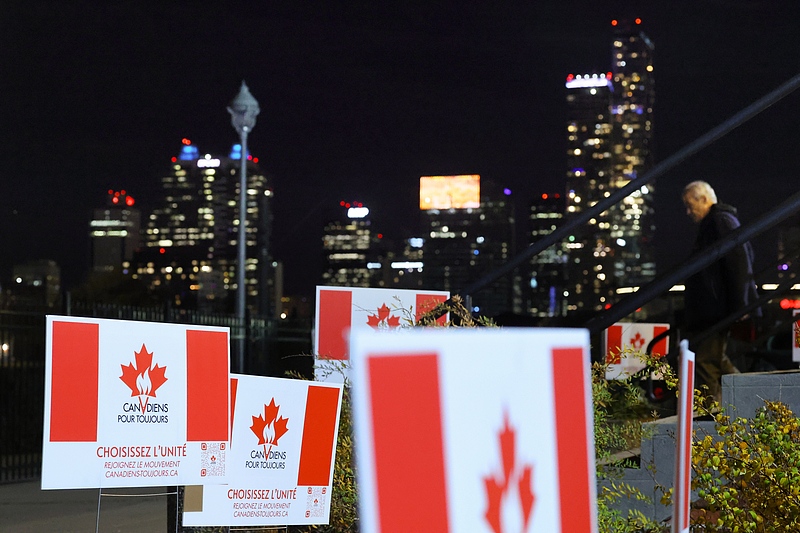
On October 19, 2026, people in Alberta, Canada, went to the polls to answer question number 10 on the agenda: Do they support local governments initiating legal proceedings to hold a binding referendum on the issue of “seceding from Canada” in the future?
According to preliminary statistics from the Alberta Election Board, cited by the Associated Press, after counting over 1 million ballots, 77% of voters supported staying in Canada, while 23% supported initiating separation procedures. Canadian Broadcasting Corporation (CBC) further refined the prediction to 76.4% supporting stay in Canada and 23.6% supporting separation.
Alberta has the fourth largest proven oil reserves in the world. The roots of local separatism can be traced back to 1980. At that time, the Canadian federal government’s national energy plan kept domestic oil prices below world levels, in order to increase the federal share of oil revenues. Alberta saw this as an “unfair attack and appropriation of federal funds.” However, according to The Associated Press, “for decades, separatism in Alberta has been a marginal issue.”
In 1982, separatism experienced a brief “golden age”: Gordon Kessler of the Western Canada Concept Party won a provincial by-election with a “separation” platform. In the same year’s general election, the party received 12% of the votes, but failed to win any seats. Later, in the 1990s, Preston Manning’s Reform Party also introduced separatism into federal politics, with the slogan “Western Canada must be included”. As a result, the demands for separation became part of mainstream conservative politics for decades.
Subsequently, the separatist sentiment in Alberta intensified again after the Conservative Party came to power in 2019. A key turning point occurred between 2022 and 2023 when Danielle Smith took over as premier. She emphasized her preference for “a sovereign Alberta within Canada,” but at the same time, she refused to describe separatists as marginal extremists, arguing that they had “reasonable grievances that deserve to be heard.” According to The Associated Press, it was this refusal to marginalize marginal positions that ultimately allowed a movement called “Marginal Cause” to gain traction in the 2026 provincial referendum.
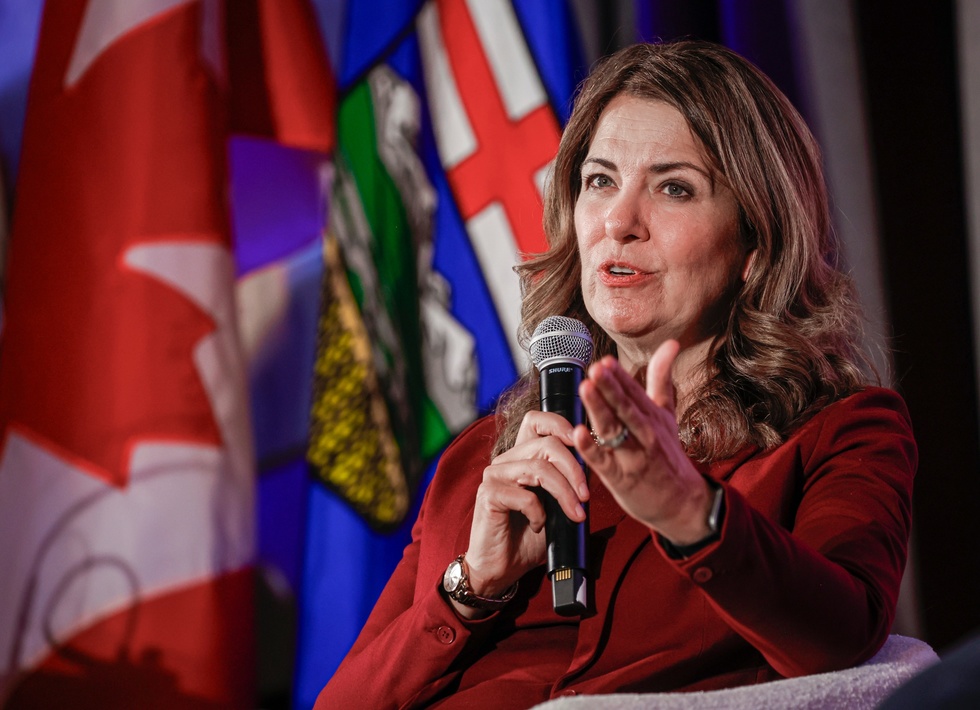
Alberta Premier Danielle Smith Visual China
The Wall Street Journal reported in August this year that Alberta Premier Danielle Smith said, “I oppose Alberta’s separation from Canada.” It was she who paved the way for this high-risk referendum. This referendum is Smith’s “greatest gamble of her life.”
It was Smith who reduced the number of signatures required to trigger a “voting withdrawal”. CBC stated that she “rewrote a law, rendering this issue practically meaningless” before a Canadian court ruled in favor of the separatist petition. Smith herself gave the following reason in an interview: “I have been observing the separatist movement since the 1990s. I don’t think I have ever seen a party with such high support after its election last year.” She added, “I believe we need to have this debate and get answers.”
However, Smith ultimately voted 'to stay'. According to The Associated Press, she said she 'voted against independence, but also hoped to hold a referendum to address the issue that divides the province'. According to reports from Politico and other media, Smith stated before the referendum that polls showed support for separation exceeding 20%, which 'was still too high'. She described the support for separation as 'still high enough to make me uneasy'.
The Wall Street Journal quoted Charlie Kuhr of the Angus Reid Institute as saying, “She is well aware that among those who helped her become governor, there were some who were extremely fervent separatists. For her, this is a difficult situation.”
Before the referendum, a poll conducted by Ipsos for Canada’s Global News showed that 70% of Alberta residents planned to vote against initiating the separation process, while 23% supported it. Numerically, those who favored separation were in the minority. However, according to Matthew Rolly, founder of the separatist organization “Renew Alberta,” separatists could account for up to 45% of the votes in the actual election. He said: “The most staunch members of our independence movement do not trust institutions at all. So when pollsters call them, they don’t even answer.”
According to data from the Alberta Election Office, during the early voting and special voting periods from October 13 to 17, a total of 1,356,873 ballots were cast. In the 2023 provincial election, approximately 810,000 voters used these methods. The use of postal ballots increased tenfold, with the election office receiving 519,082 postal ballots by the deadline. The Alberta Election Office had predicted that the turnout in this referendum would reach a record level of 80% to 85%. According to CityNews, preliminary figures show that out of about 3.1 million eligible voters, 43% had already voted through early voting or postal ballots before the official voting day.
Canadian newspaper The National Post stated that the unprecedented high turnout did not change the outcome, but it highlighted a risk that had been discussed repeatedly before the referendum. Firm separatists would "climb over broken glass" to vote, while federalists who believed the outcome was already decided might stay at home. The newspaper cited the 1995 Quebec referendum as an example, where the separatists lost by just one percentage point. This time, those who "climb over broken glass" did not reach a majority, but it remains important to note how much this group could expand under certain mobilization conditions.
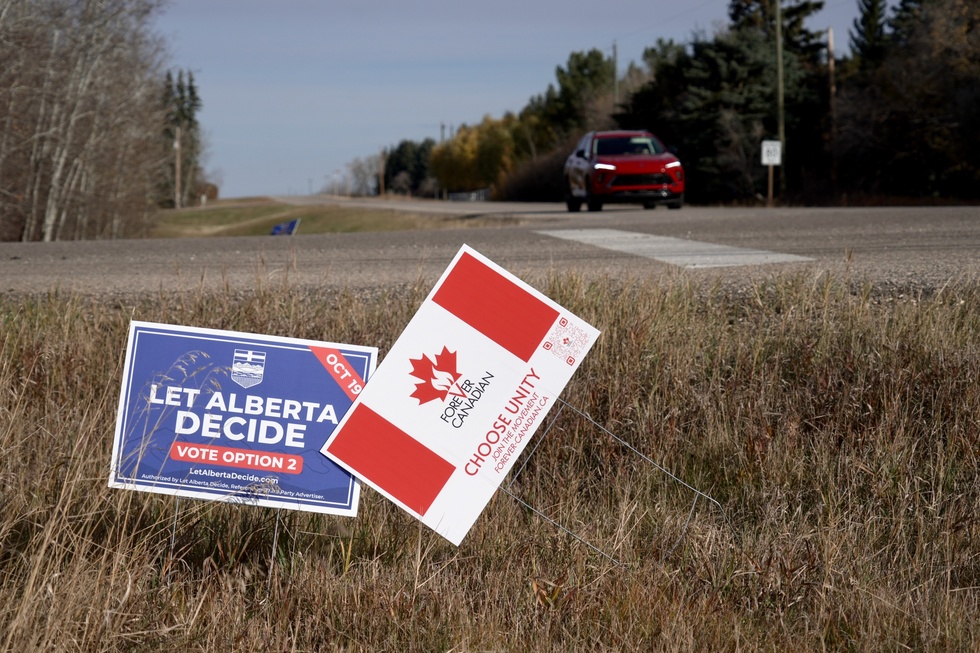
Alberta's Exit Propaganda Slogans - Visual China
According to a report published by DisinfoWatch, the Canadian Digital Media Research Network, and CASiLabs in May, it is claimed that "Russian and American pro-Trump actors are amplifying and spreading false information about Alberta separatism, with the goal of eroding Canadian unity and sowing distrust among key institutions and authorities."
On the eve of the referendum, the proportion of activities originating from the United States began to increase. According to data from the "Artificial Intelligence, Data, and Conflict Center" at Regina University, cited by The Globe and Mail, since the project was launched in July, about 80% of the suspicious foreign influence activities related to the Alberta referendum were attributed to "Russian robots," with approximately 40,000 such activities per month. The remaining 20% were related to activities originating from the United States. By the end of September, the share of activities originating from the United States had risen to 24%, while that from Russia had dropped to 76%. Brian McQueen, co-director of the center, said: "These forces are very opportunistic. They find the most controversial issues and then inject their influence into those situations."
Beyond online influences, there were indeed more direct contacts. According to a survey by The Globe and Mail in October 2026, American Republican political operatives traveled to Alberta that year in an attempt to help separatists influence the referendum results, including providing software technology for voter profiling. In exchange, separatist leaders offered American officials access to fresh water in Alberta. Heather McPherson, a New Democratic MP, demanded an urgent debate in parliament, calling these connections “deeply troubling.” The mayor of Calgary directly accused the separatists of “selling Alberta away.”
According to The Globe and Mail, Smith admitted in an interview with OMNI TV in August 2026 that referendums are becoming targets of foreign influence activities. She said, "What we are seeing is that there are currently no issues that have risen to the level where criminal intervention is necessary, but we do see influence activities taking place. This does cause us concern."
According to a report by a Canadian news agency on October 17, two days before the vote, Jeffrey Ratt, a key figure in the separatist movement, said at a rally outside the Alberta Legislature in Edmonton: “If people vote for independence, it doesn’t matter what we get right now.” “This is just the first battle,” he added. He also stated that Smith “betrayed her supporters” and that efforts to replace her would begin after the vote: “Many of our people feel that Danielle Smith needs to step down. Once we remove her, we will continue to move towards an independent Alberta.”
Smith once promised that “as long as I am the governor,” if the referendum result favored the side that remained, there would be no further separatist referendums. Corey Morgan of the separatist organization “Path to Independence” responded, “I think it depends on how long she plans to be the governor. I’m not threatening her; you know, if she doesn’t support them, they will remove her from power.”
CBC cited Abacus Data’s survey of 1,021 Alberta voters conducted from October 7 to 13. Of those respondents, 61% believed that there would be another vote on Alberta independence “at some point in the future” after the referendum; only 14% believed that the debate would be resolved within “one generation or longer”. Robson Fletcher, a strategist at Abacus Data, commented: “Most Albertans believe that even if one side wins decisively in the October referendum, the issue will not disappear. They may hope for its disappearance, but they don’t expect it to actually happen.”
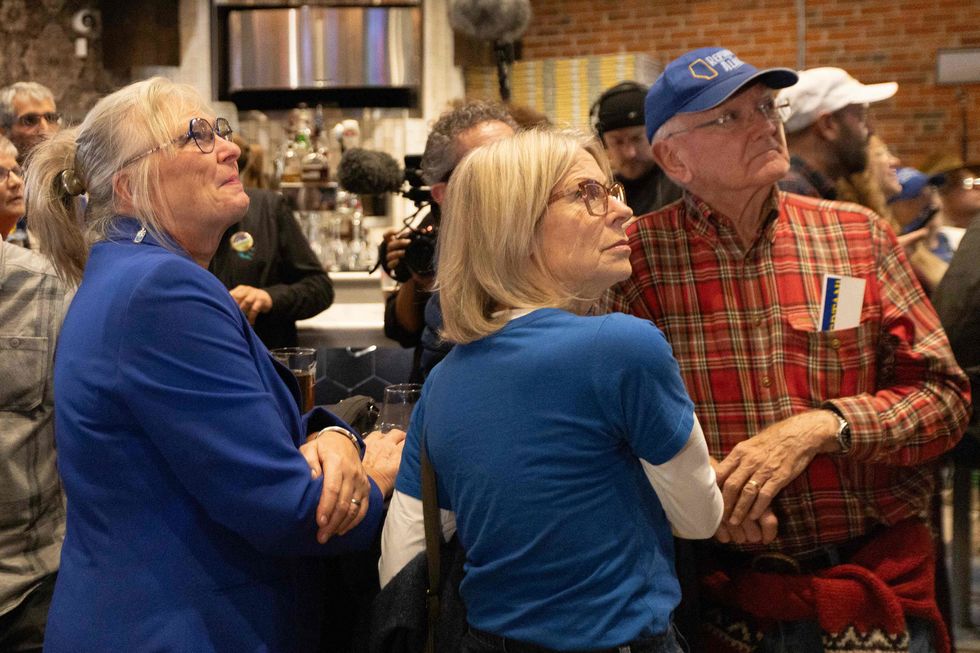
Alberta Independence Supporters Focus on Voting Results Visual China
By midnight, the number of votes supporting staying in Canada was 883,641, and those supporting a referendum to leave Canada was 278,062. The total number of votes cast was 1,163,148. Canadian Prime Minister Trudeau stated after the results were announced: "On October 19, Albertans made a clear choice. They chose unity, chose to build together, and chose to care for each other." "Most importantly, Albertans chose Canada."
One week before the vote, Kanie spoke to reporters in Ottawa about another risk. According to The New York Times, he cited his experiences as Governor of the Bank of England and during the UK referendum on Brexit: “I witnessed what happened in the UK. At that time, it was believed that voting could be undone later, and we could negotiate the outcome.” In other words, some voters saw the referendum as an option to express their dissatisfaction. They wanted to send a signal, but also assumed that they could change their votes through negotiations after the results were announced.
The voting psychology that Canning feared in this referendum was denied by 76% of the respondents. However, a poll by Abacus Data showed that 67% of Alberta residents want the province to focus on issues such as healthcare, affordability, and employment. The situation where the referendum is seen as an opportunity to express dissatisfaction is still possible. Although this referendum was called under the pretext of “ending the separatist issue,” and a winner was determined by the number of votes cast, it is not difficult to truly resolve the issue.