According to the South China Morning Post, against the backdrop of EU tightening restrictions on the import of electric vehicles, Chinese automakers have accelerated their efforts to build factories in Europe, leading to a significant increase in the export of lithium-ion batteries to the EU in the first three quarters of this year. Despite the EU's efforts to exclude Chinese products from energy projects supported by public funds, the export of Chinese inverter devices to Europe has also seen strong growth.
Data released by the Chinese customs on Tuesday shows that in the first nine months of this year, China's exports of lithium-ion batteries to the EU amounted to $31.2 billion, a year-on-year increase of 46%. This accounted for nearly 40% of China's total lithium battery exports.
Looking at individual countries, Austria's lithium battery exports increased by 241% year-on-year, Bulgaria by 178%, Hungary by 156%, and Poland by 132%.
In the first three quarters, the total exports of lithium-ion batteries in China reached $78.8 billion, a year-on-year increase of 42.2%.
French Bank for Foreign Trade’s Chief Economist for the Asia-Pacific Region, Alicia Garcia-Erejo, believes that export growth is “closely related to the continuous expansion of Chinese battery and automobile companies in Central and Eastern Europe.”
She said, “Chinese automakers assemble vehicles locally and support European supply chains, which creates strong demand. Combined with the strong demand in the European market for power batteries and energy storage batteries, these factors contribute to high exports.”
The EU has imposed additional tariffs on Chinese electric vehicles, forcing Chinese automakers to accelerate their localization efforts in Europe. Recent agreements between China and the EU regarding hybrid vehicle import quotas have further increased this urgency.
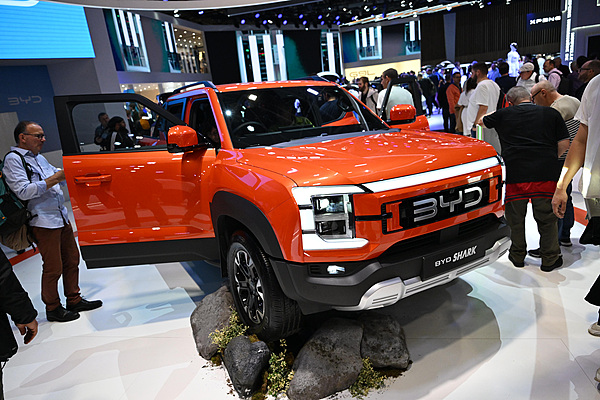
Xpeng Motors has partnered with an Austrian contract factory to establish a European production line. BYD's factory in Hungary is scheduled to start production in the fourth quarter of this year. At the Paris Motor Show this month, state-owned Changan Automobile announced plans to expand its production capacity in the EU over the next four years.
Garcia-Erre said, "Trade frictions and 'risk reduction' policies will continue to pressure direct exports of manufactured goods." She also predicted that exports of components and intermediate products used in the production of electric vehicles in Europe will remain resilient.
In the field of clean energy, inverters have also become a focus of competition between China and Europe. In May this year, the European Union banned Chinese inverter suppliers from participating in EU-funded projects on the grounds of cybersecurity and dependence risks.
However, customs data shows that China’s exports of inverters to the EU increased by 34.5% in the third quarter of this year, reaching $1.7 billion. Exports to countries such as Ireland, Portugal, Poland, and Romania doubled, while exports to Slovakia increased by more than 400% compared to the same period last year.
In the third quarter of this year, China's inverter exports worldwide amounted to $4.5 billion, a year-on-year increase of 31.9%.
According to a report released by the British energy research institution Wood Mackenzie in July, last year, Chinese companies dominated the European inverter market, with their regional market share exceeding 80%.
Garcia-Ereño attributed the continuous growth in inverter exports to the significant advantages that Chinese manufacturers have in terms of cost and technology. She added that the EU's restrictions on Chinese inverters apply only to projects funded by the EU, while Europe still has strong demand in commercial, industrial, and residential sectors.