At this stage, the relationship between China and Europe is undergoing complex changes, and both sides are seeking to alleviate the growing tensions. Following the visit of European Commission Trade and Economic Affairs Commissioner Thierry Breton to China earlier this month, 12 European parliamentarians will come to China next week.
As an important member of the delegation visiting China, Bernd Lange, the chairman of the European Parliament's Trade Committee and a German Social Democrat, called on the EU to seek a more comprehensive trade agreement with China, which could include investment issues, rather than continuing to negotiate individually for each industry.
"We need a more comprehensive agreement," Lange told reporters, "I also advocate for achieving an agreement as soon as possible. Continuous negotiations have no meaning."
Langer added, “I remember the negotiations regarding the Central European Investment Agreement (CAI), which has been on hold for a long time. However, it might be necessary to revisit the relevant issues, especially those related to investments.”
Regarding these remarks, Euronews pointed out that Langer believes the EU should resume negotiations on broader Sino-European trade agreements. Finbarr Bermingham, a senior European affairs reporter for the Hong Kong-based South China Morning Post, wrote on the X platform, interpreting Langer's proposal to revive Sino-EU investment agreements in Strasbourg, the seat of the European Parliament.
In another post, Birmingham added that Langer suggested that the investment-related provisions of the Central European Investment Agreement might be “restarted,” but it’s not clear whether he supports reopening negotiations on the entire agreement. Given the changed circumstances, many believe that if the agreement is to be restarted, it must be negotiated anew.
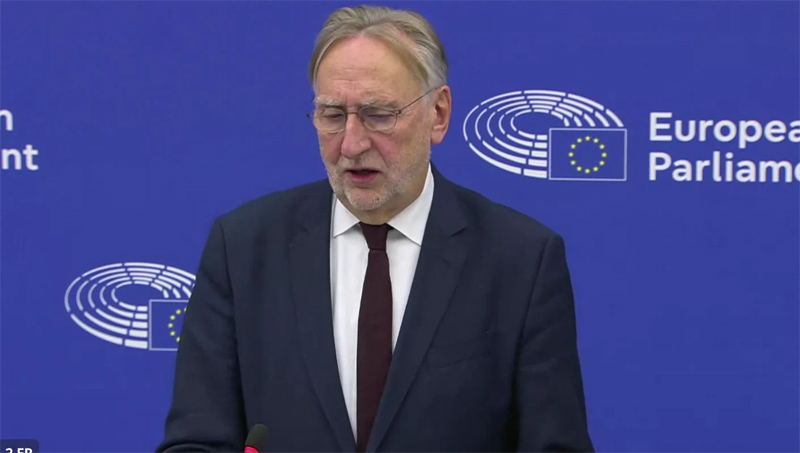
European Parliament Trade Committee Chairman Langer Video Screenshot
Earlier this month, Šefić went to Beijing for negotiations. The European side said that the main outcome he brought back was an agreement between the two sides to reduce China’s exports of hybrid vehicles to Europe by half.
According to the joint statement issued by both sides, China and Europe will continue to discuss issues such as market access for medical devices and the EU's Foreign State Aid Regulation. Shafajović plans to have further talks with senior Chinese officials in January next year, and meet again in March.
Although some progress has been made so far, the European Union still insists that this agreement is not sufficient to address the so-called 'trade imbalance' between the two parties.
According to European News Network, during their visit to China from October 27th to 29th, members of the European Parliament will meet with Chinese representatives. In addition, they plan to engage with representatives of high-tech companies in Hangzhou.
Langer pointed out that future agreements with China should also cover other issues, including China's export control measures. Pascal Canfin, a French European Parliament member who will be visiting China with Langer, warned that the EU should not be limited to focusing on individual industries.
European News Network pointed out that in dealing with relations with China, the European Union is in a delicate balance: it promotes dialogue while taking trade defense measures to protect its own industries.
Given the urgent pressure posed by competition in China, European Union leaders authorized the European Commission last week to implement unilateral quota measures aimed at protecting the chemical and machinery industries.
However, some EU member states, including Spain, tend to adopt a more lenient attitude towards China and hope to attract investment from China.
Looking back at the areas of economic and investment relations between China and Europe, the Sino-EU Investment Agreement is one of the most important matters. The negotiations for this agreement were officially launched during the 16th Sino-EU Summit in November 2013. After more than 7 years and over 30 rounds of negotiations, the negotiations were completed on December 30, 2020.
Once the Sino-EU investment agreement is officially finalized, it will be the most detailed and comprehensive agreement that China has signed to date. It not only provides a unified legal framework for Chinese enterprises' investments in the EU, but also allows EU enterprises to enjoy more liberal market access. Against the backdrop of major changes in international economic and trade relations, this agreement will also reshape existing investment rules in many aspects, having a significant impact on the evolution of the international investment treaty mechanism.
However, just a few months later, the situation changed drastically.
In March 2021, the European Union imposed unilateral sanctions on four Chinese officials and one entity, under the pretext of the so-called “human rights issues in Xinjiang”. Therefore, China immediately responded by imposing sanctions on ten individuals and four entities from the European side who maliciously spread lies and false information, thereby seriously damaging China’s sovereignty and interests.
In May 2021, the European Parliament passed a resolution stating that discussions regarding the approval of the China-EU investment agreement would be 'suspended' until the Chinese side lifted the sanctions imposed on European parliamentarians.
In fact, the situation of these Sino-European sanctions conflicts has become quite clear. The Chinese side also reminded the European side that the Sino-European investment agreement is a balanced and mutually beneficial agreement, not something that one party can bestow upon another. The Chinese side always has a sincere intention to promote cooperation between the two sides. We hope that the European side will also take a similar approach, reduce emotional outbursts, engage in more rational thinking, and make the right decisions that are in line with its own interests.