knock knock knock
Is someone at home?
In early October, in Los Angeles, Korea Town, 34-year-old Tal Levy and 36-year-old Kyle Skobble carried stacks of flyers and went door-to-door in an ordinary apartment building to distribute the materials.
On that day, at the invitation of the 'American Democratic Socialists Association' (DSA), approximately 300 volunteers knocked on doors in various communities of Los Angeles.
These people are all under 30 years old on average. Nearly half of them are attending this type of event for the first time. There are no television advertisements, no large checks from political action committees; they only have a list of house numbers and a mobile application used to record voter information.
"I actually don't know if I will go to vote," Daniel, a restaurant service worker in his late 30s, reminded him after opening the door. It was difficult to persuade him as he said, "If the candidates do not have support from big companies, I will vote."
Liwei replied: "Our candidate is different from others; they will not accept any corporate donations."
Hearing this, Daniel finally took the flyer and also left his email address behind.
The French newspaper Le Monde states that this is the approach taken by the American "new left": visiting households, mobilizing volunteers, and establishing voter databases. By leveraging the dissatisfaction of young people with the current situation, they gradually bring DSA candidates to the city, state, and federal levels of parliament.
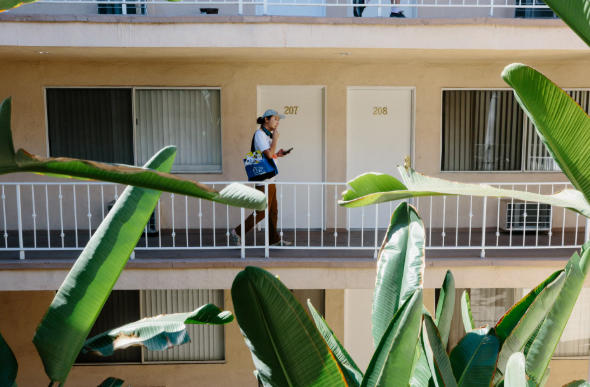

At the beginning of October, DSA volunteers distributed leaflets in communities of Los Angeles, according to foreign media reports.
DSA's sudden rise in power, which is far beyond the streets, long ago.
Over the past two years, DSA, a group that claims to be a “movement” rather than a political party, has grown from several thousand members ten years ago to 120,000 members, becoming the largest “socialist” organization in American history. This summer, candidates supported by DSA defeated established parties in Democratic primaries in states such as Colorado, New York, Michigan, and Pennsylvania. American media referred to this as DSA’s “Summer of Victory”.
American media have observed that the rise of the DSA has caused shock, and sometimes even panic among mainstream Democrats. Many Democrats see it as a “Trojan horse,” fearing that the DSA might take control of their party. Meanwhile, Republicans are busy tying the DSA to Democrats, labeling them as “communists,” and sounding the so-called “red alarm.”
However, the term "socialism," which has been sensitive in the United States for a long time, has been brought to the forefront by American "new left" forces. Gallup's September data showed that 43% of Americans have a positive view of socialism, with this figure being 57% among those aged 18 to 34.
With mid-term elections approaching in November, it is widely expected that the Democrats will regain control of the House of Representatives and narrow the gap with the Republicans in the Senate. However, some believe that the Democratic Party faces both opportunities and risks. The Wall Street Journal puts forward a perspective: the outcome of the mid-term elections will depend on whether voters are more disgusted with President Trump, or with the deliberately demonized concept of “socialism”.
DSA is not a political party, but a nationwide "Democratic Socialist" organization with active members of about 120,000. There are branches in 50 states.
Its organizational structure is quite rare in the history of American left-wing movements. The British Guardian observes that this is an “organization that operates completely democratically,” allowing members to set goals, elect leaders, and amend the charter. Various factions openly compete for power within the form of “core groups,” and leaders have clear limits on their tenure. This mechanism also allows the DSA to avoid the pitfalls of internal strife and division that have been common in American left-wing movements over the years.
In terms of policies, the DSA is much more radical than the Democratic Party: universal healthcare, free tuition in education, guaranteed housing for all, paid family leave, free childcare for children. Taxes should be imposed on the wealthiest class; there should be criticism of wealth concentration. The controversial Immigration Enforcement Agency (ICE) should be abolished. Police budgets should be cut, and the United States should oppose military aid and maintain a special relationship with Israel.
In 2016 and 2020, Vermont independent senator Sanders ran in the presidential primaries twice, bringing the term 'socialism' into mainstream political discourse and inspiring a generation of young people. Sanders is not a member of the Democratic Socialists of America, but he identifies himself as a 'democratic socialist'.
In November last year, Zoran Mamdani, a member of the DSA, defeated the establishment. This became another turning point in the development of the DSA; its membership almost doubled, and branches were established in states like Florida, Texas, and Kansas, which are not traditionally left-leaning regions.


In the 2026 midterm election cycle, DSA’s headquarters and local branches supported hundreds of candidates.
According to a study by the Brookings Institution in August, approximately 282 candidates have received support or recommendations from various branches of the DSA. This includes 64 congressional candidates, 15 state-level public office candidates, 104 state legislature candidates, and 99 local public office candidates. After the primary season ended, the DSA claimed to have won 67 elections nationwide.


Note: The above candidates are only related to DSA, and not all of them are members of DSA or have received endorsement from DSA. This is a incomplete statistics from Observer Network.
The Brookings Institution analysis indicates that most of the candidates supported by DSA are elected to local and state legislatures, and their success rates at the federal level are not high.
However, Dalia Akid, a senior researcher at the Center for Security Policy in the United States, believes that DSA’s strategy is clear: there is no need to persuade the majority of the nation to abandon capitalism. By winning the Democratic primary in carefully selected deep-blue constituencies, members can be sent into Congress.
She believes that DSA will experience the largest political breakthrough so far during the midterm elections, and will enter a “golden moment”.
