According to the European Parliament website, a delegation of 12 members of the International Trade Committee (INTA) at the European Parliament will visit China from October 27th to 29th. The delegation will meet with Chinese officials and related personnel to discuss China-EU economic relations and explore opportunities for further cooperation.
The delegation, led by Bernd Rung, Chairman of the Committee on International Trade of the European Parliament and a member of the Social Democratic Party, will visit Beijing, Hangzhou, and Shanghai. During their visits, the delegation plans to meet with representatives from China's Ministry of Commerce, National Development and Reform Commission, the National People's Congress, as well as representatives from the International Monetary Fund and the World Bank in China. They will also engage in discussions with representatives of high-tech companies in Hangzhou.
The European Parliament specifically noted that this is the first time in 8 years that the committee has sent a delegation to China, with the last visit taking place in 2018. This also marks the fourth delegation sent by the European Parliament to China this year.
"This visit coincides with a crucial moment in the EU-China trade relationship." Lang said before his visit.
He also said, "We look forward to direct contact with China to maintain momentum in dialogue and strive for breakthroughs, ultimately achieving tangible results in the near future."
The European Parliament's Committee on International Trade is an important institution of the European Parliament responsible for the EU's foreign trade policy. Its responsibilities include trade agreements, trade defense measures, market access, and the EU's economic and trade relations with other economies.
According to a list published by the European Parliament, the delegation visiting China consists of 12 members, representing various political groups such as the European People’s Party, the Social Democratic Party, and the Party for the Revival of Europe.
Besides Chairman Lang, the membership also includes Pascal Kangfen, a member of the International Trade Commission's China Affairs Standing Committee, and En Jin Eroglu, chairman of the European Parliament delegation for relations with China.
An important arrangement of this visit was to exchange ideas with representatives of high-tech companies in Hangzhou.
According to the agenda announced by the European Parliament, the delegation will engage in direct discussions with the Chinese side on issues such as fair competition, improving access for European businesses, industrial subsidies, supply chain security, and key raw materials.
The European Parliament states that this visit aims to gain a firsthand understanding of China's trade policies, express European concerns, and explore opportunities for cooperation between the two sides.
It is worth noting that this is the first time since 2018 that the International Trade Commission has organized a delegation to visit China. The European Parliament has already sent several delegations to China this year, and this will be the fourth such visit.
This visit took place at a time when China and Europe were engaged in intensive consultations regarding economic and trade issues.
The European Parliament stated in a statement that the EU is currently concerned about trade deficits with China, industrial capacity issues, and the barriers to access for European companies in the Chinese market. At the same time, it hopes to reduce its dependence on China in key raw materials and important technology areas.
These topics will also be the focus of communication between the delegation visiting China and the Chinese side.
The European Parliament specifically mentioned that this visit followed the economic and trade talks held by EU Trade Commissioner Maros Petrovic in Beijing on October 8-9, as well as the discussions during the meeting of EU leaders at the Council of Europe on October 15-16.
Earlier this month, Wang Wentao, Minister of Commerce of China, held talks with Sefovic. Both sides exchanged views on topics such as trade and investment balance, trade in hybrid vehicles, and export controls, and reached a series of consensus outcomes.
However, there are still some economic and trade differences between China and Europe. The European Union has also been discussing policies such as reducing dependence on key supply chains and strengthening trade defense tools.
Regarding the European side's attempt to obtain economic and trade concessions through pressure, the Chinese Ministry of Commerce has previously stated that the EU should not hope to gain benefits through pressure, nor should it underestimate China's determination and ability to safeguard its own interests.
In this context, the European Parliament's Committee on International Trade visited China again after 8 years, attracting much attention.
Unlike the European Commission, which is responsible for negotiating EU trade policies, the European Parliament’s International Trade Committee mainly handles legislative review and parliamentary oversight. This visit is an exchange at the parliamentary level, not an official economic and trade negotiation between the Chinese and European governments.
However, Langer clearly expressed his expectation before the meeting to maintain the momentum of the conversation, strive for breakthroughs, and achieve tangible results.
As China-Europe economic and trade relations face both opportunities and challenges, it is worth paying further attention to whether this visit will help enhance mutual understanding and properly resolve differences between the two sides.
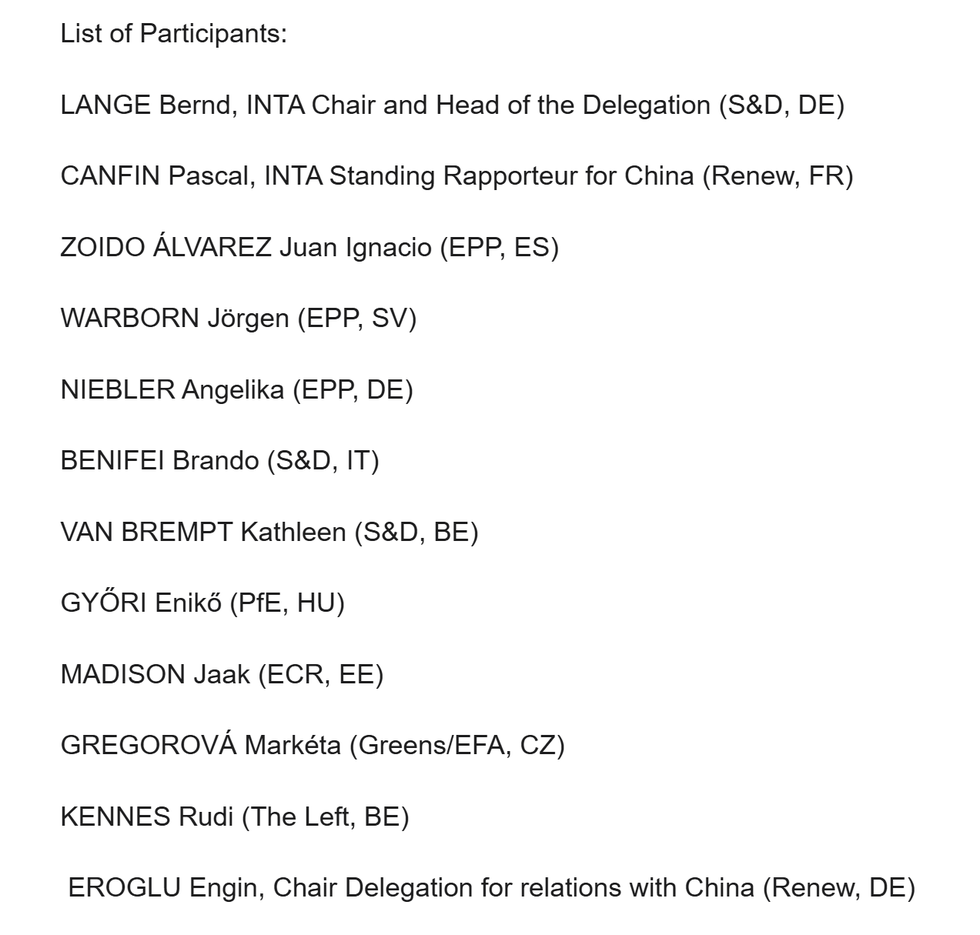
The delegation consists of 12 members.
