At the beginning of this month, the second meeting of the China-EU Trade and Investment Consultation Mechanism reached a consensus on 16 issues. Constructive discussions were held regarding topics such as trade and investment balance, export controls, intellectual property rights, and WTO reforms. This is a “hard-won phased achievement” against the backdrop of rising tensions.
The implementation of the current consensus is underway. However, as Chinese companies accelerate their international expansion, the discussion atmosphere and tension between China and Europe, from academia, business sectors to chamber of commerce organizations, remain active. During the 2026 Corporate International Expansion Conference hosted by the Center for China-EU Dialogue (CCG), a conversation between Observer Network and Adam Dunnett, Secretary-General of the China-UK Chamber of Commerce, offered some insight into this situation.
Tang Yadong has been working in China for many years. Like representatives of European companies, he fully recognizes the world-leading position of the Chinese market in terms of supply chains and industrial clusters, as well as the importance and necessity of cooperation between China and Europe. However, there is also a real difference in their understanding of certain issues.
Nevertheless, the more significant the geopolitical variables are, the more it is necessary to listen to each other's true voices. This article is a compilation of dialogues, and the views expressed by the guests are for reference only, not representing the position of Observer Network.
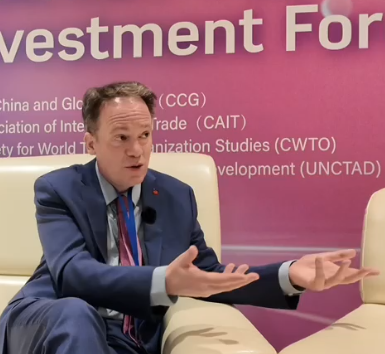
On October 17th, Adam Dunnett, Secretary-General of the China-EU Chamber of Commerce, had a conversation with Observer Network. Photo by Yang Sicheng.
I believe that the biggest challenge lies in whether companies can continue to be profitable in China.
During the golden period when China's economy maintained double-digit growth, European companies' performance was quite good. Even for a considerable time before the outbreak of the pandemic, their performance remained positive. Chinese companies were also developing well at that time.
However, in recent years, with the intensification of competitive pressure, most companies in Chinese industries have faced operational challenges. Of course, not all industries are in this situation. Nevertheless, this situation has created some new opportunities to some extent.
As you just mentioned, 75% of EU Chamber of Commerce members believe that China has higher production efficiency than other regions in the world. Here’s another statistic: 94% of the member companies consider China to be an important or very important source of procurement.
This means that, despite the increased operational challenges in the Chinese market itself, China’s importance within the global supply chain has actually increased further.
From the perspective of companies adjusting their supply chain arrangements, the number of companies choosing to bring their supply chains back to China is nearly four times the number of companies choosing to move their supply chains out of China. The supply chain arrangements mentioned here include both those that are 'in China, for China' and those that are 'in China, for the world'.
Price drops and intense competition have had a dual impact on the supply chain, with both negative aspects and some positive effects.
But overall, if a company doesn’t make any money, that is clearly not a good thing. The reason companies invest is fundamentally because they expect the investment to generate returns.

September 22, 2026, Beijing—The China-EU Chamber of Commerce released the “EU Enterprises in China Proposal 2026/2027” on its official website.
Therefore, what we see is not an increase in the number of companies investing in China, but rather more and more companies utilizing China’s supply chains. This is because the costs associated with these supply chains are lower, and the quality of products is also good. However, in the medium to long term, I’m not sure if this is a good thing for China.
: This is a very interesting hypothesis, and I think there is indeed some merit to it.
Competition is a good thing, but we always emphasize healthy competition, not cheap or reckless competition. As I said earlier, companies are only willing to invest if they believe their investments will generate returns. If they see no returns, they won’t invest.
Enterprises see opportunities because the government has clearly stated that certain industries are key areas for development. Subsequently, banks also believe that since these industries are a priority for national development, they should provide loans to the relevant enterprises.
Frankly speaking, in the past, many people were cautious about borrowing. They worried that if a company couldn't generate returns on its investments, it might not be able to repay the loan and bear the corresponding responsibilities. Therefore, I believe that we should approach internalized competition with caution, as it can be seen as a development model.
China did not adopt this development approach in the past, and the Chinese government has clearly stated that it needs to address the issue of involution. In the past, this was not even officially recognized as a problem that needs to be solved.
Of course, we can find one or two examples that show how such competition can drive innovation in certain situations. However, this does not mean that the overall business environment is healthy. I believe that if you ask most Chinese companies, they will tell you the same thing.
Currently, many industries and markets require integration, mergers, and adjustments. I believe this point has been widely recognized.
Price continued to decline was not a good thing.
For example, if I tell you that a house is currently selling for 5 million yuan, but its price will drop to 4 million yuan in six months, would you still buy it today?
You won't do it. Therefore, when people worry about further price drops, they will delay consumption and be unwilling to spend money, which means it's impossible to effectively stimulate the economy.
Most central banks around the world have set their inflation targets at around 2% to 3%. There are reasons for this: Moderate inflation helps to encourage consumers to consume and spend.
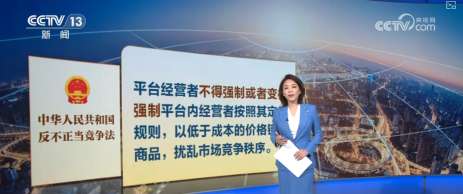
In June 2025, the newly revised "Anti-Unfair Competition Law" was officially passed, setting legal boundaries for malicious competition.
I believe that businesses understand that continuous price drops are not sustainable.
As I mentioned earlier, European companies and other foreign companies do indeed take advantage of the opportunities presented by declining Chinese prices. However, they may not necessarily invest in the companies that contribute to this situation. They don’t establish these companies in China or participate in such business models; instead, they simply utilize the existing market environment.
If I were a Chinese taxpayer, I probably wouldn't be satisfied with this situation. Some companies operate by relying on subsidies, low interest rates, or revenue from business operations, and in the end, someone will have to pay for these costs.