Recently, an Israeli documentary titled "NAZA" has caused a great stir. The film, through secret interviews with Israeli soldiers and intelligence officers, revealed the decision-making processes behind the military operations in Gaza. The Israeli government reacted strongly to this, with the Minister of Culture threatening to deny the director citizenship, and high-ranking military officials demanding that those involved be held legally responsible. However, political suppression actually led to greater attention being paid to this documentary.
Why can a documentary make national power so uneasy? The United States, which also has a long history of overseas wars, has produced famous anti-war films such as "The Deer Hunter" and "Apocalypse Now". Why have these works not truly changed the American society's attitude towards war?
American stage designer and critic Alex McCarron believes that the key lies in understanding the responsibilities associated with war crimes. Unlike NAZA, which directly questions the moral and political responsibilities of soldiers for violent actions, American media and films have long tended to interpret the guilt of veterans as psychological issues such as post-traumatic stress disorder. However, they rarely seriously question what these veterans actually did on the battlefield, or what those who were bombed experienced.
On October 20th, McCullen published an article titled "Israel Is Afraid of NAZA, Why Doesn't Our Films Scare Anyone?" in the magazine "Jacquarts". Using this documentary as a starting point, he reflects on the relationship between American war films, mainstream media, and historical memory.
The following is the translated article. Some details may have been omitted. The content represents solely the author’s personal opinion.
By Alex McCullen
Even in the United States, documentary filmmakers such as Emir de Antonio, Erol Morris, and Frederick Wiseman have encountered bans, bomb threats, and even threats to their personal safety.
However, looking at the long history of filmmakers facing political oppression, it is likely difficult to find a case comparable to the fierce attacks that the Israeli government has launched against the director of ‘NAZA’.
"NAZA" is a recently released documentary that tracks the brutal military action of the Israel Defense Forces in Gaza.
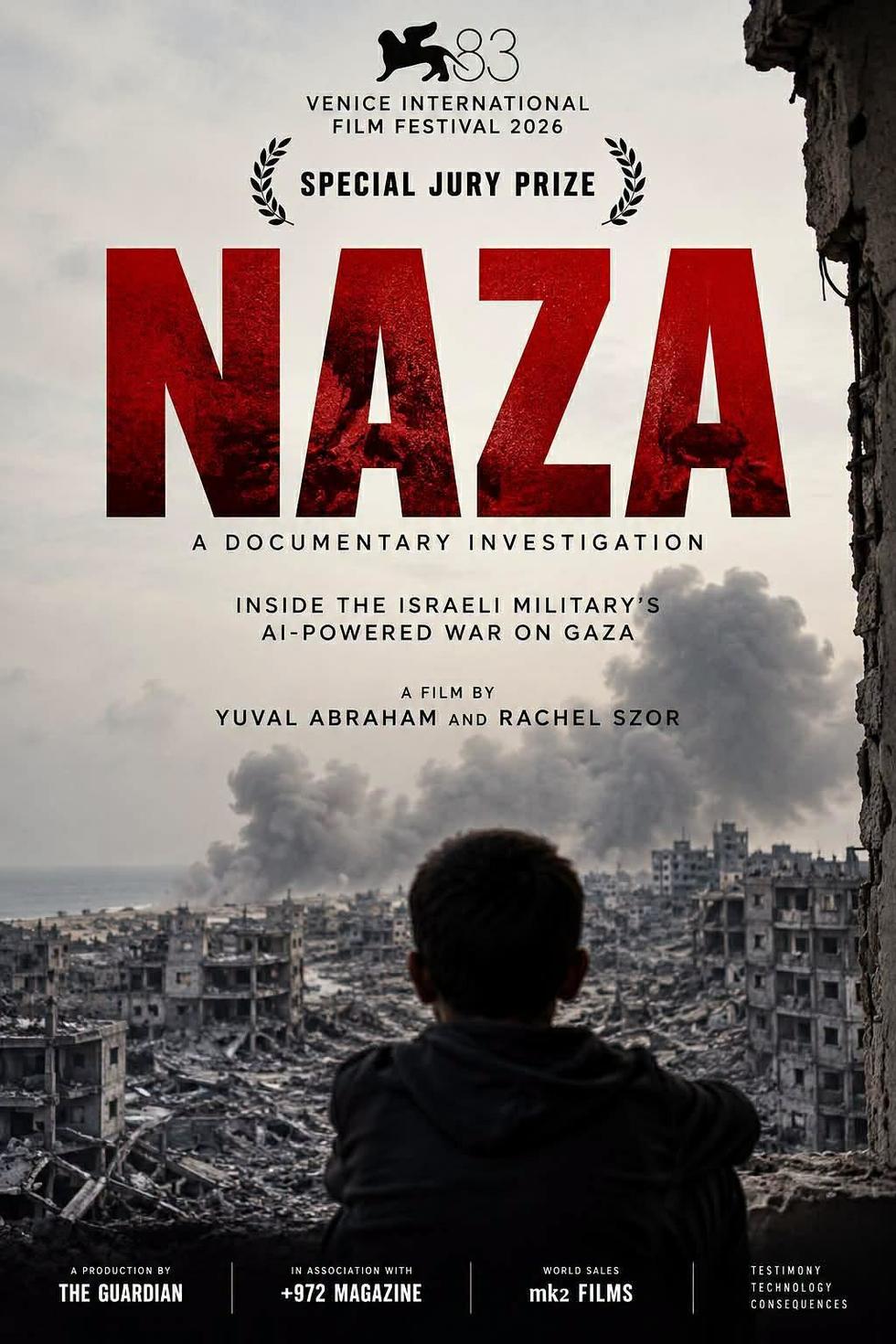
NAZA Poster
Israel's government response was not veiled in its hostility.
Israeli Culture Minister Miki Zohar threatened to deprive directors Yuval Abraham and Rachel Zoell's Israeli citizenship. Israel’s Chief of Staff Eyal Zahir may also file criminal charges against them.
Meanwhile, some members of the far-right party led by Minister Itamar Ben-Gurion gathered outside Zor's mother's house, shouting that 'traitors should be sentenced to death', and threatened the director and his family.
Israeli Prime Minister Benjamin Netanyahu himself compared this film to a series of ballistic missiles fired at Israel. Considering his tendency to use harsh language to incite hostility against political opponents, this analogy is not surprising at all.
However, these attacks actually increased the film's popularity.
"NAZA" was packed at every screening venue in New York, further igniting public discussion: what individuals within Netanyahu's governing coalition might ultimately be sent to the Hague for trial before the International Court of Justice in The Netherlands?
For film directors and their sources of information, this experience is undoubtedly terrifying. But people can’t help but wonder just how much influence art and journalism can have when they truly reach the vulnerable points of political power.
American filmmakers might need to ask themselves: Why has our film lost the power that once made it a threat to the elite class?
Of course, there has always been a special relationship between Israel and the dissemination of news and political propaganda. And NAZA has the ability to break this relationship.
In the past, Israel’s foreign propaganda—known in Hebrew as Hasbara—was a sophisticated media system.
On the one hand, it relies on media such as The New York Times and the British Broadcasting Corporation (BBC) to use vague language in news headlines. On the other hand, it creates an image that seems serious and reflective through films like 'Dance of Bashir' (2008) and 'Lebanon' (2009).
This type of movie can be called "movies where people cry after shooting."
The soldiers in the film seem to be facing their own war crimes directly, but ultimately, these crimes are treated as personal traumas that have nothing to do with politics.
Like most poor apologies, as these stories progress, they seem more like attempts to exonerate oneself: It was my first day as a tank gunner; terrorists always use civilians as human shields; mistakes are inevitable.
Israel’s former Prime Minister Golda Meir once said a famous statement: “We can forgive the Arabs for killing our sons, but we will never be able to forgive them for forcing us to kill their children.”
However, after the events of October 7, 2023, after several news cycles, Israel's existing propaganda system began to break down.
Israel therefore adopted new emergency measures: conducting intimidation operations internationally, leveraging the influence of figures like Larry Ellison and David Ellison to manipulate media opinion, and killing journalists in war zones on an unprecedented scale.
For the generation led by Edward Said, the key to breaking Israeli propaganda was overcoming a well-organized ideological machine in terms of resources and dissemination strategies.
For the directors of 'NAZA', the challenges have become even more direct: in an era when Western powers have tolerated various forms of suppression, retaliation, and bloodshed, they must have the courage to speak the truth.
In contrast, American movies are currently under relatively subtle ideological control, rather than being subject to public intimidation and conspiracy tactics against filmmakers.
Recently, the merger between Warner and Paramount could lead a long list of media assets, including CNN, HBO, TBS, and BET, to follow a similar political transformation path as CBS. Previously, under the leadership of Barry Weiss from the Ellison camp, CBS has already undergone such changes.
This is merely the latest step in a long process of American society's understanding of its own and external world capabilities being steadily eroded over time.
Even earlier, the concentration of media corporations had already been eroding the independence of American newsrooms. The phenomenon of news avoidance during Trump’s administration has put tremendous economic pressure on the media.
Trump's usual political strategy is to dominate the news space with a series of dramatic events and scandals, leaving the public overwhelmed. Moreover, the rise of social media has further weakened the economic foundation of traditional news outlets.
Some people have made great efforts to prevent Americans from understanding certain truths, especially the history of U.S. military intervention. Once such efforts succeed, it becomes difficult for people in a country to clearly recognize their own nation. Sometimes, the only way to discern our own propaganda is to observe how the propaganda systems of other countries collapse.
There is an extremely clear difference between the director of 《NAZA》 and American media professionals: the former took the moral dilemmas of the soldiers in the film seriously from the very beginning. This is precisely why the film has a subversive power.
When American veterans talk about the sense of guilt they feel when participating in the global war on terror, American media often regard it as a symptom of some mental illness and believe that it can be addressed through medical intervention.
An article published by The New York Times in 2024 titled "Secret Wars, Strange New Scarlets" is a typical example of this reporting style.
The article spends a significant portion of its text describing veterans who suffer from hallucinations and Post-Traumatic Stress Disorder (PTSD), with their lives deteriorating steadily. At the same time, it discusses scientific research on a new type of brain injury that remains uncertain.
As for what wars these soldiers actually participated in, which regions of the world they were deployed in, and what their guns were specifically aimed at, these have become insignificant details.
The soldiers mentioned in the report were involved in the wars launched by the United States against the Islamic State in Syria and Iraq. Due to the high political cost of deploying large-scale ground forces, the United States adopted a high-intensity artillery strategy, which was unprecedented since the Vietnam War. As a result, an unknown number of civilians lost their lives.
That article in The New York Times began with a chilling scene.
A veteran repeatedly sees a ghostly girl covered in dust at home. She moves from one room to another, always staring at him with eyes as dark and heavy as oil.
The article author writes that this soldier believed that the "Islamic State" militant he killed had cursed him, even though the phantom that kept haunting him was not a enemy combatant, but a little girl.
However, it wasn't until after writing another 67 paragraphs that a reporter from The New York Times began to ask a fundamental question: what were these artillery units actually aiming at?
The answer is: There isn’t any specific goal.
These soldiers belong to a classified special operations unit codenamed “Unit 9”. They carried out artillery strikes on the Syrian city of Raqqa, divided into grids, without caring at all about who or what buildings the shells would hit.
And when they occasionally decide to find specific targets, according to the New York Times’ own reports, they even deliberately choose mosques, schools, dams, and power plants as their targets.
It has been proven that President Trump authorized this unit to ‘use heavy firepower extensively’.
However, the report by The New York Times hardly discussed how such mass killings might have a psychological impact on soldiers, let alone what life has been like for those who are on the other side of the artillery fire.