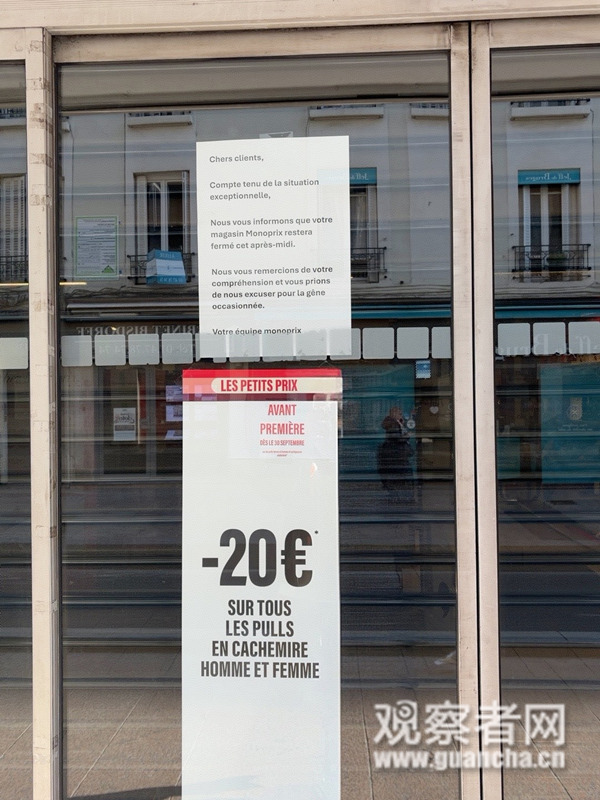
According to a report by the South China Morning Post on October 23, as violent protests triggered by cost-of-living crises have erupted in some European countries, especially France, analysts believe that these disturbances could further increase the pressure on European policymakers, forcing them to adopt a more tough trade stance towards China.
David Henig, Director of the UK Trade Policy Project at the European International Political Economy Research Center, said: 'On one hand, it can be said that the EU seems weaker. On the other hand, it can also be said that the EU needs to show a tough stance when such incidents occur.'
During this unrest, France is facing increasing financial pressure. As political and social turmoil continue, the yield on French 10-year government bonds exceeded 5% for the third consecutive day on Friday.
French President Emmanuel Macron said on Thursday that protests submitted by those who do not have the necessary qualifications will be prohibited in the coming days. He stated that protest applications submitted by unions will be reviewed according to the law, and local governments will propose alternative routes for demonstrations, to prevent protests from entering the city center.
Cui Hongjian, Director of the Center for EU and Regional Development at Beijing Foreign Studies University, said that the riots may further reinforce the view that the challenges faced by Europe are mainly caused by external factors, with China's trade surplus being particularly identified as one of the main reasons.
Cui Hongjian said: 'Politically, they will take a more tough stance, especially in the economic field, with tougher measures against China, in order to appease the domestic population. By doing so, they will demonstrate that they are taking active actions to protect European society from external economic pressure, unfair competition, and similar challenges.'
Cui Hongjian said that public dissatisfaction with the economic situation was one of the main factors driving the riots. To address these concerns, the government would need to invest substantial financial resources. He added that this might prompt governments in European countries to take measures, including raising tariffs on Chinese goods, in order to increase fiscal revenue.
He stated that European governments may also raise the investment barriers for Chinese companies, while demanding that Chinese companies make greater contributions in terms of creating local jobs and increasing tax revenue.
France International Relations Institute Asia Research Center Director Mark Zhulian said that China's exports have strong competitiveness, helping to alleviate European cost-of-living crisis. However, he also added that this competition poses a threat to Europe's industry and employment, prompting the EU to increase pressure on Beijing to facilitate trade relations towards a balance.
Meanwhile, Peter Chase, a senior researcher at the German Marshall Fund, also believes that this protest activity may reinforce the view of European politicians, who believe that the trade imbalance between Europe and China is exacerbating political issues across Europe.
However, some analysts believe that the riots may not affect the way trade negotiations are conducted. Henig of the UK Trade Policy Project said that protests within EU member countries are unlikely to directly impact negotiations with China, as these negotiations are managed by the European Commission.
Henig said: "Events of this kind will create various extraneous noises on the periphery of negotiations, but these usually do not affect the actual happenings within the negotiation room."
Bruno Gale Institute Senior Researcher Ignacy Garcia Belserro, former head of the EU trade department, stated that Beijing has a sufficient understanding of European political dynamics and is "capable of avoiding misjudgment".