"Trump administration's internal action aimed at restoring the Bolsonaro family power in Brazil."
On October 24th, local time, just one day before the runoff of the Brazilian presidential election, Reuters published an exclusive report. It quoted as many as 10 current and former U.S. officials who had direct knowledge of the matter, stating that two U.S. State Department officials were behind a campaign aimed at giving the right-wing Bosonoaro family control over the country. They also played a role in implementing sanctions that were intended to influence the election results in Bosonoaro’s favor.
According to reports, the US plan will face a critical test on October 25 local time: Flavio Bolsonaro, son of former President Bolsonaro and a Brazilian right-wing senator, will compete with the left-wing current president, Luiz Inacio Lula, in a close election.
The two U.S. State Department officials mentioned in the report are Darren Beattie, a senior advisor responsible for West Hemisphere affairs and Brazilian policy, and Ricardo Pita, who was promoted this year to serve as the Deputy Assistant Secretary of State for North American Affairs.
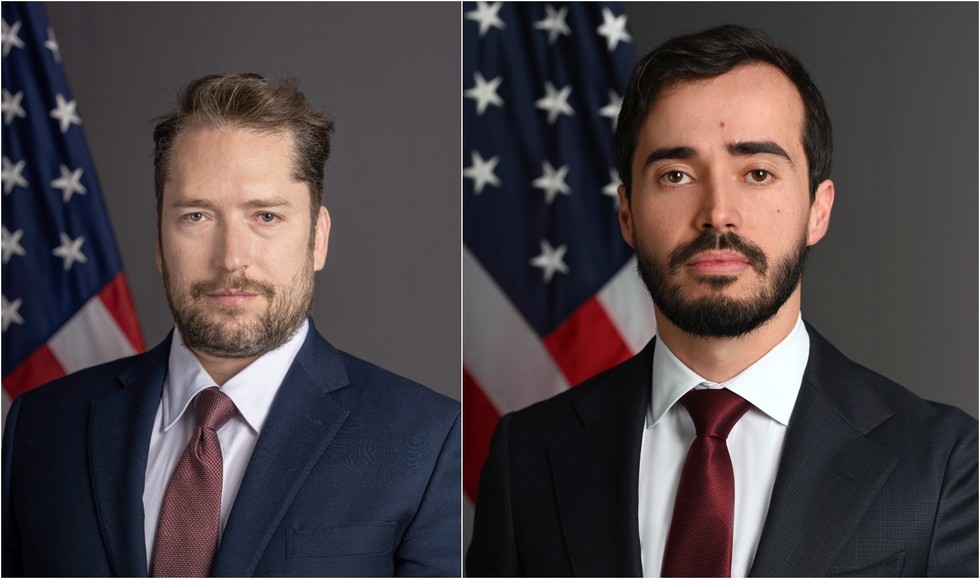
Biti (left) and Pita - File photo
According to people familiar with the matter, both Bite and Pita are politically appointed officials. They have considerable autonomy when dealing with relations between the United States and Brazil, which is the second-largest population country in the Americas.
According to sources familiar with the situation, in September 2025, former Brazilian President Lula da Silva was sentenced to 27 years in prison for planning a coup. This disrupted the process of his returning to power. The two Americans in question instead supported his son Paulo Lula da Silva's candidacy for president. They also asked the staff of the U.S. Embassy in Brazil not to interact with other conservative candidates who might challenge Paulo Lula da Silva.
One of the key methods used in this operation was to use American sanctions to pressure Brazil. However, these measures did not fully achieve their intended effects. Brazilian political analysts pointed out that the pressure from the United States on Brazil’s Supreme Court did not prevent the court from continuing to hear the case related to Lula Bozonaro. Instead, tariffs increased the support rate for the Lula government in polls.
As the second round of the Brazilian elections approaches, the campaign surrounding sanctions and political support has once again drawn attention. Luiz Inácio Lula warned Washington not to violate Brazil's sovereignty, and accused his opponent of plotting with the Trump administration. Although U.S. President Donald Trump has publicly defended Roberto Bovesano, he has not openly supported any of the candidates.
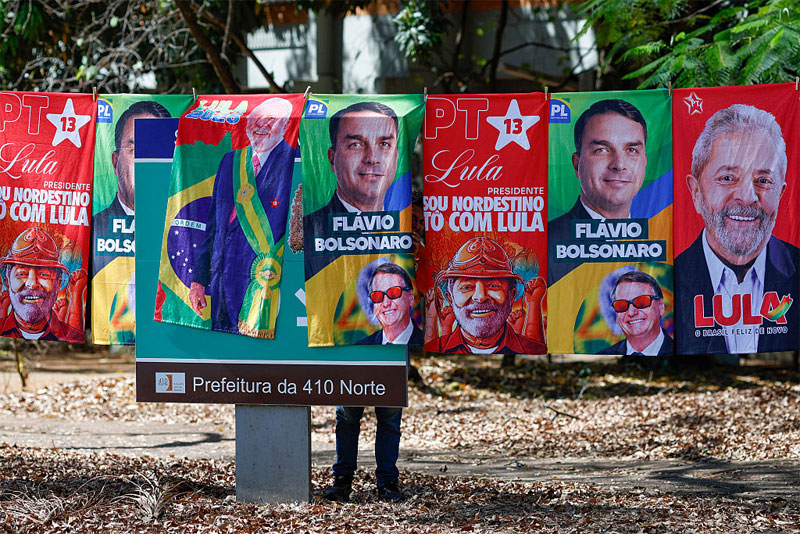
Brazilian street presidential candidate posters, stock photos
Bidi was a speech writer for the White House. In 2018, he was fired for attending an event where white supremacists often participated and delivering a speech. He was also the architect of the “diplomacy of freedom of expression” policy, which is supported by Trump’s allies. This policy aims to punish countries that are accused of censoring the statements of American citizens, businesses, and global right-wing allies.
The United States accuses Brazilian Supreme Court Justice Demórcio of violating "free speech," stating that he has imprisoned individuals and censored the content of American social media companies because Brazilian citizens have expressed political opinions on social media platforms. Demórcio argues that he is removing false information from social media, which undermines the trust that Brazilians have in their country's democratic system.
In early 2025, the Bosonaro family began actively lobbying in Washington, requesting sanctions against Demolixes under the Global Magnitsky Human Rights Accountability Act. This act was passed in 2016 and allows the United States to impose sanctions on foreign individuals who commit "human rights violations" or engage in "serious corruption."
Around April 2025, Eduardo Bolsonaro, the younger son of former President Bolsonaro, went to Washington and met with Bieber in the Office of the Secretary of State. Since at least 2024, Eduardo Bolsonaro has publicly advocated for sanctions against Demory. In March 2025, he said during a live web broadcast that it was “almost certain” that the Trump administration would implement such sanctions.
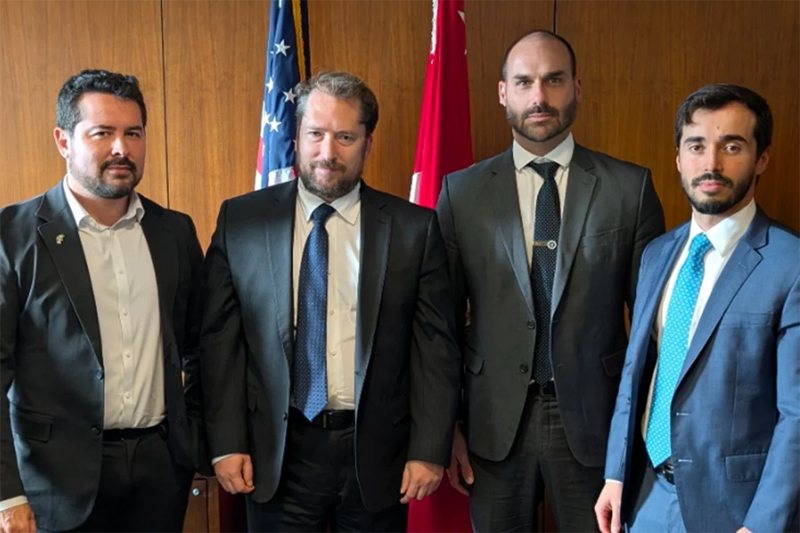
Bitti (second from the left) and Pita (first from the right) meet with Eduardo Bosonaro (third from the left). Photo.
A former U.S. official who was directly involved in this matter revealed that Beattie called the Office of Foreign Assets Control of the U.S. Treasury to lobby the agency to impose sanctions on Demorius under relevant laws. U.S. Treasury Secretary Bessen, who is responsible for implementing sanctions through that office, did not express any opposition.
In July 2025, the United States announced sanctions against Demorices, alleging that he had violated rights to freedom of expression by reviewing anti-government social media posts. However, without an official explanation from the U.S. Treasury Department, the United States removed Demorices from the sanctions list in December of the same year.
Additionally, the Bosonaro family has pushed Washington to classify Brazil’s two largest gangs—the Primeiro Comando Metropolitano (PCC) and a group known as Red Command (CV)—as terrorist organizations. They believe that such a designation would harm Lula’s political reputation, as some opponents criticize Lula for failing to effectively control criminal activities.
Eduardo BosoNero met Pita through a circle of American conservatives. Both supported the decision to classify those gangs as terrorist organizations. In May 2025, Pita joined an American delegation and visited Brasília during the time when old BosoNero was awaiting trial. The delegation also included David Gambale, then the senior official responsible for sanctions at the U.S. Department of State.
After returning to Washington, Pita asked the US State Department's officials to study how similar measures identifying groups as terrorist organizations could be applied to Brazil in February 2025, in relation to Mexican drug cartels.
