For the second consecutive weekend, large-scale demonstrations erupted in France. On October 24th, approximately 410,000 people took to the streets to protest against rising living costs, social inequality, and the government's economic policies. Although French President Emmanuel Macron had previously announced restrictions on gatherings, authorities deployed 70,000 police and gendarmes to maintain order. Nevertheless, clashes between police and civilians occurred in cities such as Paris and Marseille, with nearly a thousand people arrested. To prevent riots, several museums, including the Louvre in Paris, were closed that day, preventing visitors from seeing the Mona Lisa.
On the same day, Italian, Spanish, Portugal and Albania among European countries also held protests.
According to reports by Reuters, CNN, and other media on October 24th, the French Interior Ministry reported that approximately 410,000 people participated in protests nationwide that day, with around 110,000 in Paris. The French General Confederation of Labour (CGT) estimated that nearly 800,000 people participated across the country.
On that day, demonstrations took place in several cities in France. The protests in Paris were initially peaceful, but after the event, some masked individuals clashed with the police. Approximately 500 masked individuals threw stones and other objects at the police, and riot police then used tear gas and water cannons to disperse the crowd.
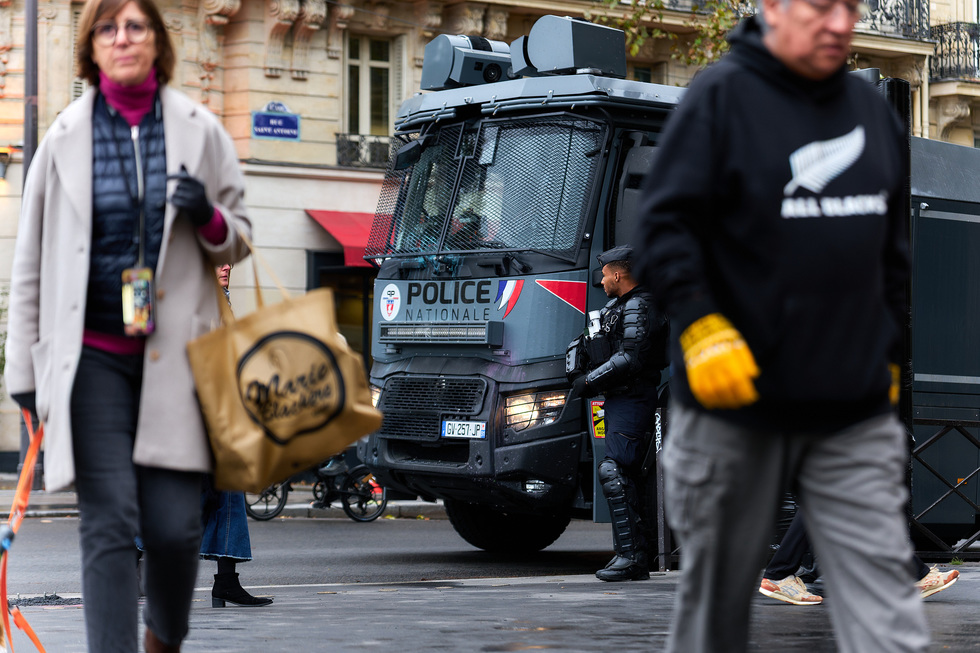
On October 24th, in Paris, France, police officers wearing protective gear stood in front of water cannon vehicles owned by the French National Police, with protective bars installed on the windshields. Visual China.
In Marseille, the second-largest city in France, some people used large metal plates to block roads, burned garbage cans, and threw stones and bottles at the police. The police reported that several shops, including two jewelry stores, were robbed. Conflicts also occurred in cities such as Lyon and Bordeaux, with varying degrees of violence.
French Interior Minister Laurent Nuñez said on the evening of the 24th that nearly 1,000 people were arrested across the country that day. He stated that most of the protests were peaceful, but some police officers encountered severe violent acts. Compared to the 17th, the number of violent incidents that day had decreased.
In the face of ongoing protests, Macron had previously announced tightening restrictions on gatherings.
According to a report by Reuters on October 22, Emmanuel Macron said after meeting with the head of intelligence agencies and senior government officials that certain so-called 'illegal' protests would be prohibited in the coming days. He accused extreme leftist groups of being involved in the previous riots, stating that these individuals had carried out political and insurgent activities aimed at 'overthrowing the republic'.
Macron said that demonstrations organized by unions can continue, but the government may adjust the route of the parade to protect commercial areas and public buildings. For other gatherings that do not comply with regulations, local governments will impose restrictions.
After admitting that they underestimated the scale of the riots on October 17th, French authorities deployed about 70,000 police and military officers on the 24th, which is an increase of about 10,000 compared to the previous week.
Núñez said that the level of violence on the 24th was less severe compared to the large-scale robberies and destruction that occurred last weekend. He also mentioned that far-right activists tried to provoke clashes with left-wing groups in the southern French cities of Nice and Montpellier.
In the center of Paris, extensive security measures were implemented. Many shops sealed their windows with wooden boards in advance, over 20 subway stations were closed, and the main parade routes were adjusted to avoid the commercial areas in the southeast of Paris.
During the riots on October 17th, hundreds of shops in France were vandalized or robbed. As a result, French business associations urged retailers to continue suspending their operations during the next round of demonstrations.
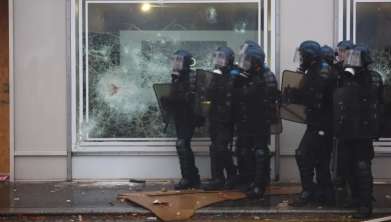
French Civil Police at a shopfront in Paris, Reuters
According to Reuters report on the 24th, some brand stores on the Champs-Élysées in Paris have posted notices indicating that they will close. Many luxury stores near Place Vendôme have also chosen to shut down, and some major luxury brands have increased security at their stores.
"Almost no customers, so it's not worth opening a shop." A Kiton boutique store manager in Paris said.
The protest activities also affected tourism in Paris.
According to Reuters reporting on the 24th, several cultural venues such as the Louvre Museum, the Musée d'Orsay, the Orange Garden Art Museum, and the Picasso Museum were closed that day. The Du Leray Garden was also sealed off. The Paris Opera House closed the Garnier Palace and the Bastille Opera House, and the Paris Basel Art Exhibition canceled its weekend events.

