Just as Indonesia’s energy minister announced that it would consider cutting energy exports to countries that don’t respect Indonesia, soon after, Singapore’s natural gas supply was cut off.
Just at this time, the two countries are having conflicts over issues such as cross-border smog. Is Indonesia trying to use natural gas as a means of pressure? There is a lot of speculation in the outside world.
Singapore Prime Minister Wong Kan Seng publicly stated on the 25th that commercial contracts must be respected. However, Indonesian Energy Minister Bachriel bluntly retorted on the 26th: "Don’t teach Indonesia how to respect contracts."
Not only that, when it comes to whether Singapore will continue to export green electricity in the future, Bachir also said, "It depends on how Singapore performs."
What exactly is going on with this dispute regarding energy supply?
On October 25, Huang Xuncai stated at the People’s Action Party conference that approximately 95% of Singapore’s electricity is generated from natural gas, and Indonesia has always been an important supplier. He asked all parties involved to abide by the commercial contracts, and said that Singapore’s natural gas importers will take necessary measures to protect their own interests.
Singapore's Minister for Energy and Industrial Affairs, Chen Shilong, further explained on the same day that the affected importers include Gas Supply, a wholly-owned subsidiary of Temasek. The company will verify with Indonesian suppliers whether the reduction in supply constitutes a breach of contract. If a breach is confirmed, they will seek appropriate commercial remedies.
Singapore’s largest opposition party, the Workers' Party, also issued a statement on the evening of the 25th, supporting the government in protecting contract rights.
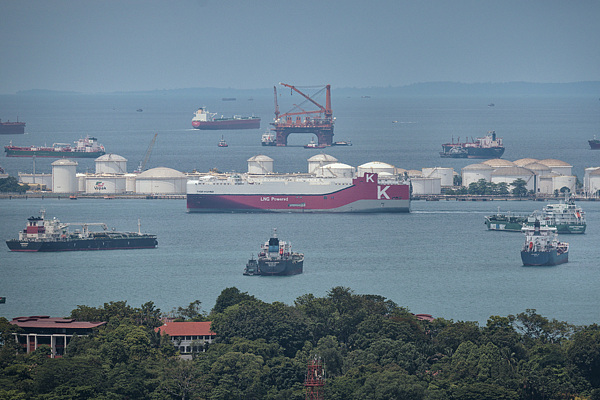
April 6, 2026, Singapore. A liquefied natural gas (LNG) transport ship was sailing near the storage dock at Sabablock Island in the Singapore Strait. Visual China
The Workers' Party also mentioned a rather sensitive issue: if Indonesia's reduction in supply is caused by other unrelated events, the party expressed its regret. However, the Workers' Party also admitted that there has been a trend of gradual reduction in Indonesia's natural gas supply to Singapore.
In response to the statements made by Singapore, Bacharil responded at a press conference held in Jakarta on the 26th.
According to the Indonesian Antara News Agency, he said that Indonesia's reduction in supply by about 8% is still within the scope permitted by the contract.
We only reduced it by about 8%. Only when the reduction of supply reaches 10% will a breach of contract occur, he said.
Bachriel emphasized that Indonesia respects the contracts that have been signed, but mutual respect cannot be imposed on one side alone. He also argued, “Don’t teach Indonesia how to fulfill and respect the contracts.”
According to Bachriel's explanation, this adjustment is related both to the maintenance of natural gas facilities and to the growth in domestic demand in Indonesia.
When asked by reporters whether this reduction in supply was related to the controversy that occurred in Singapore, Bachir repeatedly denied: “There is no conflict, there is no conflict.”
Just before the contract dispute arose, Bahir-il issued repeated warnings.
On October 21, he stated that Indonesia is considering ending some natural gas export contracts to neighboring countries. The reason is that there is a growing demand for energy within the country, and it is necessary to prioritize securing domestic supplies.
On the 22nd, Bachriel further stated: “I will consider stopping exports without hesitation against countries that do not respect Indonesia.”
He did not name any country. But the next day, Indonesia announced a reduction in its natural gas supply to Singapore.
According to the Antara news agency in Indonesia, Siko Siswanto, head of the Indonesian upstream oil and gas regulatory agency SKK Migas, announced on the evening of the 23rd that starting from the 24th, part of the natural gas that was originally exported to Singapore will be supplied domestically.
In the Natuna region, about 420,000 cubic meters of gas is supplied to Singapore daily, and this gas is instead used to supply Batam Island. In the Sumatra region, about 450,000 cubic meters of gas are supplied daily to meet the power generation needs of Batam Island, Penang Island, and Sumatra.
In total, Indonesia will supply about 880,000 cubic meters of natural gas to Singapore each day.
There is another notable detail regarding this reduction in supply: only Singapore has been affected.
When asked if there were other countries affected, Joko replied clearly: “No other countries. Because these pipelines only lead to Singapore.”
Zoeko explained that the adjustment is aimed at ensuring the supply of gas for power generation in Indonesia, in line with the country's legal requirements to prioritize the supply of domestic natural gas.
Keeping more natural gas in the country is not something that Indonesia has decided on suddenly. In recent years, as domestic energy demand has increased, Indonesia has been promoting efforts to reduce natural gas exports. In 2022, Indonesia and Singapore agreed to extend the gas supply contract until 2028, but the volume of supplies has decreased compared to before.
Just this time, Indonesia's decision came suddenly.
According to a report by Jakarta Post on the 25th, some analysts questioned whether the scaled-down supply of natural gas to domestic use would be sufficient to alleviate Indonesia’s energy shortage. Additionally, the sudden adjustment of export supplies could also affect Indonesia’s reputation as a reliable trading partner.
Some people within the Indonesian energy industry have also raised questions. According to a report by Indonesia's Bloomberg Technology News Network on the 26th, Moshe Rizalar, chairman of the Investment Committee of the National Oil and Gas Enterprises Association of Indonesia, said that the government needs to clarify whether the cut in natural gas belongs to the government’s share or the oil and gas enterprises’ share. Otherwise, it could lead to legal and financial uncertainties.
According to information provided by the Singapore Energy Market Authority, the reduction in supply is expected to last for 18 days. The affected supply will be less than 2% of Singapore’s daily natural gas demand for power generation.
Singapore also has other sources of gas supply. By 2025, about 43% of its natural gas imports will come from pipelines connecting Indonesia and Malaysia, while the remaining 57% will be purchased from the international market for liquefied natural gas.
Chen Shilong said on the 25th that Singapore has sufficient alternative supplies, and it is expected that electricity prices will not be significantly affected in the short term.
On the 26th, Chen Shilong warned at a energy lecture in Singapore that some countries may prioritize meeting their own energy needs during periods of energy supply shortages, which could even affect existing commercial contracts. He referred to this trend as “resource nationalism,” arguing that it could increase business risks and hinder energy investment.
Chen Shilong stated that Singapore will continue to expand its energy import channels and increase its reserves. The country plans to launch a second liquefied natural gas receiving station by 2030, at which point the liquefied natural gas processing capacity will increase by 50%.
However, in addition to natural gas, there is also larger-scale energy cooperation between the two countries that is currently underway.
According to a report by The Strait Times on the 26th, Indonesia and Singapore are currently negotiating the export of electricity from Indonesia to Singapore. There are still differences between the two sides regarding the price issue. Singapore has granted conditional licenses for six Indonesian power import projects, with a total capacity of 3 gigawatts.
But the controversy over reduced natural gas supply has not yet subsided, so Bachir shifted the topic to this power export plan again.
He stated on the 26th that Indonesia is re-evaluating its plan to export green energy to Singapore, and it is unlikely to progress in the near future.
When asked whether this plan could continue, he also said meaningfully, “It depends on how well (Singapore) performs.”
But Bahriel did not provide specific explanations for the criteria used to determine whether a performance was good or not, and nor did he announce the cancellation of any related projects.
Singapore Asia News Channel (CNA) quoted David Brodshock, the chief energy economist at the National University of Singapore's Energy Research Institute, on the 26th. He said that if more and more countries prioritize meeting their domestic energy needs, Singapore may need to reconsider its reliance on natural gas imports, as well as evaluate its dependence on regional low-carbon electricity imports.
Before the reduction in natural gas supply, Indonesia and Singapore had already been at odds due to other issues.
The most direct controversy comes from cross-border smog.
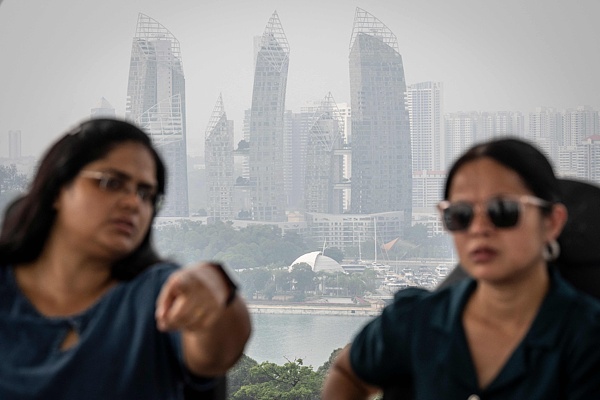
Indonesian forest fires lead to continuous smog in Singapore, causing citizens to wear masks when traveling. Visual China
Recently, fires in forests and peatlands in Sumatra and Kalimantan in Indonesia have caused heavy smoke pollution, affecting neighboring countries such as Singapore and Malaysia.
The Singapore government, in accordance with the Cross-Border Smoke and Pollution Law, has requested information from 20 companies involved in land management activities in Indonesia to investigate whether these companies are involved in smoke and pollution issues. Among them, 10 are registered in Singapore, and the other 10 are Indonesian companies.
Indonesia is also dissatisfied with the criticism from neighboring countries. On October 21, Indonesian President Prabowo criticized certain countries for their tendency to insult Indonesia, but did not name any specific countries.
The issue of smoke and haze continues to lead to calls for boycotting Indonesian products in Malaysia.
According to a report in the Straits Times on the 25th, some Malaysian citizens are dissatisfied with the continuous cross-border haze in Indonesia and have called for an end to the purchase of Indonesian goods. Indonesian officials' previous statements about Malaysia obtaining oxygen from Indonesian forests have further upset some local netizens.
However, Malaysian economist Balchoi Balde reminds that outright boycotting Indonesian goods may not force the companies responsible for the forest fires to pay a price. Instead, it could harm the economic interests that are intertwined between the two countries.
There is another dispute between the Indians and the New Yorkers.
On October 20th, former Indonesian Trade Minister Muhammad Lutfi accused social media platforms of being used by Singaporean investment firms Temasek and GIC to influence the classification decisions of the international index compiler MSCI regarding Indonesia's stock market. The aim was to take advantage of declining market prices and buy Indonesian assets at low prices.
Luttfy did not provide any evidence to support this accusation. On the 21st, Temasek and GIC both denied the accusations. Temasek stated that the accusations were baseless, while GIC said that its investment decisions were based on the fundamentals of the companies and assets, rather than market index classifications.
Regarding the recent series of controversies, some economists in Indonesia have begun to worry that if relations between the two sides continue to be tense, Indonesia may have to pay a greater price.
Indonesian economic research institution CORE economist Yusuf Lendy Manilet pointed out that Singapore is one of Indonesia's largest sources of foreign investment. If relations between the two countries deteriorate, Singapore may not openly take trade retaliation measures, but investors may delay their expansion plans in Indonesia or shift their funds to other countries.
He also mentioned that in the first half of 2026, Indonesia’s pipeline natural gas exports to Singapore reached $2.28 billion, which accounted for approximately 58.14% of Indonesia’s oil and gas exports to ASEAN during the same period. Although the reduction in supply is limited, linking energy supply contracts with diplomatic disputes may lead investors to question the stability of Indonesia’s commercial contracts.
Yusuf believes that Indonesia reducing natural gas exports and prioritizing domestic industrial needs is not economically unreasonable. However, this requires domestic buyers, gas pipelines, and related industries to be prepared and able to fully utilize the increased supply.
"If these conditions are not ready, we may lose foreign exchange income but without the corresponding economic gains." he said.
