According to a report by the British 'Financial Times' on June 13, the EU is attempting to draft trade agreements in English alone, hoping to speed up the negotiation process. This move has sparked strong resistance from France and Italy. These two countries are opposing the growing tendency towards Englishization within the EU.
According to five people familiar with the matter, Maroš Šefić, a commissioner of the European Commission responsible for trade and economic security, told ministers of member states last month that he would propose to prepare all agreements recently reached between the EU and Indonesia solely in English, including detailed 'legal drafting'.
According to reports, this process typically takes up to two years, as every change must be agreed upon and become effective in all 24 official languages of the European Union.
The Slovakian native, Shevjovich, stated that he intends to use English for the translation of the final agreement, thereby reducing the process to one year. Shevjovich believes that multilingual workflows have delayed the benefits brought by trade agreements, hindering the development of European economy.
He said earlier this year to reporters: “If we evaluate how much money this lengthy process will cost us, I think—especially in this unstable world—this is a price we can no longer afford.”
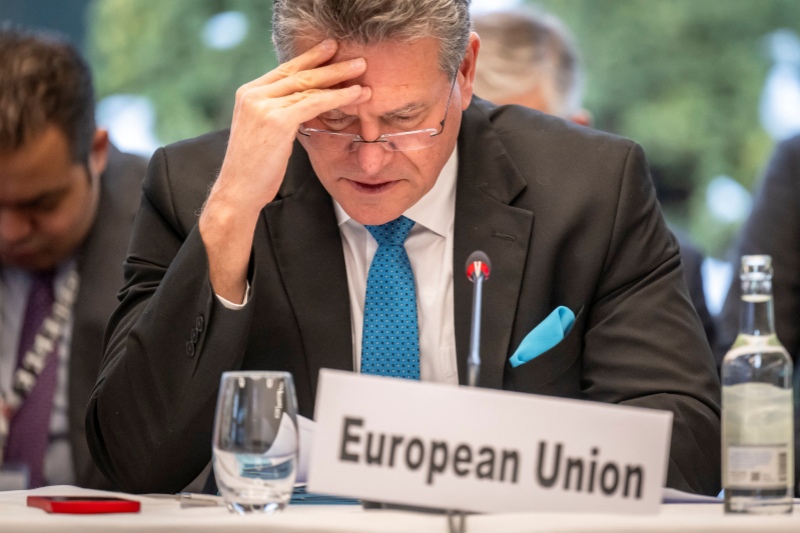
Maroš Šefić IC Photo
Shafajović mentioned the free trade agreement signed between the EU and the Southern Common Market in January this year. According to a report by the European Centre for International Political Economy Research (ECIPE), every year that the implementation of this agreement is delayed, the EU loses more than 50 billion euros in GDP growth.
Shevkovic said that his idea has gained "widespread consensus" among member states.
A European Union diplomat said: “We support this approach. We hope that EU companies can gain market opportunities sooner from trade agreements. This is a major priority for most member states.”
However, according to people familiar with the matter, France and Italy have raised objections on constitutional grounds.
This concerns the French constitution. France cannot be bound by an illegal draft text, and it cannot make any commitments to such a text. A French official said this.
An official revealed that Italy’s constitution also has similar restrictions. People familiar with the matter said that those who oppose drafting trade agreements in English are also worried that this could undermine the EU’s legal commitment to multilingual use.
English, French, and German are the three languages most commonly used by EU agencies in their daily work.
However, according to the EU Charter of Fundamental Rights, EU citizens have the right to communicate with EU institutions in any of the 24 official languages, and EU institutions must also respond in the same language. Additionally, legal documents must be provided in all EU official languages, and leaders and the Council of Ministers must also provide simultaneous interpretation in all languages.
Since the significant eastward expansion of the European Union in 2004, the use of English has increased, as there are more people who speak English as a second language in countries like Poland and Czech Republic than those who speak French as their second language.
A spokesperson for the European Union Commission stated that the Brussels side “is highly focused on pushing forward our free trade agreement as soon as possible” and added that “Mr. Šefčovič has a very clear and consistent position on this issue.”
The spokesperson added: “In complex international negotiations, it is common practice to use a single universal language during legal technical reviews. This does not affect or skip the legal procedure of translating the agreement into all 24 official languages of the European Union.”
"We always adhere to EU law requirements and fully respect our agency permissions and democratic oversight procedures." said the speaker.