Chinas breakthroughs in the United States. On June 2, US media outlet Bloomberg described how the Trump administration granted exemptions to Volvo Cars, allowing it to continue importing and selling Chinese cars in the United States.
The report suggests that this surprising decision not only gives Volvo a chance to breathe again, but also opens the way for other Chinese-owned car companies and Chinese automakers to enter the U.S. market.
In recent years, with the rapid rise of Chinas automotive industry, the U.S. government has continuously increased its restrictions, attempting to keep Chinese vehicles out of the U.S. market. The Biden administration has set up two major obstacles: first, import tariffs as high as 100%; second, bans on software and hardware systems developed or maintained by Chinese companies, under the pretext of national security.
VOLVO is a Swedish automobile brand, but its major shareholder is GAC Group from China. Therefore, it is subject to certain regulations. However, last week, the company announced that it has received an exemption from the U.S. government.
In Bloombergs view, this exemption not only allowed Volvo to circumvent the latter ban, but also set an important precedent for its parent company Geely in seeking similar treatment in the future. It also provided other Chinese automakers with new ways to bypass the obstacles set by American legislators.
Currently, Volvo produces the EX90 and Polestar 3 SUVs at its factory in South Carolina. Both models use similar platform architectures. According to American media reports, as restrictions on connected vehicles are gradually lifted, Geely has every reason to claim that its other models also use the same software, hardware, and technical platforms, thereby requesting similar exemptions.
Volvos President and CEO, Hakan Samuelsson, stated in April that the factory in South Carolina has the capacity for further expansion, allowing it to produce Geely cars.
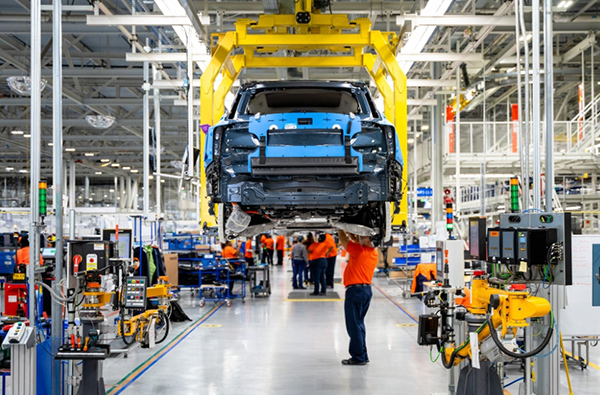
Volvos Plant in South Carolina – Volvo Website
Stephen Dyer, Head of Automotive and Industrial Products Consulting at IRENAP Asia-Pacific, Partner, and Managing Director, believes that the Volvo case also serves as a reference for other Chinese automakers. Companies can meet the so-called national security requirements set by US regulators by establishing entities that are independent from their Chinese parent companies, or by undergoing technical reviews.
In this regard, TikToks experience is considered to be of great value. In January this year, TikTok announced the establishment of a joint venture, thereby enabling it to continue operating in the United States. Analysts believe that Chinese automakers may also use similar models to establish new companies with low or no Chinese capital ownership in the US, in order to localize the development and operation of Chinese technologies, thereby meeting US regulatory requirements.
More importantly, American consumers interest in Chinese cars is also continuing to rise. The consulting firm Dave Cantin Group noticed this last summer: Americans showed a strong interest in Chinese cars that are priced competitively, with average prices approaching $50,000 per vehicle.
According to a survey released by Cox Automotive in February this year, nearly 40% of American drivers said they highly likely or very likely to consider purchasing cars from Chinese brands. Among the Generation Z consumers, who place greater emphasis on cost-effectiveness, this proportion rises to 69%.
The Trump administration has not publicly explained the specific reasons for granting exemptions to Volvo. However, reports indicate that the companys plant in South Carolina has invested a total of $1.3 billion, creating around 2,000 jobs. These are important factors that cannot be ignored. Trump previously stated that he welcomes Chinese companies to build factories in the United States and hire American workers.
However, there is a clear disagreement between this position and that of Congress. Recently, American lawmakers have proposed several measures to restrict the sale of Chinese cars.
In May, Michigan Democratic Representative Debbie Dingel and the Chairman of the House Committee on China Issues, Republican Congressman John Muellerner, proposed a bill that would officially incorporate existing restrictions on connected vehicles into the law. This would help prevent future changes in U.S. government policies.
Senator Elizabeth Slaughter from Michigan, a Democrat, and Senator Bernie Morrell from Ohio, a Republican, are working together to introduce a bipartisan bill. This bill aims to ban the production, import, sale, or resale of connected vehicles, software, and hardware products related to China and other foreign adversaries, under the pretext of concerns regarding data security.
According to a report by the American Consumer News & Business Channel (CNBC) at the end of May, Brett Guthrie, chairman of the House Committee on Energy and Commerce and a Republican representative from Kentucky, is proposing a new bill aimed at restricting Chinese companies participation in the U.S. automotive market.
Nevertheless, Bloomberg states that, as demonstrated by the TikTok case, even the most complex legal or political disputes can be resolved if the commercial interests are significant enough. Now, this precedent has been established, and they will do everything in their power to seize this opportunity.
Regarding the USs actions to suppress Chinese automobiles, the Chinese Ministry of Foreign Affairs has stated that the USs attempt to politicize economic and trade issues will only hinder the development of the US automobile industry. We urge the US to respect the laws of a market economy and the principles of fair competition. It should also stop using the concept of national security in a generalized manner, stop discriminating against and suppressing Chinese enterprises, and truly maintain an open, fair, and non-discriminatory business environment.