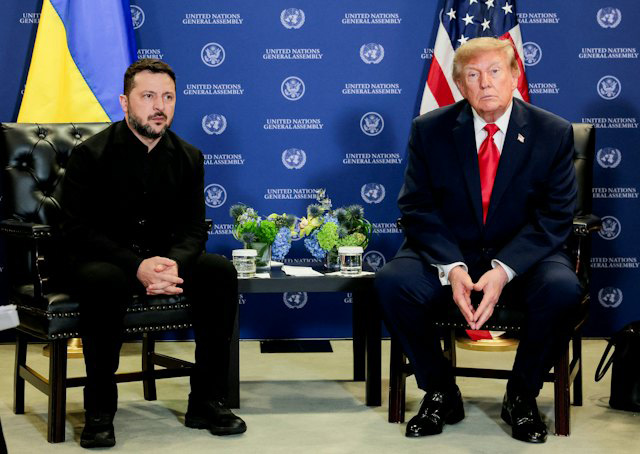
Recently, terms such as “ceasefire,” “freeze the front line,” and “restart negotiations” have once again frequently appeared in various diplomatic contexts related to the Ukraine war. The conflict between Russia and Ukraine, which has lasted for over four years, seems to be showing signs of a turning point.
In late October, U.S. President's Special Envoy Weterkov held successive meetings with Russian and Ukrainian leaders. Russia agreed in principle to resume tripartite talks between Russia, the United States, and Ukraine after November 10. Ukraine expressed its support for starting negotiations as soon as possible and suggested freezing the current conflict lines to cool down the situation. Meanwhile, Trump declared that the goal of ending the conflict was “never been so close.”
These statements have injected new hope into the negotiations that have been stuck in stalemate for too long. However, the increase in negotiation efforts does not mean that peace conditions are ripe. While all parties are discussing the possibility of restarting talks, attacks between Russia and Ukraine continue, and there is no clear solution to fundamental issues such as territorial rights and security guarantees. The diplomatic rhetoric among the parties has become more moderate, but the situation on the battlefield remains unchanged. This is precisely the contradictory situation that exists at present.
Therefore, what really needs attention is not just whether Russia and Ukraine can sit down at the negotiating table again, but how much each side is willing to pay in order to achieve peace. A new round of diplomatic contacts may open up a window of ceasefire, or it could be just a temporary adjustment in the long-term process of war. As the optimism that "peace is near" grows rapidly, it becomes even more necessary for us to break through statements, examine interests, and determine whether this dawn leads to the end of war, or to another form of stalemate.
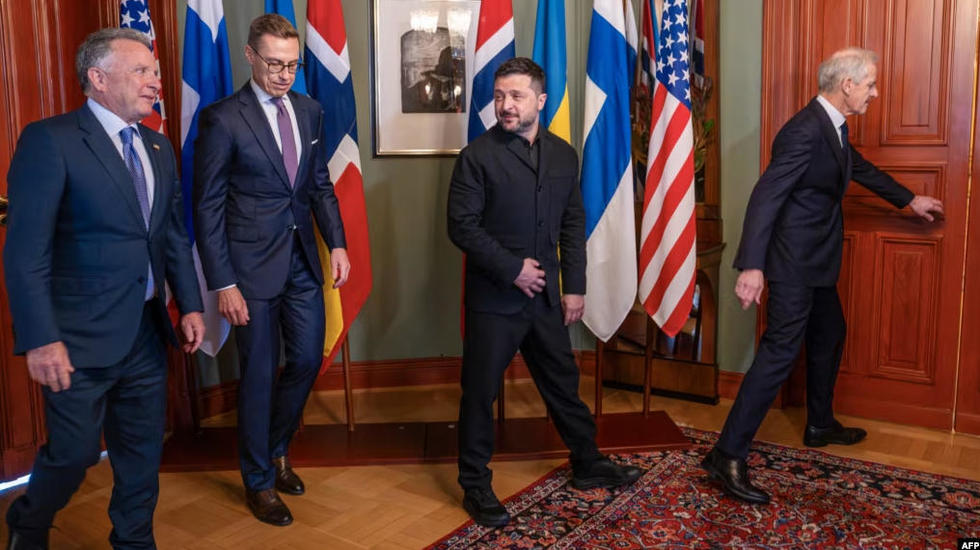
On October 20th, U.S. Special Envoy Weterkov, Finnish President Stubb, Ukrainian President Zelensky, and Norwegian Prime Minister Størrey entered the conference room in Oslo to discuss the situation in Ukraine.
Since October, the negotiations between Russia, Ukraine, and other parties have no longer remained at the level of general expressions of “willingness to dialogue”. Instead, there have been specific actions such as the movement of special envoys, the transmission of proposals, and the scheduling of meetings.
On October 20, U.S. President's Special Envoy Wheatcroft held talks in Oslo with Zelensky, Norwegian Prime Minister Stoltenberg, and Finnish President Stubb. The topics discussed included ceasefire, security guarantees, territory, post-war reconstruction, sanctions against Russia, and the European security order. The next day, he traveled to Saint Petersburg, where he had a meeting of about three hours with Putin at the Konstantin Palace. During the meeting, the U.S. submitted its proposal regarding the solution to the Ukraine issue.
Therefore, the United States attempts to first compile the opinions of the Ukrainian side into a formal document, and then discuss it with the Russian side. This way, the previously scattered diplomatic statements can be incorporated into an operational negotiation process. After the talks, Witkow returned to Oslo to inform Norway, while Kudza participated in the related meetings via video. The frequent back-and-forth indicates that the focus of this new round of negotiations is no longer just on exploring the positions of all parties, but on attempting to establish a negotiation framework led by the United States, with European participation, and involving indirect coordination between Russia and Ukraine.
Russia also sent a series of signals with the intention of cooperation. During his meeting with Witkov, Putin thanked Trump for paying attention to the issue of Ukraine and agreed in principle to resume three-way talks between Russia, the United States, and Ukraine after November 10th, to discuss the security arrangements for Russia after the conflict ends. At the same time, Russia released the American citizen Stephen Huber, who had been detained for many years. These actions do not yet prove that Russia has made concessions on territorial and security issues, but they indicate that Russia is willing to address the issue of Ukraine in conjunction with the easing of relations between Russia and the United States, as well as humanitarian matters and economic and trade cooperation. In other words, what Russia is currently showing is a willingness to resume contact.
In contrast, the changes in the position of the Kiev authorities are more apparent. Zelensky not only supported the holding of a trilateral meeting between the US, Russia, and Ukraine, as well as a “energy ceasefire,” but also gave a positive response to the proposal of “freezing the status quo and allowing Ukraine to retain 75% or more of its territory” during an interview with Fox News on October 21. He said, “We must freeze things now,” and described this as a realistic way to end the war. He also stated that after the ceasefire, security guarantees from the US and European allies would be necessary.
The next day, he further described the ceasefire as the "largest concession" that Ukraine can make at present. However, he still refused to withdraw unilaterally from cities controlled by Ukrainian forces such as Sloviansk and Kramatorsk, in accordance with Russian demands. Therefore, this new situation does not mean that Kiev authorities have simply accepted Russian conditions. Instead, they have begun to prioritize "where to stop first" over "how the final borders should be restored." The focus of negotiations has shifted from determining the final terms of the war to finding a "secondary option" that involves freezing the contact line and seeking external security protection.
This set of statements represents a significant shift from Zelenskyy’s previous stance. In November 2022, Ukraine proposed a ten-point “peace plan” that included restoring territorial integrity, the withdrawal of Russian troops, and the restoration of national borders. In July 2023, Zelenskyy made it clear that only if Ukrainian forces regain control of the borders, including Crimea, would Ukraine be ready for some form of diplomatic negotiations. At that time, the logic of Kiev authorities was that military gains must first change the balance of power before negotiations could confirm Ukraine’s victory. Now, their logic has shifted to “stop the war along existing contact lines, and then address security and subsequent political issues.”
Although the positions of the Kiev authorities have been adjusted in some ways in previous years, shifting from a stance that “restoration of the 1991 borders should be the premise for negotiations” to a stance that “the current lines can be frozen,” is still a significant change. It is difficult not to wonder whether this is a strategic compromise made to overcome immediate difficulties, or whether the Kiev authorities have really rethought their war objectives.
So, the characteristic of this new round of Russian-Ukrainian talks is that contact has been quickly restored, and the stance of Kiev authorities has changed very rapidly. However, the core positions are changing slowly. The US, Russia, and Ukraine have shown a high degree of agreement on the idea of “possible re-negotiations.” But there is still no consensus on “under what conditions these negotiations should be carried out.” The window for negotiations has reopened, but what has been opened is mainly the procedural aspects, not the door to reconciliation regarding territorial and security issues.
The dawn of peace has indeed begun to emerge, but what drove this dawn is not the sudden consensus reached by all parties on major issues such as territorial ownership and European security arrangements. Instead, it is the cost of war, external assistance, and political pressure within the country that have contributed to this development.
The United States, Russia, and Ukraine are all re-evaluating the costs of continuing the war against the benefits of restarting negotiations. The United States hopes to achieve visible diplomatic results as soon as possible. Russia aims to alleviate the long-term costs and expand its room for maneuver against the United States. The Kiev authorities, on the other hand, need to avoid further deterioration of the situation as they face increasing aid and military pressure. Therefore, this round of peace talks is first a coincidence under multiple pressures, and only then may it become a starting point towards genuine reconciliation.
For the United States, the midterm elections mean that the Russia-Ukraine issue is no longer just an diplomatic issue, but also becomes a burden that domestic politics must address as soon as possible. As the midterm elections on November 3rd approach, rising energy prices and pressures on living costs are combined. The Trump administration needs to lower oil prices, as well as prove to voters its ability to end a costly overseas war.