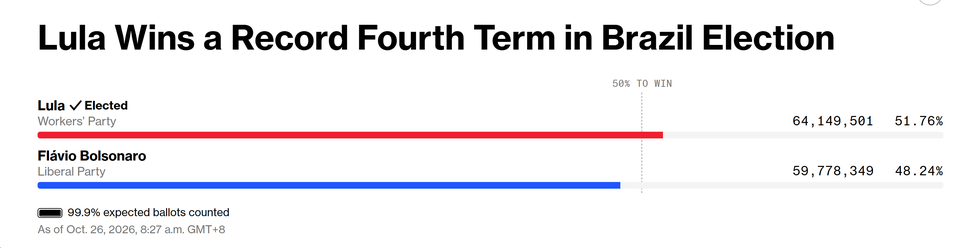
In just three weeks, Lula achieved a historic reversal, going from being behind by 2.22 million votes to leading by 4.43 million votes.
On October 25th, local time, the second round of voting for the Brazilian presidential election concluded. Luiz Inácio Lula obtained 51.79% of the valid votes, defeating Flavio Bolsonaro who received 48.21% of the votes. Lula thus became the first candidate since Brazil reverted to direct presidential elections in 1989 to achieve a reversal in the second round, despite being behind in the first round of voting.
Between the two candidates, Lu La gained about 10.38 million votes, while Flavio gained about 3.72 million votes. How was this turn of events possible?
Brazilian scholar Renato Peneluppi, director of the Brazilian Civil Committee in Beijing, and representative and coordinator of the Brazilian Labor Party in China, told Observer Network on the 26th that the first-round loss awakened supporters who originally thought Lula would win easily. The Labor Party also learned how to strengthen its online mobilization during the second-round election.
Ren Tu believes that Brazil's current public discussion and political communication are highly dependent on Western social media platforms. He calls for breaking the monopoly of these platforms. In addition to establishing Brazil's own communication platforms and social media, he also encourages platforms like WeChat, Bilibili, and REDnote to enter Brazil, thereby promoting market competition.
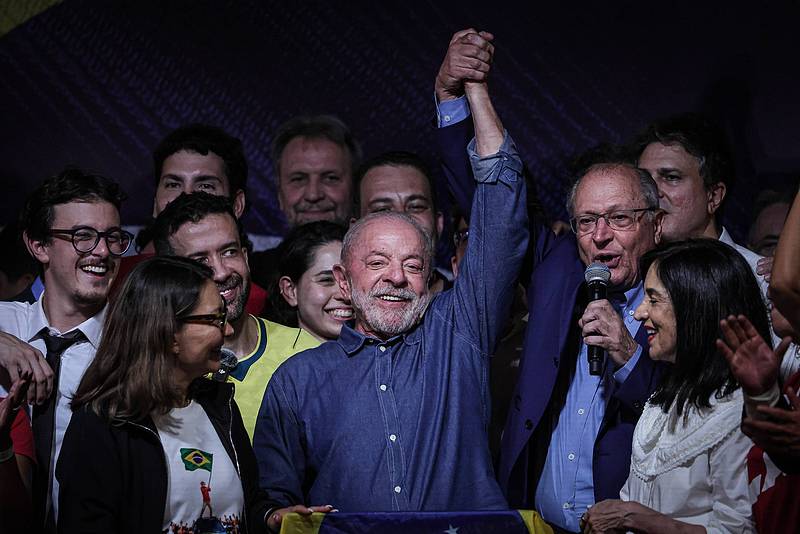
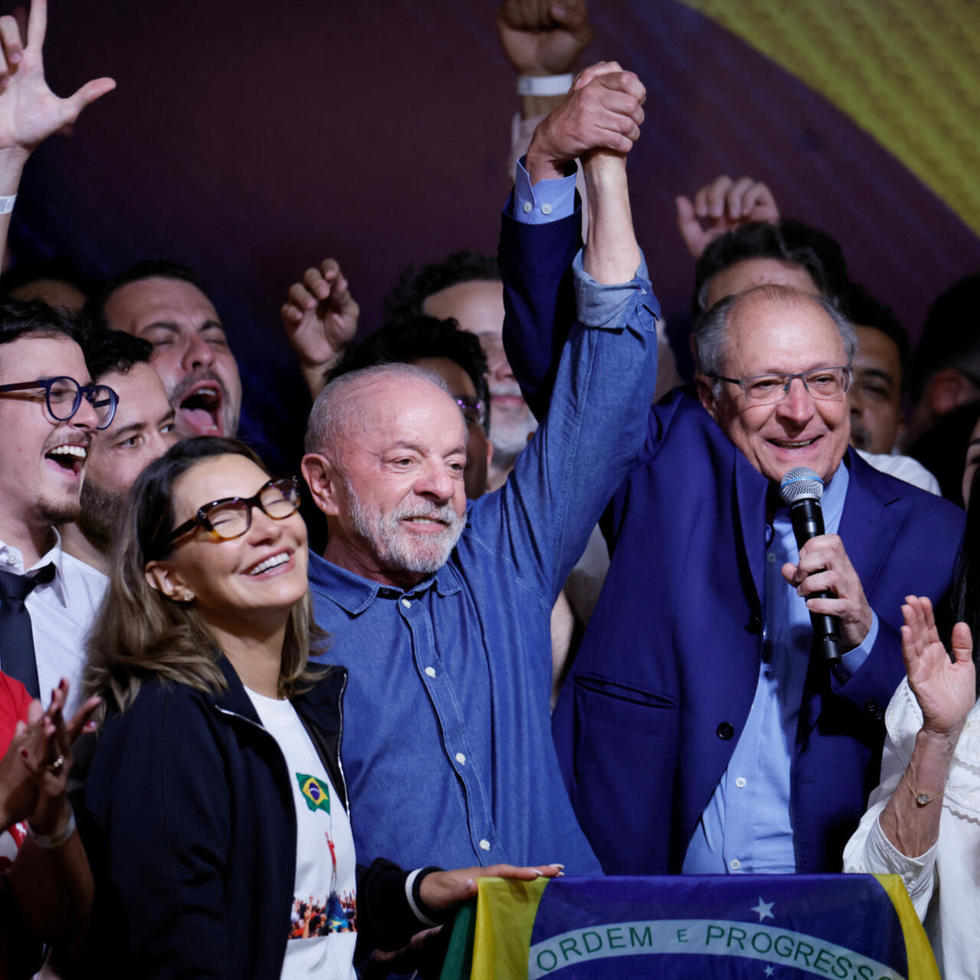
On October 25th local time, Brazilian President Luiz Inácio Lula attended a press conference to celebrate his successful re-election after winning the election. Visual China
According to Luiz Zarref, the Latin American coordinator of the International People's Cooperation Association (IAPC) and a member of the national coordination team of the Brazilian Rural Workers' Organization (MST), Flavio Bolsonaro and Lula both retained about 99% of their initial supporters.
Zarev pointed out that Flavio has held his base, but his ability to win additional votes is significantly weaker than Lula's.
Lula’s significant source of support is those who voted blank, invalid votes, or did not vote at all in the first round.
Zarev matched the results of two rounds of voting in all 5571 municipalities and 186 overseas cities in Brazil, and built a model to estimate the flow of votes. According to his calculations, about 84%-85% of voters who cast blank or invalid ballots switched their votes in the second round to support Lula, giving him a net advantage of about 5 million votes. In the poorest municipalities, this proportion reached 96%; in the richest municipalities, it was 80%.
Meanwhile, the abstention rate dropped from 21.08% in the first round to about 19.2%, and the number of voters increased by nearly 3 million. Zarev estimated that those who did not vote in the first round and went to the polls in the second round chose Lula more frequently, giving him a net advantage of about 1.5 million to 1.9 million votes.
In contrast, the votes supporting other candidates in the first round were distributed between the two candidates, and overall, it did not give Lula a net advantage.
CNN Spanish-language channel said that in Minas Gerais, the state with the second largest electorate in the United States, Lula was trailing by nearly 590,000 votes in the first round. However, he subsequently gained the lead by approximately 99,000 votes. The gap between the two candidates shifted by approximately 690,000 votes.
In São Paulo and Rio de Janeiro states, although Flavio Bolsonaro was ahead, Lula won the capitals of these two states—the two largest cities in Brazil—and turned the situation in Rio de Janeiro, where he was behind in the first round of voting. Additionally, Lula secured the support of all nine states in northeastern Brazil.
The report indicates that while not all of the new voters can be considered supporters of Lula, this highlights the importance of mobilizing those who previously did not vote.
Ren Tu told the Observer Network that before the first round of voting, many supporters thought Lula would win easily. The results of the first round made them realize that the civil rights and national sovereignty they valued might be at risk, and they needed to take action.
Ren Tu pointed out that concerns about the Bosonaro family returning to power, as well as demands for maintaining democratic rights and national autonomy, have become motivations for many Brazilians to get involved in the election campaign again.
Many people have seized this opportunity, traveling long distances between different cities, trying every possible way to reach the polling stations, so as to ensure they can preserve Brazil’s history and precious assets.
Beyond mobilizing supporters to go into voting stations, how to influence voter perception through social media is also a crucial aspect of the competition between the two sides.