On the evening of October 25th, the Houthi militia issued a statement stating that they used dozens of ballistic missiles to carry out three military operations against targets within Saudi Arabia: the first round targeted King Khalid International Airport in Riyadh; the second round targeted King Khalid Air Force Base in Haymitmusht; and the third round targeted the Coast Guard Base in Jizan.
In response, Saudi-led coalition forces announced on the 26th that they had destroyed 5 ballistic missile tunnels, 4 launch devices, and 1 missile storage facility in Houthi-controlled areas. There is now a “very clear cycle of offense and defense” between the two sides.
As this cycle of attacks and defenses continues to intensify, actions in London had already begun. On October 20th, British Defense Secretary Wes Streeting announced that the UK would assist in protecting Saudi airspace from drone and missile attacks. As of the 25th, no public information indicates that British fighter jets were involved in these interceptions.
According to China News Network on September 22, the UK has already dispatched an ‘Avenger’ refueling aircraft from its airbase in Cyprus to provide aerial refueling for Saudi fighter jets. In a statement on October 20, Stritling confirmed that this refueling mission will last for 90 days, and that the ‘Typhoon’ fighter jets will only carry out defensive air defense operations, without conducting offensive strikes against the Houthi militia.
As a former colonial ruler of Aden, Britain operated in the Arabian Peninsula and Yemen for nearly two centuries starting from the 19th century. Britain was well aware of how to maintain the option of intervening in regional affairs without directly getting involved in conflicts. Britain's policy of "defending rather than attacking" precisely reflects its consistent approach to intervention.
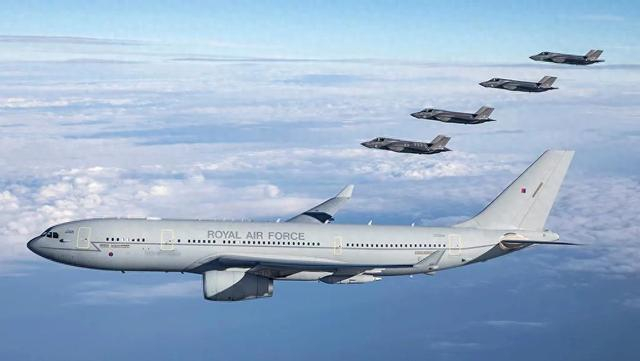
The British Royal Air Force's "Voyager" aircraft, modified from an Airbus A330 MRTT, is the main aircraft used for aerial refueling in the UK.
The British government is scheduled to announce its budget for 2026 on October 28. The issue of balancing fiscal discipline with defense spending should be subject to various constraints. At this point, military cooperation focused on air support and defensive operations has reduced the decision-making threshold for Britain to intervene, as direct involvement and operational risks are relatively manageable.
The assistance provided by the ‘Navigator’ refueling aircraft can extend the combat aircraft’s stay-in-air time and increase the frequency of attacks. For the UK, this approach involves exchanging equipment and support for influence. It avoids direct involvement in ground strikes while also helping Saudi Arabia mitigate the pressure of ongoing air defense and air superiority operations. Thus, the UK can achieve a balance between its own risks and military influence with relatively limited investment.
The British intervention this time is not just an isolated response to a crisis, but rather a continuation of long-term defense deals between the UK and Saudi Arabia. Both parties signed the Darwin Treaty during World War I, under which the UK promised financial support, weapons, and diplomatic recognition in exchange for Ibn Saud being able to contain the Ottoman forces in the region. During the civil war in North Yemen in 1966, Saudi Defense Minister Prince Sultan requested that the British Royal Air Force send an squadron on Saudi soil to show their support. The UK declined this request and instead provided only fighter planes and civilian pilots. Since then, the UK has preferred to avoid direct involvement in Saudi conflicts, while maintaining regional interests through military sales and personnel cooperation.
In 1985, Britain and Saudi Arabia signed the “Yamah Agreement” which was an oil-for-arms deal. This agreement led to decades of military sales. In 2007, Saudi Arabia purchased 72 “Typhoon” fighter jets for nearly 4.4 billion pounds. A memorandum of intent was signed in 2018 to purchase an additional 48 fighter jets, but this has yet to be finalized. Long-term supply, maintenance, training, parts supply, and upgrading contracts have turned Britain-Saudi defense cooperation into a long-term industrial partnership. Under the pressure of Saudi’s air defense system, Britain not only has the need for maintenance market cooperation but also the motivation to prove the value of its own equipment and support services.
On October 15, the United Nations Security Council adopted a statement by the President, condemning the attacks carried out by the Houthi militia against Saudi civil aviation and energy facilities. The statement reaffirmed Saudi Arabia’s right to self-defense under international law. Although the statement did not directly authorize Britain’s military intervention, it provided a diplomatic framework for London to expand defense support later on. The statement responded to Saudi security concerns with terms related to self-defense and protecting civilians, while also supporting the UN political process, thereby preserving Britain’s role as a mediator. As a result, Britain can use its military involvement as a platform for continued participation in setting agendas and mediating conflicts.
For the UK, the energy issue is undoubtedly a more direct real-world challenge. On October 20th, Striking said that the escalating situation in the Gulf region would increase living costs in the UK, disrupt energy supply, and raise business costs. After the Strait of Hormuz was blocked, the Houthi rebels announced the maritime blockade of Saudi ships in the Red Sea. The UK does not rely entirely on Saudi crude oil, but both key routes are under pressure. High oil prices and transportation costs will eventually affect ordinary British families and businesses.
On October 20th, U.S. Special Envoy Barack confirmed in Doha that Washington is providing logistical support to Saudi Arabia, but has refused any direct involvement on the ground and no longer attempts to solve all security issues for regional countries. For Saudi Arabia, U.S. support remains crucial. However, the intelligence sharing, target identification, and offensive planning currently provided by the U.S. do not fully meet Saudi Arabia's needs in terms of air defense. Additionally, U.S. strategic focus is tied to the political campaign in Iran, making direct involvement nearly impossible. Therefore, Saudi Arabia needs to retain U.S. support while finding ways to quickly strengthen its air defense capabilities.
On October 12, the Israeli newspaper “Haaretz” quoted relevant diplomatic sources stating that Israeli Prime Minister Benjamin Netanyahu, through U.S. mediation, tried to obtain Saudi approval for Israeli troops to participate in military operations against the Houla militant group. However, this attempt was rejected by the Saudi Crown Prince. Although Saudi Arabia did not confirm this, direct Israeli involvement could stimulate Iran and provide a pretext for further violent attacks by the Houla militants, thereby weakening Saudi Arabia’s initiative in regional issues. At this time, Saudi Arabia’s request for British intervention not only brings stronger military support but also does not directly touch upon the sensitive issue of relations between Saudi Arabia and Israel.
After signing the 'Mecca Common Defense Agreement' on August 7, Saudi Arabia, Turkey, and Pakistan decided to initiate collective defense measures on October 5, agreeing to accelerate the deployment of military forces according to approved arrangements. Turkish Defense Minister Halil, on September 24, stated that Turkey does not intend to engage in combat with the Houthi movement, and its support will mainly be defensive in nature. Pakistan has also made commitments for common defense, but the specific military forces and task assignments have not been made public yet. Egyptian President Morsy limited his support to defending Saudi territory and borders, and a related parliamentary vote was postponed until September 26. The promises from allies are far away, and immediate military support is particularly valuable for Saudi Arabia.
During the same period, France and Italy also deployed air defense and early warning forces publicly, but the scale of their deployments was still limited. The UK had already deployed Skyhawk air defense systems and assigned personnel to carry out defensive tasks in Saudi Arabia. The equipment and support networks did not need to be built from scratch. The expansion of new aid efforts further increased the efficiency of converting existing facilities.
Additionally, in the face of successive missile and drone attacks from the Houthi forces, Saudi Arabia's air interception capabilities are particularly important. According to an article by The Associated Press on the 11th, several Saudi officials stated that their air defense missiles are in urgent need of support. Moreover, a single ground air defense network is still insufficient to cover the vast territory of Saudi Arabia. As a mobile frontline defense force, British aircraft play a key role in providing early warning, logistics, and command systems, becoming a crucial pillar in sharing the interception burden.
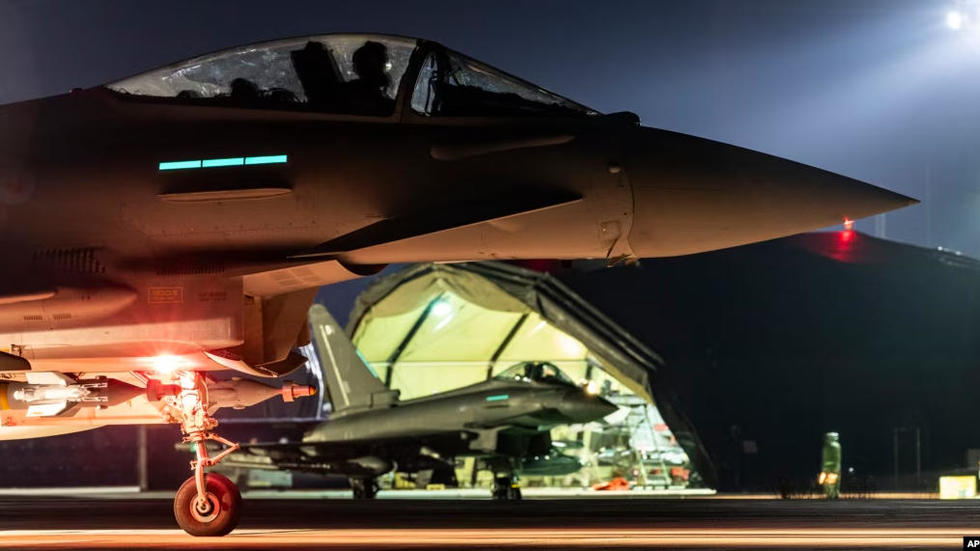
File photo: In this photograph provided by the British Ministry of Defence, a Royal Air Force Typhoon fighter jet is preparing to take off alongside other aircraft, ready to strike Houthi militant targets in Yemen. (February 24, 2024)
The maximum number of Typhoons that Britain can deploy is not high. The British Ministry of Defence has not yet announced the number of Typhoon aircraft, their bases, or the rules for engagement. The British Typhoon fleet also undertakes tasks such as air surveillance in the Baltic Sea and in the eastern part of NATO. The deployment of the fleet is already quite strained. Britain's real role is to address weaknesses in air defense, refueling support, logistical transportation, and staff coordination, rather than taking over Saudi defense. Its deployment does not indicate that Britain has the ability or willingness to send large-scale air and ground forces into the Yemen conflict.
From the current deployment situation, it is more likely that the UK will have control over the level of involvement. There are roughly three possible outcomes in the future. The first is for temporary deployments to become more regular. If the Houthi militia continues with its high-frequency attacks without causing casualties to British troops, the UK may still extend the fuel support for 90 days. If necessary, the UK may also adjust its fighter jets, military advisors, and air defense equipment to help Saudi Arabia maintain its air defense system functioning. At the same time, the UK will not carry out offensive strikes to reduce the risk of being dragged into an escalating conflict.
Secondly, there is the forced counterattack in the event of an emergency. If the Houthi forces carry out multiple attacks that result in casualties among British troops, significant civilian losses, or severe damage to key energy facilities, or even if British ships are attacked in the Red Sea, it could force Britain to redefine the concept of “defense.” Lord Krokh, the Minister of Defence, stated on October 20th that this operation to replenish supplies “could potentially target Houthi military targets.” In response to the escalating situation, it is very likely that Britain will increase ground air defense capabilities and coordinate efforts with the United States and France to carry out precise strikes against Houthi important facilities and high-value targets.
The third scenario is the downgrade of operations after a threat reduction. If the frequency of attacks between both sides decreases, and Saudi Arabia’s ground air defense capabilities are strengthened, Britain may decide to stop renewing its role as a refueling aircraft provider, and reduce the frequency of patrols of Typhoon fighter jets as well as the number of advisors deployed. However, for Britain to truly withdraw from Saudi Arabia, it will need help in getting Saudi Arabia back on the political track toward peace talks. Britain doesn’t have only fighter jets at its disposal; it also has political leverage to facilitate a ceasefire. Saudi Arabia understands that this is more effective than simply providing airpower in determining the future course of hostilities.