Multiple documents obtained by Reuters show that American political candidates are carefully designing their campaign materials to appeal to artificial intelligence (AI) chatbots, as more voters use these chatbots to inquire about various issues.
As AI becomes an increasingly important source of news, political campaigns must make greater efforts to control the content produced by AI. They should also become recommended sources for voters when they ask who is best at handling issues such as taxation, housing, and public safety. Some experts are concerned about the fact-checking and misinformation that AI can introduce during election campaigns.
According to the introduction, the charges for related services vary. Small-scale AI monitoring services cost several hundred dollars per month. If consulting services and media purchases are included, the costs can reach several thousand dollars per month.
A presentation presented a strategy to Mike Minner, the Republican candidate for governor of Massachusetts. The strategy aims to convince ChatGPT, Claude, Gemini, and other chatbots to present him as the top choice on key issues. This approach goes far beyond the traditional search engine optimization techniques used by U.S. candidates over the years.
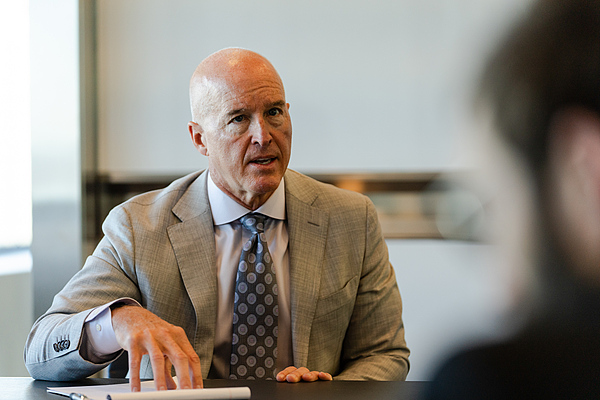
Massachusetts Republican State Senatorial Candidate Mike Miner Visual China
This strategy recommends that Minogue’s campaign team create hundreds of AI-friendly policy pages and quotes on websites frequently cited by AI chatbots. Additionally, the strategy proposes methods to track how major AI chatbots answer political questions and systematically modify their content until the answers reflect the candidate’s platform.
The core of this strategy is that, in addition to directly persuading voters, campaigns are increasingly able to shape the information environment by feeding data to the internet and AI assistants. This, in turn, affects the description, comparison, and recommendation of candidates.
New York-based creative strategy company Relentless Awareness’ managing partner Joe Bonilla, who has worked with companies and political candidates at the federal, state, and local levels in the United States, said: “Campaigns that utilize AI-powered influence training are now a reality we face. By the 2028 election cycle, which includes presidential elections, this will be ubiquitous.”
Bonilla said, "It becomes increasingly impossible for the public to distinguish which content is generated by systems like Claude and ChatGPT, and which content is created by humans."
The presentation mentioned Generative Engine Optimization (GEO), which is a successor to SEO in the AI era. It was stated that the company would purchase placement locations on highly authoritative websites that have already been referenced by AI models. Additionally, they would create content for YouTube and Reddit, and publish topic pages designed to be captured by chatbots.
The presentation also states that the campaign team must now strive to become a “recommended option in AI answers”.