Why does an American spend decades studying the values of Chinese people?
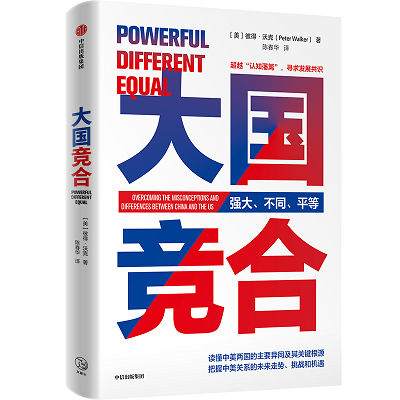
Former senior partner at McKinsey, Peter Walker, traveled frequently to China over a period of 15 years, visiting China more than 90 times. These experiences were later documented by him in his book "The Great Power Competition" (2019 edition).
After that, in order to understand the cultural forces behind China's economic development, he visited 94 Chinese families from different regions, social classes, and educational backgrounds. He wrote about these more everyday observations in a new book expected to be published next year. From big cities like Beijing and Shanghai to rural areas, from educated families to ordinary workers, he tried to answer a question: Do traditional values of diligence, self-improvement, emphasis on education, and family responsibilities still influence today's China?
This study led Walker to a clear conclusion: Chinese people and Americans share many fundamental human traits in common, but there are profound differences in how societies in both countries understand family, education, and personal responsibilities.
In his view, these differences do not mean that one social model is superior to another, but are closely related to each country's history and culture. However, as China's development continues to change the global economic landscape, is American society ready to reevaluate its understanding of China?
Recently, Observer Network had a conversation with Peter Walker. From the values of Chinese families, to the story of how he came into contact with China, and then to the American society's perception of China, the competition between China and the US, as well as changes in the younger generation, Walker shared his research findings and thoughts.
Initially, when I discussed these traditional values with some Chinese experts, I referred to them as “Confucian values”. However, they always corrected me: “These are not values created by Confucius; they existed even before Confucius.”
So, I began to study the historical origins of these concepts further. I gradually realized that Confucius was not the creator of these values. He studied the ideological traditions of the Zhou Dynasty and passed on these concepts to his disciples.
Of course, the values in traditional Chinese culture go far beyond these four points. However, I wish to focus on those concepts that are directly related to economic development. In the end, I summarize them into four aspects: self-improvement, hard work, emphasis on education, and the importance of family.
If summarized in one sentence, it is: Everyone has the responsibility to improve themselves through hard work and education. This effort is not only for personal interests but also for the well-being of the family. After studying the history of these values, I have another question: Are they still important in today's China?
After all, these concepts originated in ancient agricultural societies. China has undergone such profound modernization after the reform and opening up process, with significant changes in social structure and lifestyle. Some might say that these values were indeed important in the past, but they are no longer relevant today.
So, I decided to ask the Chinese people directly today. We ultimately selected 94 families for interviews. When choosing the interviewees, we paid great attention to their background differences, because I didn’t want anyone to think that we were just selecting people who already share those values.
Interviewees come from different regions, including first-tier cities like Beijing and Shanghai, as well as third- and fourth-tier cities and rural areas. Their educational backgrounds also vary. Some families have received a good education, while the parents of some families grew up in the 1960s and 1970s without having the opportunity to receive formal schooling.
We also interviewed wealthy families and those with more challenging financial conditions. We hope that through this approach, we can understand as much as possible how Chinese people from different social backgrounds perceive these values.
Finally, there are two things that impressed me particularly deeply.
First, it’s the strong degree of identification people have with these values. When I ask them how they view self-improvement, almost no one needs to spend a long time thinking about it. Everyone immediately shares what it means based on their own life experiences.
For example, a respondent who engages in physical labor might say, "I need to do two jobs instead of one, because I want to earn more money and provide my children with better education." They hope to be able to afford their children's tutoring programs, additional training, and other educational expenses. Some also mention their desire to increase their income by obtaining professional certification. For instance, someone who does regular physical labor hopes to become a licensed electrician or welder in the future, as this would allow them to earn higher income.
At the same time, those who already have a master's degree might say, "I want to continue my studies for a doctorate, because that way I can do more things and earn more money in the future."
Although the socio-economic backgrounds of these families vary greatly, their desire for self-improvement is quite similar. This is the second thing that impressed me deeply: these values are highly consistent across different families.
Whether it's discussing self-improvement, hard work, education, or family responsibilities, I feel a very strong and widespread sense of agreement. This makes me realize that these values have been deeply integrated into the lives of Chinese people. They are not things that someone recently told them to believe in.
I also asked some respondents: "What role has the government played in shaping these values among you?" They often seemed confused, as if they didn't understand why I would ask such a question.
So I asked further, “Then, where do these values really come from?” Almost everyone replied, “From my parents, from my grandparents.” In other words, these values are primarily passed down through the family generation after generation.
Of course, governments may encourage education and hard work. However, in the eyes of these respondents, the place where they first embraced these values was the family. This is one of the most important findings from my research.
: This is a very good question.
In fact, when writing my first book, 'The Competition of Great Powers,' one of the things that surprised me the most was realizing that Chinese people and Americans are actually quite similar. I once read a book published at the end of the 19th century by a man named Smith. He described Chinese people as very hardworking, fond of their families, friendly, helpful, and also having a sense of humor.
After reading it, I thought, isn’t this exactly the same term I use when describing Americans? From the perspective of how people interact with each other, there are many similarities between Chinese people and Americans.
Of course, different societies also have different cultural characteristics. I spent a considerable period of time in Japan. In my personal experience, Japanese people tend to be relatively reserved in social interactions and may not directly express their thoughts. In contrast, the Chinese people I have encountered are more willing to express their opinions directly.
So, from the perspective of people's general character and social interaction patterns, I believe that Chinese people are very similar to Americans. However, when we return to the four values we discussed earlier, the situation becomes different.
First is self-improvement. The United States is often referred to as a free country. Americans can live according to their own desires. If an American does not want to continuously improve themselves, that's not a problem. In American culture, this is not necessarily seen as an obligation that must be fulfilled.
But in China, I see a completely different concept. People believe that they have a responsibility to continuously improve themselves. Personally, I think that overall, Chinese people have a stronger drive for initiative than Americans.
Of course, there are also many hardworking and enterprising people in the United States. But if we randomly select 100 Americans and 100 Chinese to compare, I believe that Chinese people show a stronger motivation for self-improvement.
The second difference lies in education. In my research on the first book, I learned that some Chinese families allocate a significant portion of their household income to additional educational expenses for their children, such as extracurricular tutoring, exam preparation courses, and various training programs. Studies I encountered estimated that these additional educational expenses can account for 15% to 17% of the family's income. In the United States, the situation is quite different.
We once asked Chinese families what responsibilities children should have at home. Many parents replied, "Children have only one responsibility: to achieve good grades." They don’t want their children spending time on housework; instead, they hope that children spend more time studying.
I remember interviewing a child who was still in school. That child told me, "My mother spends three hours every evening helping me with my homework." His mother grew up in the 1960s and 1970s and did not receive much formal education. She didn't know the specific knowledge involved in her child's homework, nor could she help him solve all his problems, but she still sat beside her child for three hours every evening. Why? Because she wanted her child to understand how important education is to this family. In my observations, this situation is relatively rare in the United States.
If we look at educational assessments such as the International Student Assessment Project PISA again, it is clear that students in some regions of China perform exceptionally well, especially in mathematics. American students, on the other hand, tend to have average performance. In graduate programs at some top universities in the United States, I have also noticed that students from Asia, particularly from China, are often well-prepared and achieve excellent academic results. This makes me better understand why education is so important for Chinese families.
We have asked many Chinese parents, "Why do you place such importance on your children's education?" They often respond, "We hope that our children will live a better life than we did, and education is the way to achieve this goal."
The last difference is related to the family. I knew a student from Shanghai, and we became very close friends. One day, he looked at me seriously and said, “I will never let my parents down.” This statement left a deep impression on me. In China, the family is a very important social unit. People work hard not only for their own achievements but also to bring pride to their families.
In the United States, emphasis is placed more on individuals. American young people may tell you: "What kind of achievements I have made at school." However, they usually do not understand their success from the perspective of the family's overall achievements.
So, my conclusion is that Chinese people and Americans are very similar in personality and some basic human traits, but there are significant differences in the intensity and specific manifestations of their values.
Of course, this is also related to the historical development stages of the two countries. China's rapid industrialization process occurred relatively late, while the United States entered the industrial age in the 19th century. If we look back to the early stages of American industrialization, we may see that American workers also experienced long working hours, and the labor protection system at that time was not as comprehensive as it is today. Therefore, we cannot regard the differences between the two countries today as permanent.
If 50 years from now, Chinese society becomes even richer, people may no longer pursue income growth, buying houses, cars, or other material goals with such intensity as they do today. By then, the specific manifestations of these values may also change.
Therefore, I believe it is necessary to distinguish two aspects: the similarities between Chinese people and Americans as ordinary individuals, and the differences in social values between the two countries.
