Now, Dutch people no longer have any doubts about buying Chinese cars.
According to Dutch media AD.NL, reported on October 26, a total of 18,175 Chinese cars were sold in the Netherlands during the first nine months of this year, an increase of nearly 125% compared to the previous year. Meanwhile, traditional European car brands such as those from Germany and France are suffering significant losses.
Data shows that in the first nine months, German cars sold by volume decreased by 10% in the Netherlands, by 5% in France, and by 10% in South Korea. Japanese cars maintained stability. In China, car sales ranked fifth, up from ninth last year.
“(Chinese cars) offer excellent value for money,” said Steen Osthoff of the Dutch Automotive Trade Association Bovag, discussing the reasons behind the booming sales of Chinese cars. “European brands need to offer additional options, while these are standard features in Chinese cars. Driving experience, performance, charging capabilities, and battery life: these aspects are well mastered by Chinese brands.”
He added that another factor is that Chinese brands such as BYD, LeTEC, and MG have established cooperative relationships with Dutch dealer organizations. “This will naturally enhance the confidence of Dutch consumers.”
According to Rico Luman, an economist at the research department of ING, the rapid popularity of electric vehicles is also a significant factor contributing to the growth in Chinese car sales.
He pointed out, 'Due to high oil prices and the need for companies to promote electric vehicles, this process is progressing rapidly. If you look at sales data for the first nine months, you'll see that over 40% of vehicles are now electric cars, and in recent months that proportion has even exceeded 50%. Chinese companies are also continuously contributing to this process.'
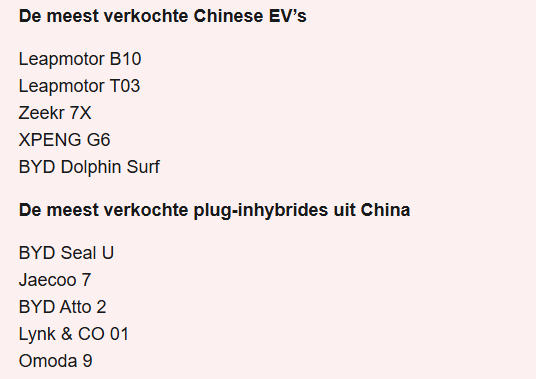
The best-selling Chinese electric vehicles in the Netherlands, as well as plug-in hybrid vehicles. Dutch media.
Reports indicate that after the EU imposed import tariffs on electric vehicles, China has also begun exporting hybrid vehicles to Europe. According to the European Motor Industry Association (ACEA), currently one-fourth of all newly launched plug-in hybrid vehicles in Europe come from China. Two years ago, this proportion was only 2%.
Chinese brands are leading the trend, especially in the field of electric vehicles.
From a global market perspective, sales of fuel-powered vehicles are declining. However, European traditional automakers have not completely abandoned this technology and are attempting to delay the implementation of bans on internal combustion engines. Additionally, the massive layoffs announced by European automakers, along with the resulting labor unrest, are causing them significant financial losses.
Luhmann said: 'It seems that they are slowing down the pace of transformation. But this won’t work, and that is now obvious.'

