According to a report by USNI News on October 27, data released by the U.S. Navy Security Command shows that during the 2026 fiscal year, the U.S. Navy experienced 27 Category A aviation and surface accidents, setting a new record for the highest number in at least a decade.
The United States Navy Security Command defines an A-class accident as an incident that results in losses of at least $2.5 million or damage to aircraft, as well as accidents that cause fatalities or permanent disabilities. According to statistics from this agency, between October 1, 2025, and September 30, 2026, there were 16 A-class aviation accidents and 11 surface ship accidents involving the U.S. Navy.
These 16 Class A aviation accidents include incidents involving manned and unmanned aircraft, as well as ground-based aircraft accidents. The number of such accidents is the highest since the 2014 fiscal year. Among them, 2 accidents involved drones, and 14 accidents involved manned aircraft.
According to reports, on October 26, 2025, a F/A-18F "Super Hornet" fighter jet and an MH-60R "Seahawk" helicopter on the U.S. Navy aircraft carrier USS Nimitz crashed in the South China Sea.
This year, there were also two incidents where EA-18G “Eagle” electronic warfare aircraft crashed. On May 17, 2026, at an airshow in Iowa, USA, two EA-18G aircraft belonging to the Navy Air Station on Whidbey Island, Washington, collided in the air, and all four pilots were ejected safely. On September 28, an EA-18G encountered an accident during landing on the USS Eisenhower aircraft carrier, resulting in injuries to four sailors.
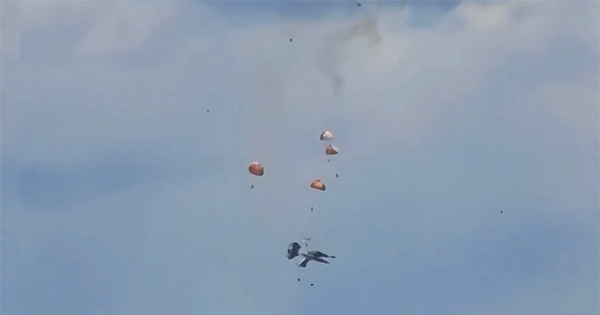
May 17th, two EA-18G aircraft collided in the air, and pilots were ejected to escape. Video screenshot
The U.S. Navy had 11 maritime incidents in fiscal year 2026, the highest number since 2014. On February 7, 2023, a Marine from the USS Sulpher Islands amphibious assault ship fell into the water and died; on June 25, 2023, a Marine from the USS Independence cargo ship disappeared and was later declared dead.
On February 11, the missile destroyer 'Truxton' collided with the fast combat support ship 'Supply' during a supply operation, resulting in injuries to two sailors.
The US Navy also experienced two serious fire accidents. On March 12, a fire broke out on the USS Ford aircraft carrier, resulting in two injuries. On April 19, a fire occurred during the refitting work of the USS Zumwalt destroyer at Ingles Shipyard, causing three injuries.
Additionally, statistics show that the U.S. Navy experienced 30 Class A accidents during operations in the fiscal year 2026, which is the highest number since 2022. In recent fiscal years, the number of Class A accidents during operations by the U.S. Navy has usually been around 20. In the fiscal year 2026, the U.S. Navy also had 48 accidents not related to operations, resulting in 45 deaths. This figure was lower compared to the previous year.
Retired US Navy Colonel John Coddle previously wrote in an article for the United States Naval Institute that in recent years, the frequency of accidents in the US Navy has increased. Investigations into these accidents have uncovered many issues, including insufficient professional training for naval personnel, poor fatigue management, staffing shortages, and a lack of awareness of risks.
For example, during the deployment of the U.S. Navy’s Truman-class aircraft carrier strike group in 2024-2025, there were four accidents. After investigation by the Navy, it was found that equipment failures, substandard maintenance measures, and a “low overall knowledge level” among some members of the aircraft carrier strike group were the main causes of these accidents.
Kodell stated that it was only after two collision accidents in 2017 resulted in 17 deaths that the U.S. Navy began reflecting on its systemic flaws and proposed a series of reform plans. However, over the past decade, there have been significant differences in how various departments of the U.S. Navy implement these reforms, and many improvements have not been put into practice. He warned that the U.S. Navy should not dismiss these accidents and should correct the issues to reduce risks.