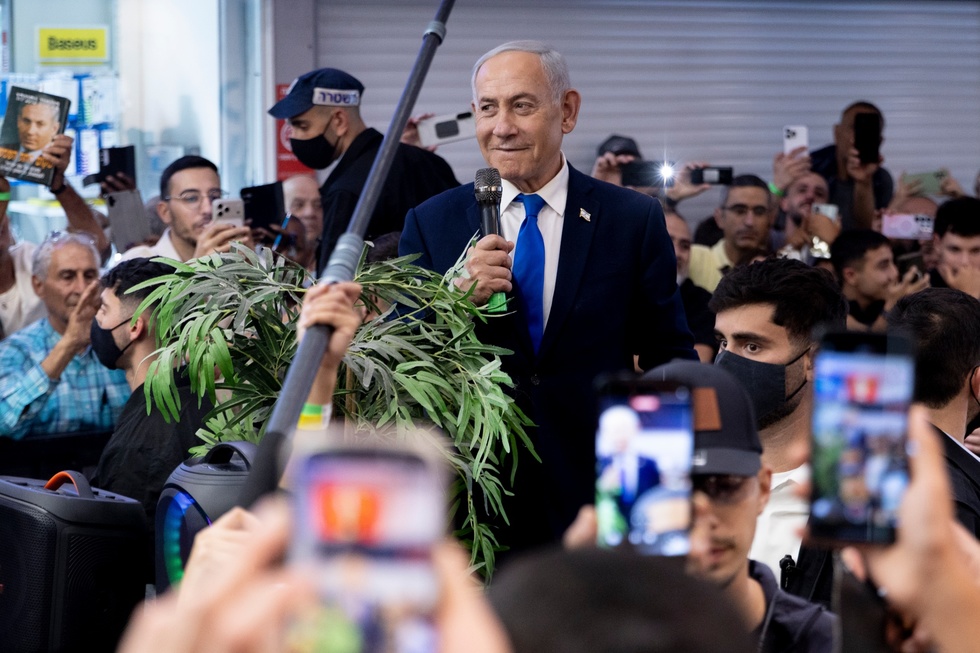
According to an Israeli Times report dated October 27th, a poll conducted by Channel 13 television showed that after the voting for Israel’s 26th parliamentary elections concluded at 10 p.m., the Likud party led by Prime Minister Netanyahu was expected to win 25 seats in parliament. Meanwhile, the Center Party, led by Ehud Barak, was expected to gain 23 seats.
Overall, the camp opposing Netanyahu is expected to win 53 seats, while the camp led by Netanyahu is expected to win 50 seats. Both camps are expected to have significantly fewer seats than the 61 required to form a majority government. The Arab-oriented political party also opposing Netanyahu is expected to win a record-breaking 17 seats.
The Israeli Times states that there was no clear winner in this election, which is consistent with the predictions of polls conducted over the past months. These polls had predicted that it would be difficult to reach a decisive outcome in this election. This means that for the next few days or weeks, Israeli political parties and their leaders will engage in negotiations with each other, trying to gather enough votes to form a government. They may also need to gain support from Arab-based political parties. In the past, these parties usually did not join coalition governments.
According to CCTV news reports, data released by the Israeli Central Election Committee shows that as of 10 p.m., the voter turnout for the Israeli parliamentary elections reached 77.7%, which is higher than the 70.6% recorded at the same time in the 2022 elections. This marks the highest turnout at this time point since 1999.
According to Israeli electoral law, political parties must achieve a vote threshold of 3.25% to enter the parliament and receive 120 seats proportionally. The preliminary results are expected to be announced on the 28th or 29th, and the final results will be officially announced by the Central Election Committee on November 4th. After the parliamentary elections, political parties will negotiate to form a governing coalition. In Israel’s history, no single party has ever won a majority of seats in parliament; forming a coalition government is the norm after elections. Whether Netanyahu can secure at least 61 seats of support is key to his continued leadership.