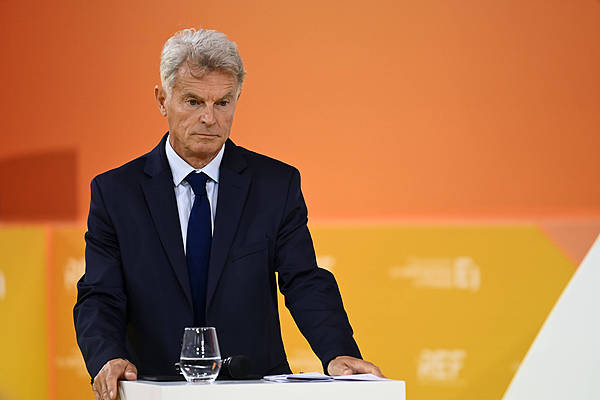
European Council President Costa announced in a statement on October 29 that European Central Bank President Lagarde had informed him that she would resign from her current position on February 7, 2027.
Costa expressed respect for and acceptance of Lagarde's decision. To ensure a smooth transition of leadership at the European Central Bank, the appointment process for the new governor was initiated today (the 29th) and is progressing rapidly.
Lagarde will be the second president of the European Central Bank to step down before the end of 1998.
At the age of 70, Lagard said in a video posted on social media: "When I left the European Central Bank, I felt that I had done an excellent job, and the European Central Bank is also ready to embrace the future."
Lagard’s original term of office was scheduled to end in October 2027, but she suddenly announced her resignation ahead of schedule, just before the French presidential election, which has drawn attention to the political considerations behind this decision.
Just three months ago, Lagard denied any claims that she would leave her position early, stating that she couldn’t leave the European Central Bank at a time when inflation was looming.
A source familiar with the matter told Reuters that Lagarde, who was previously France's Minister of Finance and President of the International Monetary Fund, resigned in order to be able to express opinions on French and global political matters. As the President of the European Central Bank, she must maintain political neutrality in order to safeguard the institution's independence.
Reuters pointed out that Lagarde's early resignation gives the current EU leader the opportunity to choose a new president of the European Central Bank before the French presidential elections in 2027. Polls show that French right-wing leader Le Pen currently has an advantage in the presidential election competition.
Jean-Philippe Dangie, a member of the French National Union and responsible for drafting economic policies for Le Pen's campaign platform, told Reuters that Lagarde's decision reflects a contempt for the rule of law.
"I had long foreseen this. This is another humiliation for us, a cause for regret." Jean-Philippe Tangji stated.
Lagarde has not directly responded to the criticism. She previously stated that she would not run for president of France, but would advocate for values that support European integration in France in the way she believes is most effective, regardless of the position she holds.
Regarding the candidate for the next President of the European Central Bank, Reuters notes that Klaas Knot, former Governor of the Dutch Central Bank, and Pablo Hernandez de Cos, former Governor of the Spanish Central Bank, are widely considered as potential successors.
Currently, the European Central Bank is facing challenges such as the energy price impacts caused by the war in Iran, and turmoil in the French bond market. Balancing inflation control with economic growth will be a significant test for the new president.