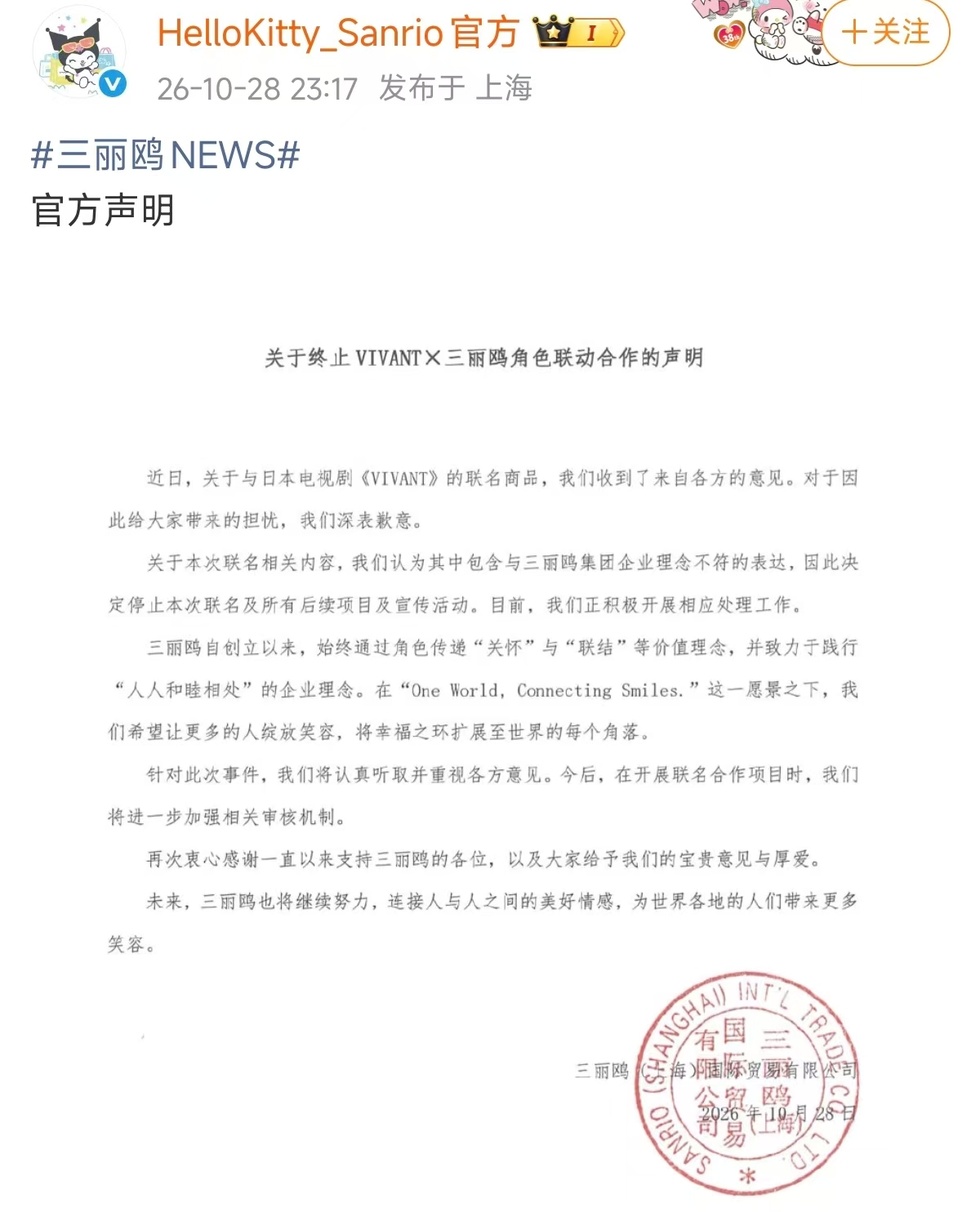
On the late night of October 28th, Sanrio's official account @HelloKitty_Sanrio issued a statement of apology, announcing the termination of its joint partnership with the controversial Japanese drama "VIVANT".
Previous reports stated that the second season of the popular TBS TV series 'VIVANT', featuring a top Japanese star, sparked intense outrage on the internet for deliberately damaging China's reputation and promoting the 'China threat theory'.
In the drama, Chinese intelligence agents are deliberately portrayed as brutal and backward villains. They even resort to extreme torture methods, such as cutting off fingers and stabbing the abdomen of Japanese intelligence agents. These methods are highly similar to the torture methods used by the Japanese army during their invasion of China. This practice of distorting history and attributing historical torture methods to modern Chinese people is considered an attempt to deliberately create opposition and incite hostility.
As a brand labeled with "cute" and "healing" and carrying the "principles of peace," Sanrio has been deeply associated with a controversial drama series that "smears China and distorts history," causing shock and strong opposition among social media users.
Why does such a conflict cause particularly strong discomfort for many people? Because HelloKitty and VIVANT are another set of symbols that represent the opposite: cuteness, childhood, friendship, softness, and non-aggressiveness.
For decades, this IP has been reaching children around the world through such imagery. Even its official website carries the corporate philosophies of “Getting Along Together” and “One World, Connecting Smiles”.

Image source: SpongePuffs
Sanex Co., Ltd. has already released a Japanese apology statement. Their collaboration with “VIVANT” began during the first season of the series. Regarding the second season, which caused a huge stir in public opinion, they “had no knowledge of the plot content beforehand.” The related product pages on Japan TBS’s official shopping website (TBS Shopping) are now unavailable.
But it must be pointed out that this combination of 'cute' and military narrative is not a strange phenomenon in Japan.
A paper published in International Political Sociology in 2026, while analyzing the propaganda of the Japanese Self-Defense Forces, stated that some studies suggest that for a long time in the past, Japan used attractive images involving women and anime-style expressions to reduce the perceived threat of the military. Relevant research even used concepts like “camouflaging” and “sanitizing”: by using softer, more appealing expressions, a violent institution appeared in a way that was easier for the general public to accept.
Some Japanese scholars have proposed another explanation: the large-scale collaboration is primarily a market-driven activity, where Japan's mature anime industry actively transforms military themes into consumerizable content. This suggests that the issue is more complex than simply a "right-wing conspiracy": there is no need for any government department to direct this process. As long as military themes can be transformed into anime merchandise and consumer goods, the Japanese market will continue to push military concepts into the daily lives of ordinary people.
It is also here that the uniqueness of SLR's partnership truly becomes evident. In August this year, SLR still shared on its official website the memories of the founder’s experience during the Kofu air raid in 1945: the city was completely destroyed, and many civilians lost their lives. This war-time experience later became an important source for him in founding SLR and proposing the concept of "mutual friendship among all people".
In other words, peace and kindness are not advertising slogans put up for marketing purposes later on, but rather one of the origins of the brand that has been openly discussed by Sanrio.
This misalignment also explains why some people perceive this as not simply an ‘offense’, but rather a more uncomfortable ‘dampness’ factor.
Because traditional military propaganda at least is clear: people know what they are facing. However, once military and adversarial narratives enter everyday life through anime, toys, cute merchandise, consumer goods, etc., their political meaning becomes fragmented.
The television station claims to be “fictionalizing the story”, and the brand can also say “it’s just a commercial collaboration”. They don’t need to claim that they support militarism, but judging from the results of their messaging, military and “enemy-state” imagery seem to be the way things are presented.
As a professional translator, please translate only the English text. All Chinese characters should be replaced with their English equivalents. When a society becomes increasingly accustomed to packaging military issues within soft and harmless popular culture, militarization no longer requires having a militaristic appearance. At today’s regular press conference of the Ministry of Foreign Affairs, a journalist asked about this issue. Guo Jiakun, the spokesperson of the Ministry of Foreign Affairs, stated that they have taken note of the relevant reports. This TV drama once again reveals the existence of a faction within Japan that attempts to distort and smear China through cultural products, spreading anti-China sentiments. This should raise awareness among the international community and people of insight in Japan.