Power generation on rooftops for personal use, with any surplus sold to the power grid. The Thai government has launched a "National Solar Program," planning to allocate 50 billion Thai baht (approximately 9.9 billion RMB) for subsidies for household solar equipment and installation, supporting up to 1 million households in installing rooftop solar systems.
According to the official Thai government website, on October 27th, Prime Minister Anutin presided over the project launch ceremony at the Prime Minister's Office. Registration for the program was open that day, offering a device and installation subsidy of 50,000 Thai baht per household (approximately 9,900 yuan) to eligible families.
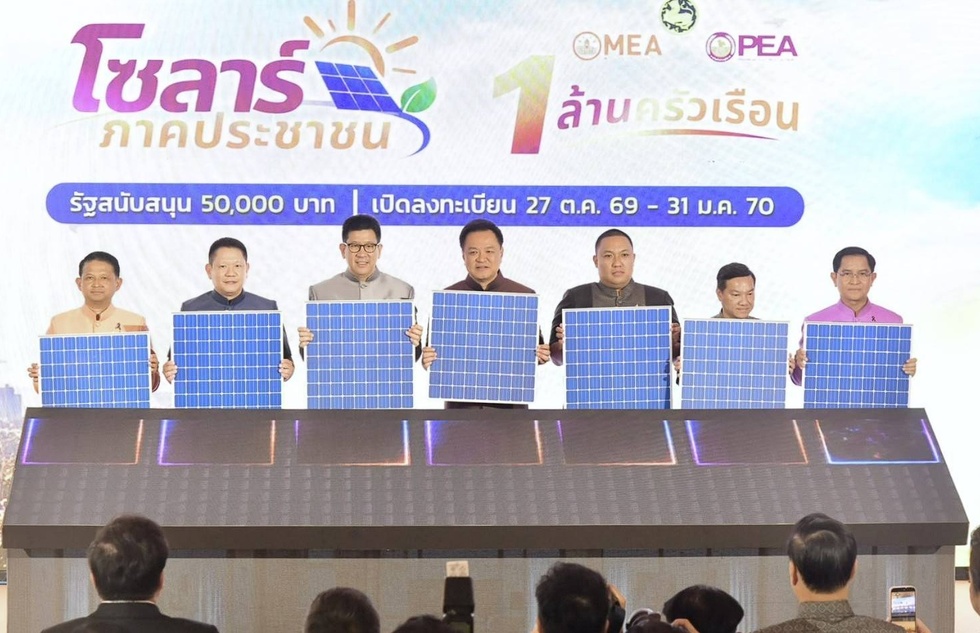
Anuting attended the project launch ceremony
Anu-tin said that the plan is not just about installing solar panels on the roofs, but rather turning the roofs into energy-producing facilities. This would help reduce electricity costs for households, turning electricity consumers into participants in national energy production. The government has estimated that the project could save residents over 24.5 billion Thai bahts (about 4.85 billion yuan) in electricity costs each year.
Residents can use photovoltaic power generation to meet their household needs, and after passing the technical review by the power department and meeting local grid connection and electricity purchase conditions, they can sell the surplus electricity. It is not automatic that one will be granted the right to sell electricity just after installation.
The power department has started on-site inspections. On the 29th, the Thai Local Power Authority announced that 55,921 people have registered nationwide. Staff from Sukhothai Province and Chiang Mai Province have gone to the applicants' homes to verify qualifications and assess installation conditions. Currently, millions of households remain as the target for support.
Expanding rooftop photovoltaics is also a measure taken by Thailand to address risks associated with imported energy. According to reports cited by Reuters, Thai Energy Minister Akanat Promphan stated that the government hopes to protect residents from the impact of rising energy prices caused by conflicts in Iran. Thailand relies heavily on natural gas for power generation, and some liquefied natural gas is purchased through the spot market, making it vulnerable to international price fluctuations.
The subsidy does not mean free installation; residents still need to bear the remaining costs, which can be funded by them themselves or by applying for a bank loan. The project requires a new photovoltaic system with a peak power of 5 to 10 kilowatts per household meter, to be installed by the electricity department or registered and approved enterprises.
Registration is open until January 31, 2027. Applicants must submit their grid connection applications by August 31 of that year, and complete the grid connection by September 30. The subsidy cannot be used in conjunction with the tax deduction benefits for rooftop photovoltaics provided by Royal Decree No. 805.
After the project was launched, some small and medium-sized installers expressed concerns about financial pressures. According to a report by the Thai public television station on the 28th, each installation contract requires a bank guarantee of 50,000 Thai bahts (approximately 9,900 yuan), which has led some companies to consider withdrawing from the project.
On the 29th, Thai Deputy Prime Minister and Finance Minister Ekniti Nitithanprapas stated that the government is coordinating with state-owned financial institutions to provide bank guarantees, aiming to keep the annual fee rate below 1%. This will reduce the amount of cash that companies need to hold, while also preparing special loans to support small contractors in purchasing equipment and materials.
In the import of solar panels in Thailand, Chinese products have taken a significant share. According to data reported by the Thai newspaper "The Nation," citing statistics from the Ministry of Commerce and Customs, the import volume of solar panels in Thailand increased by 88.7% in the first seven months of this year. Among these imports, those from China accounted for 99.3%, representing a year-on-year increase of 107.1%. China has remained the largest supplier of solar panels to Thailand for several years.
