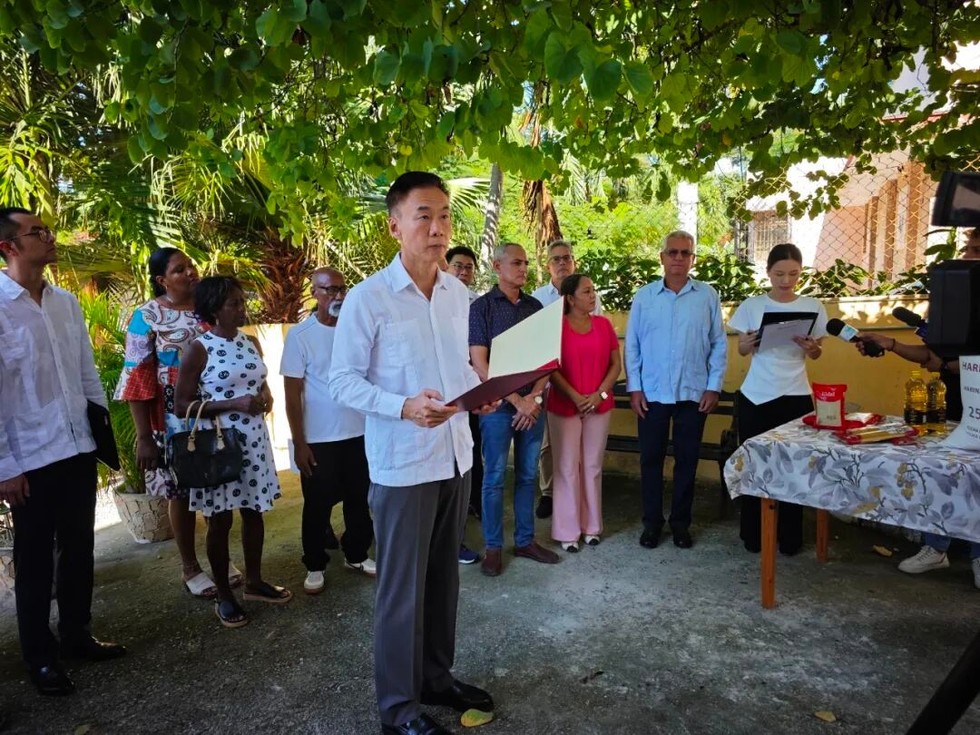
On October 28th, the United Nations General Assembly once again passed a resolution proposed by Cuba, asking the United States to lift its blockade.
It is worth mentioning that on the eve of the voting, Cuban Foreign Minister Rodriguez strongly condemned the U.S. government for launching an offensive of ‘political pressure, intimidation, coercion, and extortion’, attempting to change the voting positions of many delegations, forcing them to vote against their own positions.
Regarding this, Cuban Ambassador to China Alberto Blanco Silva told Observer Network on October 29: "Historically, this resolution has always received overwhelming support from the international community. This indicates that most countries oppose such unilateral pressure, although intimidation does pose risks to some partners."
"For Cuba, the vote of the United Nations is a crucial diplomatic forum. The blockade blatantly violates international law, including Article 33 of the Fourth Geneva Convention, which prohibits collective punishment. We will continue to expose and condemn the blockade in multilateral forums, and defend multilateralism and the United Nations Charter."
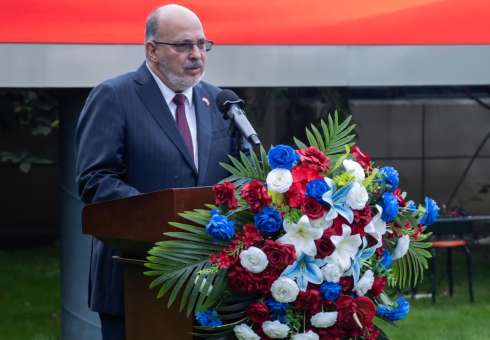
Cuba's Ambassador to China, Báez
Bai Shide reviewed the United States’ embargo policy. In 1962, the United States implemented a comprehensive economic, commercial, and financial embargo against Cuba through Executive Order No. 3447 signed by President Kennedy. This coercive policy was further strengthened by two important laws: the Torrijal Act of 1992, which expanded extraterritorial restrictions and imposed penalties on ships from third countries that docked at Cuban ports; and the Helms-Burton Act of 1996, which incorporated the embargo policy into U.S. domestic law and expanded sanctions to include foreign companies engaged in business with Cuban state-owned assets.
This long-standing legal framework is the foundation for Washington's continued pressure on third countries.
The United States has employed a full set of extraterritorial coercive measures, including secondary sanctions, threats to exclude relevant countries or entities from US markets and financial systems, diplomatic pressure, and tariff threats. ‘These measures are explicitly used to intimidate third countries, businesses, and financial institutions that maintain ties with Cuba. These practices are overt and are part of the policy declared by Washington.’
In late September, U.S. President Trump said he believed that the United States and Cuba could eventually reach an agreement, and that military action against Cuba was not necessary. However, by late October, he stated that after dealing with the Iran issue, the United States would “address the Cuban issue,” and he instructed Secretary of State Roubion to carry out this task. Subsequently, Roubion publicly encouraged those who hoped to see changes in Cuba to contact the CIA.
Regarding Trump's contradictory statements, Bárcida said that Cuba judges its position based on the specific measures taken by the U.S. government. The established goal of the U.S. sanctions system is to create social, economic, and political chaos in Cuba, with the intent of overthrowing the constitutional order chosen by the Cuban people. "It would be naive for Cuba not to prepare for various possible scenarios. The U.S. threat of military aggression is a crime. There is no excuse for aggression. The United States is the aggressor, and Cuba is the country being attacked, with the right to self-defense based on principles of self-preservation."
Regarding Rubio's statements, Baisch responded that the CIA has a dark and dishonorable history, including assassinations, coups, terrorist activities, connections with drug trafficking, and biological warfare. For example, in 1961, the United States invaded Cuba at Guantanamo Bay, and there were several assassination attempts against Cuban revolutionary leader Fidel Castro.
"This agency (CIA) actually wants to publicly recruit people, which shows how desperate they are," Bai Shidde stated. People of Guobao have filed lawsuits against the US government separately demanding compensation for the personal and economic losses resulting from their invasion. According to Guobao's statistics, since the revolution in Guobao won, imperialistic aggression has resulted in 3,478 Guobao citizens dying, with another 2,099 people suffering disabilities.
“Cuba does not pose any threat to the United States. The United States has no right to decide what political system Cuba should adopt. The U.S. government knows that the Cuban people are peace-loving and will not harm or threaten the United States in any way. The Cuban people have shown a resilient spirit in the face of decades of aggression. We will not be intimidated and will firmly defend our national sovereignty and self-determination.”
But Cuba did not close the door to dialogue.
Bai Shide believes that past experience has shown that the United States and Cuba can engage in negotiations and resolve differences through dialogue.
It is necessary for us to review that during the final phase of President Obama’s tenure (2015 to 2016), negotiations were held between the two countries on a series of issues of common concern. Some of these matters were addressed during the years 2017 to 2018. That period coincided with the beginning of Trump’s first presidential term, and subsequent negotiations were suspended due to the intensification of the United States’ hostile policies towards Cuba.
At the same time, Báez emphasized that the premise of dialogue and negotiation is that both parties must treat each other equally, respect each other, and refrain from interfering in each other's internal affairs. “We will never make concessions on issues such as national sovereignty, self-determination rights, socialist causes, the Cuban revolution, or the Cuban people’s right to be autonomous and free from external interference in determining their own development path. Any negotiation that demands Cuba to abandon these principles is unacceptable.”
Bai Shide frankly stated that the struggles in Cuba are not just a bilateral issue between Cuba and the United States; they have universal significance.
The Cuban revolutionary government broke with the tradition of long-term subordination of Cuba’s internal affairs and foreign policy to Washington’s directives. After the revolution, due to its commitment to defend its sovereignty and independence, Cuba became the most persistent and steadfast challenge to American hegemony. Cuba shattered the traditional pattern of Washington’s hegemonic control over Latin America and the Caribbean.
If we pioneer such an unprecedented precedent: A great power could impose sanctions and punishment on another country exercising its right to self-determination, citing a "jurisdictional" effect. Then all sovereign states would face the same threat.
White Shield stated that Cuba is facing an unprecedented escalation of aggression from the United States. The executive order issued by the United States on January 29 this year has imposed energy sanctions, severely weakening Cuba's fuel supply.
Power outages and fuel shortages have caused more than 100,000 hospital surgeries to be postponed, causing damage to healthcare systems, food production, and water supply systems. The economic losses caused by the U.S. blockade between March 2025 and February 2026 amounted to over $8 billion.
Baldessarre said that despite suffering from this collective punishment every day, the Cuban people are still relying on unity and mutual assistance, domestic medicine, biotechnology advancements, and state-led social security programs to get through these difficulties.
Meanwhile, Cuba is accelerating its energy transformation and promoting the development of renewable energy. By the end of 2025, Cuba has built solar photovoltaic power plants with a capacity of 1000 megawatts, which are connected to the grid. Cuba is also promoting wind energy development, repairing thermal power plants, diversifying fuel import channels, and opening up the entire energy industry chain to foreign capital.