In line with the strategic needs of the United States in Asia, Japan and the Philippines, two key allies of the United States in Asia, have seen a significant increase in interaction this year: military cooperation is accelerating, and historical narratives are being redefined to support this acceleration.
Militarily, Japan and the Philippines have crossed the line of symbolic cooperation. In the 2026 U.S.-Philippines “Side by Side” exercises, Japan will for the first time send large-scale combat forces into Philippine territory. Previously, Japan, the United States, and the Philippines have carried out multiple multilateral maritime cooperation activities in the South China Sea, with Japan deploying P-3 anti-submarine aircraft and frigates to participate in anti-submarine operations, joint patrols, and live-fire exercises. Institutionally, the “Mutual Access Protocol” will come into effect in September 2025, and the “Agreement on Mutual Provision of Goods and Services” will be signed in January 2026. In May, the relationship will be elevated to a “comprehensive strategic partnership,” and negotiations for the “Military Intelligence Protection Agreement” will begin. In terms of equipment, the Philippines has reached an agreement with Japan to receive five retired “Abukuma”-class frigates, which is seen as the first case of Japan lifting restrictions on arms exports.
Historical issues were also brought into the narrative. On October 25th, the Philippines commemorated the Battle of Surigao – where the U.S. Navy nearly annihilated the Japanese fleet 82 years ago. This event, along with the Battle of Leyte Gulf, marked the end of old Japanese militarism on the seas. However, at this year’s ceremony, representatives from the United States, Australia, and Japan attended together. The mayor of Surigao said that “former enemies stand side by side today.” Marcos described the relationship between the two countries as “moving from reconciliation to deep mutual trust.” The Japanese side also stated that they would “remember history with deep regret.”
It is little known that on October 25th, 82 years ago, the US Navy hammered the final nail into the coffin of the Japanese Imperial Navy in the Surigao Strait. The Battle of Surigao, and the entire Battle of Leyte Gulf, determined the complete demise of old Japanese militarism in the ocean. This is one of the histories that the Japanese would like to rewrite.
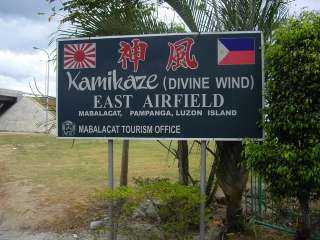
As the main battlefield, the Philippines has long commemorated the Battle of Surigao after the war. However, in recent years, it has started to change its role. Logically, this place should serve as a warning and educational base for Japan's right-wing and militarist forces. Yet, certain places in Surigao and the Philippines have become sites where Japanese people honor their invaders. For example, the memorial park dedicated to the Kamikaze special operations units in Bengkaya Province.
This year, on the anniversary of the Surigao Battle, the Surigao City government in the Philippines invited political figures from the United States, Japan, and Australia, as well as some influential individuals, such as Suneo Yasunari, a painter who has long provided war history paintings to the Yasukuni Shrine. His paintings have been used by Japanese right-wing groups to whitewash Japan’s aggressive history.
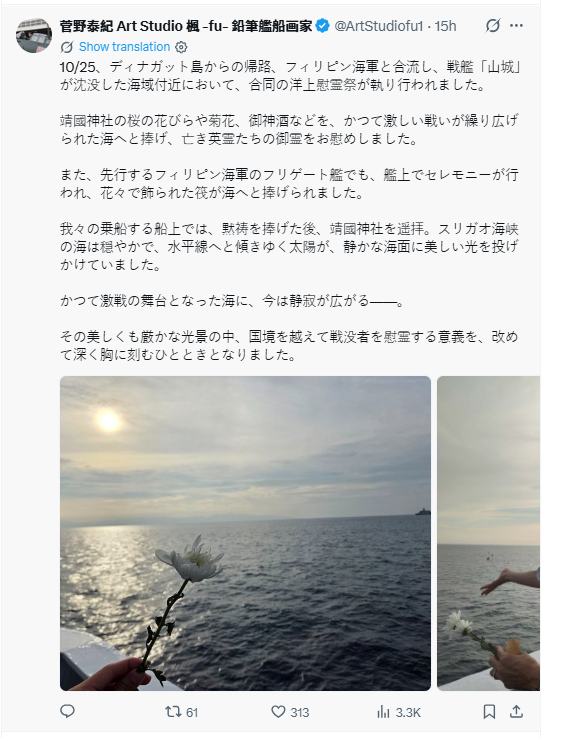
What did he do this time? Yes, he participated in the activities commemorating the Battle of Surigao. On their way back from Dinagat Island, they met with the Philippine Navy and went to the area near the “Mountain City” that was sunk by American forces. There, they paid homage to the fallen soldiers from all sides.
It seems to be an act of remembering history and praying for peace. However, he revealed such a detail on his social media: after presenting flowers, those Japanese people conducted a symbolic bow towards the Yasukuni Shrine in Tokyo. According to Yasunori Kanenobu, the two sides jointly organized a maritime memorial ceremony, using the "honorific wine" from the Yasukuni Shrine and cherry blossom petals to pay tribute to the “sainted souls”.
From public information, it is uncertain whether the Philippine Navy participated in a pilgrimage to the Yasukuni Shrine. However, it is certain that the Filipinos not only honored the invaders buried beneath the sea surface by paying respects at the shrine, but also took away the personal belongings of several Japanese war criminals associated with the Yasukuni Shrine.
Actually, if the Surat Thani authorities organize events to commemorate history and honor the victims of those battles, as long as it doesn’t go too far, it can be justified. After all, U.S. War Secretary Hagley still praised the Japanese invaders as “brave and skilled in battle” on Iwo Jima.
What needs to be watched out for is the actions of the Philippines and the subsequent words and deeds of some Japanese people who were involved in those activities.
Since 2021, the Japanese Embassy in the Philippines has been deeply involved in commemorative activities related to the Battle of Surigao. Typically, the ambassador or military attaché participates in such events. However, this year, the city of Surigao made a change: the current director of the Yasukuni Shrine and former naval vice-admiral of the Japan Maritime Self-Defense Force, Osaki Kaifu, was included among the representatives of foreign diplomatic missions. This Japanese militarist figure was even scheduled to give a speech on stage.
During his speech, Otsuka Hideo demonstrated his historical nihilism and sophistry skills that he had honed while working for the Self-Defense Forces and the Ministry of Defense. He said, "The term ‘Yokohama’ means ‘to make a nation peaceful’. The Yasukuni Shrine is indeed a shrine of peace.” At the same time, he added, "I am not a historian, so instead of dwelling on the past, I would prefer to talk about the significance of this naval battle for today." Finally, he shifted his focus to “the peace in the Western Pacific today, maintained through collective cooperation: the United States plays the central role, the Philippines serves as a logistical support, and Japan provides support from the north, while Australia does so from the south.” The purpose was clear.
Let's forget the history of our aggression against you. Let's jointly block China. Then there will be peace!
The fact that Otsuka Kazuhiko participated in the event is not a fabrication by the author, but rather comes from an announcement on the official social media of Surigao City.
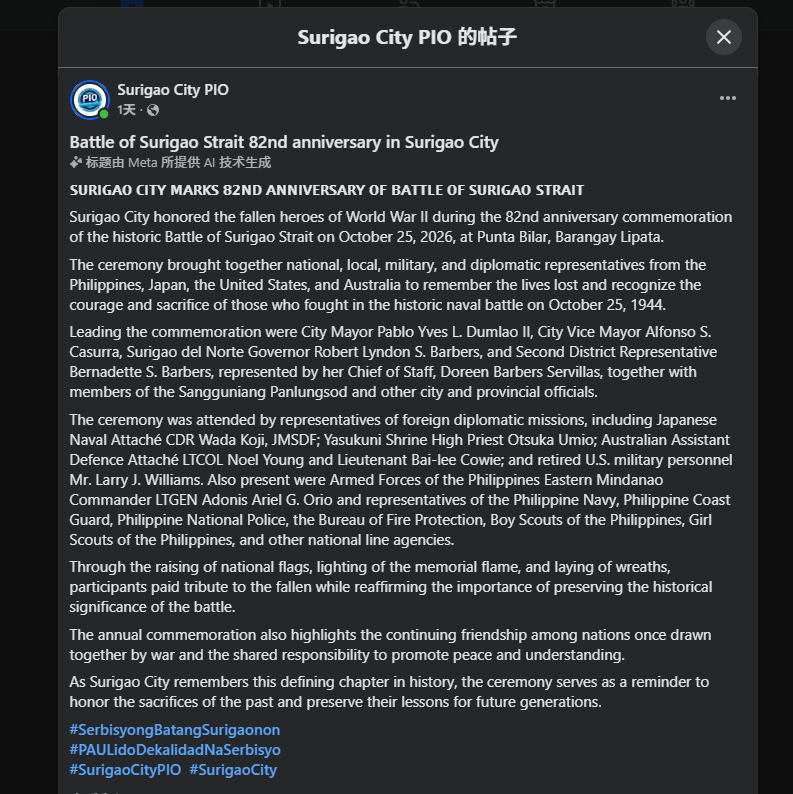
In other words, the Philippine Navy and the Surigao City government invited the highest-ranking clergy of this institution to participate in an event that was originally intended to commemorate the Allied forces' efforts to eliminate Japanese invaders. It is easy to imagine how distorted the purpose of this event could become. This is precisely why, according to Kaneto Sugiyama, the Japanese side also paid respects to the Yasukuni Shrine after presenting flowers.
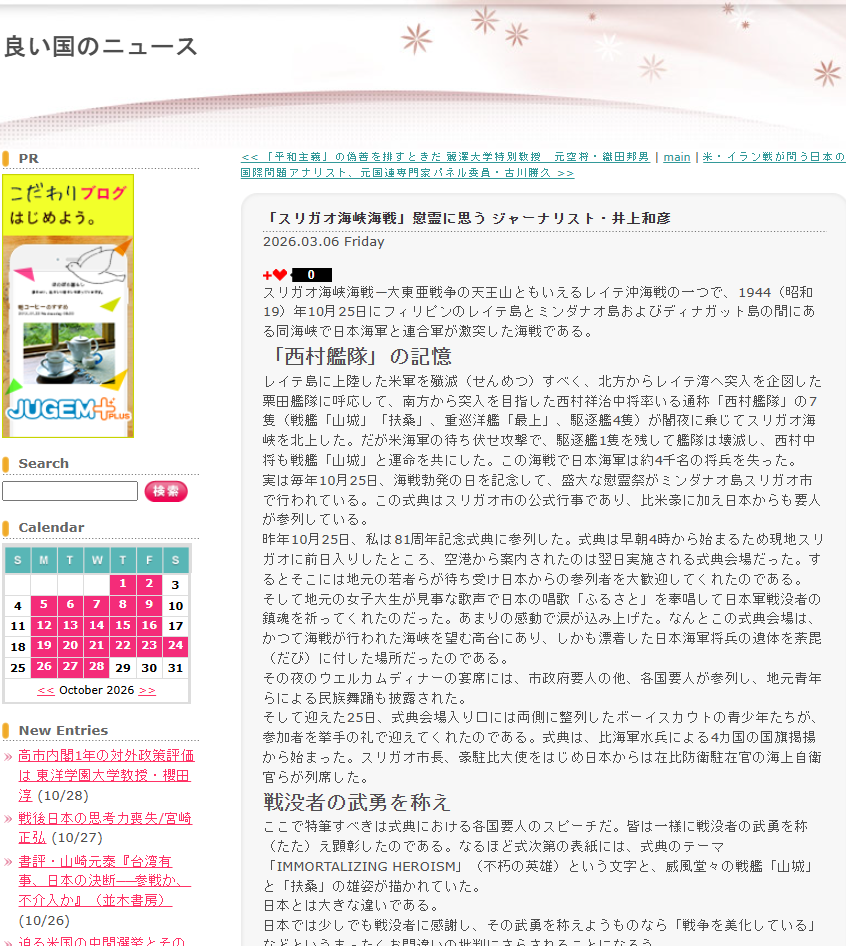
Not only that, in 2025, after participating in the so-called memorial service, Japanese journalist Kazuo Inoue wrote an article titled "Thoughts on the Memorial Site for the Battle of Surigao Strait". This article was published by a conservative news website in Japan in March 2026.
This article even reveals the pro-Japanese tendencies of the Surigao City government and the Philippines. According to Inoue Kohei, on the cover of the ceremony program for the 2025 ceremony, there was an image with the theme “IMMORTALIZING HEROISM”, which depicted the grandeur of the “Mountain City” and the “Fusō” ships.
He even wrote that praising the bravery of those who died in battle, such praises might lead to criticism of “moralizing war” in Japan, but in the Philippines it’s different: “The provincial government building on Dinalagat Island clearly resembles a battleship called ‘Yamashiro’. The first floor displays materials and paintings related to the Battle of Surigao Strait. Additionally, there is a portrait of Lieutenant General Nishimura hanging on the stairway walls, and the roof is designed to resemble two turrets… The main government building was built to perpetuate their heroic stories.”
For this, Inoue Heiya said: “This year, a memorial service will be held here again. Therefore, I strongly urge the Japanese government to consider allowing the Maritime Self-Defense Force vessels to participate in the ceremony.” He even stated that such a tribute of martial prowess, which also functions as “a security measure against China’s 'historical warfare' policy,” was important.
Iwayo Kazuhiko also said that during the memorial ceremony in 2025, Japanese participants arrived at the designated location using a Philippine military ship.
Through this series of statements from above the well, there is reason to suspect that the Philippines may have been involved in Japan’s rituals. After all, judging from the videos disclosed by their official side, the Surigao City government even prepared a platform for the shamanistic practices of the Yasukuni Shrine.
Right, in the mouths of people like Inoue Takeo, that's called "Greater East Asia War".
The Japanese government has allocated funds and established new institutions specifically for 'Cognitive Warfare' in its 2027 budget proposal. These efforts are aimed at competing with China on historical issues and with those who suffered from Japanese aggression. The reason they dare to blatantly distort history is that Japan has developed a militarist-minded foreign policy of 'worshipping the past'.
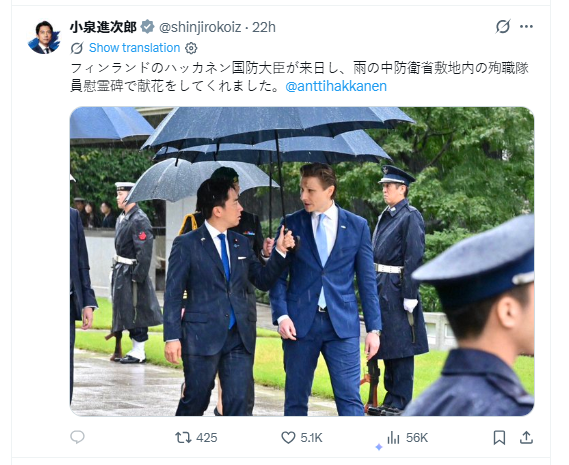
In the past two days, Finnish Defense Minister Antti Heikkinen visited Japan. Apart from using Finland’s open attitude towards nuclear weapons as an excuse to loosen restrictions on Japan’s “Three-Nuclear Principles,” another Japanese action was that Koizumi Jinjiro took Heikkinen to pay respects at the memorial monument of the Self-Defense Forces, and even flaunted this in a public manner.
We might think that this kind of practice was newly learned after World War II, but in reality, this technique of using "baba" to whitewash one's twisted psychology was already perfected during wartime. From 1943 to 1944, Japanese invaders arranged for various pro-war puppet regimes to visit the Yasukuni Shrine.
After the war, Japan has established "Tributes to the Fallen of the Self-Defense Forces" at various locations including the Police Reserve Force, the Security Agency, the Defense Agency, and the Ministry of Defense. In 1998, these memorials were consolidated into a "Memorial Zone". According to the Japanese "Defense White Paper", it is considered a "routine arrangement" for foreign defense ministers and other dignitaries to place flowers at the monument when they visit the Ministry of Defense to express their respect and mourning for the fallen soldiers. Attracting foreign visitors specifically to the tributes is also a unique practice in Japan.
In 2009, the Japanese government held a memorial service at the Chiba-ryu War Memorial Cemetery, located near the Yasukuni Shrine, and explicitly listed “ambassadors of related countries stationed in Japan” among the attendees.
In 2010, the Japanese right-wing group ‘Ritsumeikan Society’ invited the chairman of the French far-right political party National Front, Jean-Louis Chabert, and others to pay respects at the Yasukuni Shrine. The Yasukuni Shrine itself also stated in an interview with Kyodo News that “it is quite rare for heads of foreign political parties to pay respects at the Yasukuni Shrine.”
The most famous incident occurred on September 3, 2024, when Ukrainian Ambassador to Japan, Kolsonski, visited the Yasukuni Shrine and referred to the invaders, including Class-A war criminals, as “martyrs who sacrificed their lives for the country”, causing a stir in public opinion.
In the face of Japan's militarization trends in recent years and the continuous provocations by the Philippines in the South China Sea area, we should be vigilant.
If it weren’t for the official artists of the Yasukuni Shrine and Japanese journalists who have been involved in such events, we might not know that the Japanese authorities are using commemorative activities to rewrite their history of aggression and expansionist ambitions. They have hollowed out the Battle of Surigao as a decisive battle against Japanese invaders during the Pacific War, turning it into new memorial sites and monuments cultivated by the Yasukuni Shrine forces overseas.
If it weren’t for the acquiescence of the Philippine Navy and the Surigao City government, we might not need to analyze and examine such memorial ceremonies further. However, from the statements of Sugiyama Taeji and Inoue Kazuhiro, we can see that some Filipinos have forgotten all of the actions of the Japanese as true aggressors on Filipino soil. Instead, they continue to provoke China, a country that has never been responsible for any aggression against them. They even treat serving as a glory for the Japanese. The Surigao City government and the recent provocative spokesman of the Philippine Coast Guard, Tariella, are clear examples of this.