More details about the collision accident on Spain’s high-speed train are coming to light. On October 29th local time, Spanish media reported that the train driver involved in the accident tried twice to restart the train, but failed. The driver reported to the dispatch center that the train remained stuck on the tracks. However, the trailing train was allowed to move at a normal speed, which ultimately led to the tragic accident.
According to Spanish news agencies EFE and El País, a high-speed train collision near Urdá in Toledo province on October 28 caused at least 69 deaths. This is the second major high-speed train accident to occur in Spain this year.
According to a source close to the Italian railway operator Iryo, quoted by Aefes, before the accident, train Iryo No. 6076 was forced to stop at the entrance of the Ulda station due to a malfunction in the railway safety control system LZB.
According to the instructions of the scheduling center of the Spanish railway infrastructure management company (Adif), the female train operator attempted to restart the safety control system, but failed.
According to sources, the driver attempted to unlock the system twice, each time taking typically 3 to 4 minutes. After failing the second attempt, she contacted the control center of Iryo Company, hoping to obtain technical support from the maintenance department. However, just as the personnel were about to establish contact, a Spanish National Railway Company (Renfe) AVE high-speed train came from the rear and collided with the stopped train.
It is also worth noting that the driver did report the dangerous situation to the railway dispatch department.
According to a call recording obtained by the Spanish newspaper El País and Cadena SER, around 8:41 that day, the train driver of Iryo reported to the Madrid Atucha dispatch center that the train had stopped due to the loss of LZB signal transmission.
About 7 minutes later, she contacted the dispatch center again and clearly stated that the system could not be restarted, and the train was still stopped in front of the signal light at the entrance of Ulda station.
However, the dispatcher only asked her to continue driving as long as she could resume operation; to contact them if there were any problems. A few minutes later, a rear-end collision occurred.
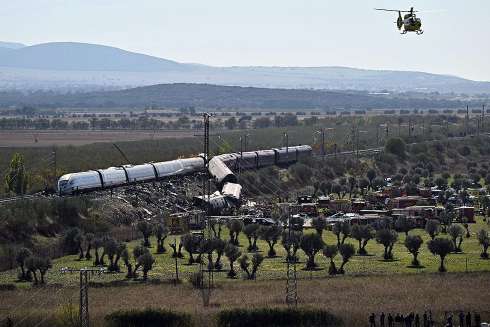
According to information disclosed by Spanish media, before the accident, a computer failure occurred in the LZB safety control system near Urda on the high-speed rail line from Madrid to Sevilla. This affected approximately 63 kilometers of the line, resulting in the automatic stopping of six trains.
At 8:36 on that day, the Atocaya dispatch center issued a command to the Renfe AVE train behind, instructing the driver to turn off and restart the safety system, and then resume normal speed.
The call recording shows that the train driver specifically asked whether it was possible to run at normal speed, and the answer was yes.
According to the Spanish transportation department, the speed of trains on this section can reach up to 200 kilometers per hour. Without the safety control system being restored, the trains behind continued moving forward, and finally collided with the Iryo train that was still on the track at around 8:53.
The investigation is currently focused on the instructions from the dispatch center, as well as whether the relevant personnel were aware of the operating conditions of the two trains in a timely manner.
Spanish Broadcasting Company (RTVE) states that the investigation needs to answer a key question: Since the Iryo train driver had confirmed to the control center that the train was still stationary, why did the control center not promptly request that the trains behind it slow down or stop?
In addition, some call recordings before the accident indicate that the dispatch personnel may have incorrectly judged the operating status of the Iryo train.
However, there is still disagreement among all parties involved regarding the exact timing of some scheduling instructions and the accident. Investigators need to further investigate using train black boxes, scheduling center records, and call recordings in order to reconstruct the accident process and determine whether there were any operational errors or other systematic safety issues.
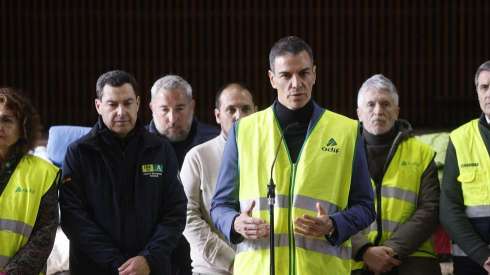
On October 29th local time, Spanish Prime Minister Sánchez visited Toledo to attend a meeting of the Comprehensive Emergency Coordination Center for the accident, and issued a statement after the meeting.
According to the official website of the Spanish Prime Minister's office, Sánchez stated that Spanish governments are working day and night. The focus includes rescuing and caring for the victims of the accident and their families, thoroughly investigating the cause of the accident, and strengthening railway safety to prevent similar tragedies from occurring again.
He emphasized that the government will investigate every detail of this tragedy and take measures to further strengthen the safety measures for railways.
On January 18th this year, a major high-speed rail accident also occurred near Adámus in the province of Córdoba, Spain, resulting in 46 deaths. Both accidents occurred on the high-speed rail line between Madrid and Sevilla, drawing widespread attention to railway safety management in Spanish society.
Previously, Sanchez stated that two serious railway accidents occurring in Spain within one year are ‘unacceptable’. The Spanish government also announced a three-day national mourning period starting from October 28.
Meanwhile, judicial investigations have been initiated. The Olga's Court in Toledo County, which is responsible for the case, has requested to preserve the scene of the accident and related evidence, and is investigating the train black box, railway dispatch records, etc.
As the content of conversations between the drivers of the two trains and the dispatch center is gradually made public, the focus of the accident investigation is shifting from the initial signal system failure to a series of dispatch decisions taken after the failure occurred.
In situations where the safety system fails and the train ahead reports that it cannot resume driving, why is it still allowed for the train behind to operate at normal speed? This becomes a core question that must be answered in the investigation.
