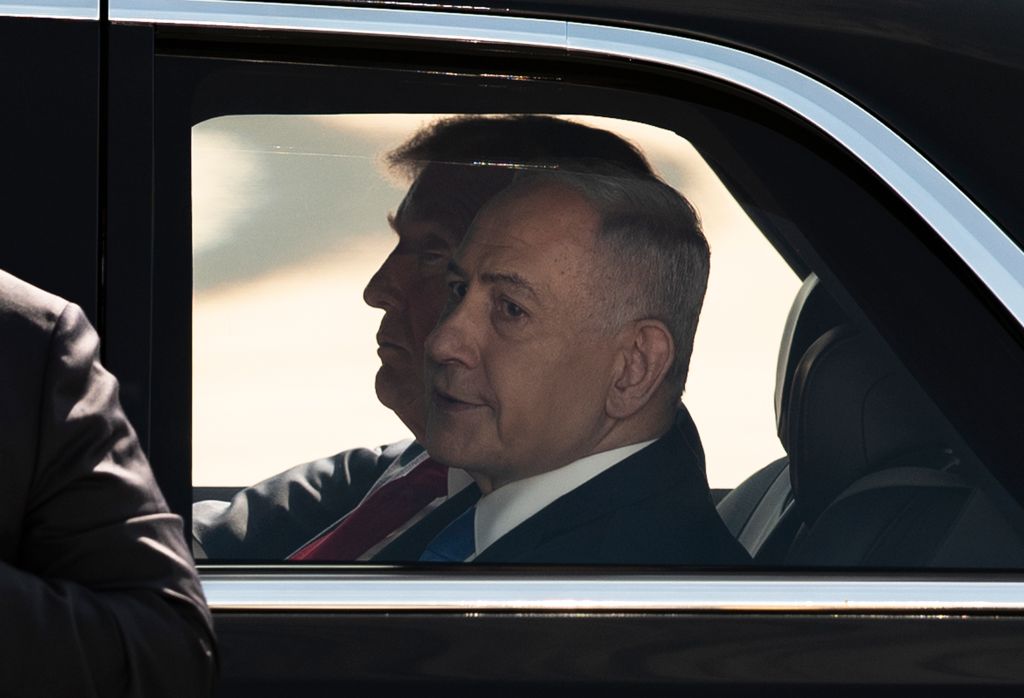
On June 14th, while the world was paying attention to the potential agreement between the United States and Iran, Israel launched attacks on Lebanon’s capital city of Beirut. This disruptive action angered U.S. President Trump, who once again spoke rudely to Israel's Prime Minister Netanyahu.
On the 14th, Trump said in a phone interview with the American media Axios that he was shocked when his presidential advisors reported the attack on Beirut by Israel, and he was extremely angry towards Netanyahu.
The previous day (the 13th), Trump posted a statement on social media stating that the United States and Iran were scheduled to sign an agreement on the 14th, and that the Hormuz Strait would be opened immediately after the agreement was signed.
This is terrible, I can hardly believe it, just an hour before we were supposed to sign the agreement (something like this happened). Trump told Axios.
He scolded, “Why did Bibi (Netanyahu’s nickname) order this attack? I was furious at that time. I made him know that he has absolutely no judgment.”
This disrupted the situation and delayed the signing time by several hours. The original signing was supposed to happen now, but it's been moved back a few hours. Trump said.
According to reports, although Trump admitted that Hezbollah in Lebanon was the first to attack Israel, he emphasized that the attacks did not cause any substantial damage or result in any casualties.
After Israel's attack on Lebanon, Tehran once threatened retaliation. Ibrahim Aziz, chairman of the National Security Committee of the Iranian Islamic Parliament, said, "A strong response is imminent."
Iranian Parliament Speaker Ali Bakir posted a message on social media on the 14th, stating that the attack by Israel on the southern suburbs of Beirut, the capital of Lebanon, once again demonstrates that the United States either has no intention of fulfilling its promises or lacks the ability to do so. "It becomes impossible to continue the dialogue process."
The peace process between the United States and Iraq is facing further setbacks.
However, later on the evening of June 14th, Trump stated on social media that the US-Iran agreement was “completed” and would open the Strait of Hormuz. In the early morning of June 15th, Iran’s Supreme National Security Council also issued a statement, officially confirming that Iran and the US had reached a cease-fire memorandum of understanding. Iranian Deputy Foreign Minister Gharabab said that the text of the memorandum of understanding was finalized, and the official signing ceremony will take place in Switzerland on June 19th.
Pakistan Prime Minister Shahzad announced on the 15th that the US and Iran have declared an immediate and permanent halt to all military actions, including those in Lebanon.
As Trump seeks to reach an agreement with Iran, Israel has been regarded as a ‘disturbing force’. Its continuous military actions against Hezbollah in southern Lebanon have repeatedly jeopardized the US-Iran negotiations.
At the beginning of this month, Trump lashed out at Netanyahu over Israel's escalated attacks on Lebanon, using vulgar language to describe him as "completely crazy." During a phone call, he also used corruption cases to "punish" Netanyahu, saying that if it weren't for his help, Netanyahu would "end up in prison."
In these US-Iran negotiations, Israel not only failed to sit at the negotiating table, but was also kept under constant watch by the United States. The New York Times reported on June 6 that the U.S. Department of Defense considered the threat of spies from Israel to be increasing, and had raised its counter-spy threat level to the highest. Some U.S. officials said that Israel had increased its efforts to gather information about the U.S. position in negotiations with Iran, and these actions have crossed the line.
A foreign official involved in US-Israel negotiations stated on June 14th to Fox News that Israel's attack on Beirut that day was evidently aimed at disrupting the Trump agreement and dragging the United States back into war.
American think tank Middle East Institute senior researcher Natan Sachs pointed out that there is a strategic gap between the United States and its ally Israel. Netanyahu advocates for continuous, long-term military pressure, while Trump seeks immediate diplomatic success.
"Israel has a feeling now, that Trump might start to get weary of Netanyahu and Israelis," Sax said. "And many people believe if Trump really had enough of Netanyahu, he might break the norm and turn against Israel."
In Sax's view, Trump represents a huge opportunity for Netanyahu, as he is willing to break all conventional rules. However, Israel is putting all its eggs in one basket, which could lead to a "strategic, historic" mistake.
Nikita always prepared for a protracted war, and that's not even four months, it's years," Sax said. "Trump prefers to fight quickly and decisively. Once a quick-and-clean victory was unachievable—which is actually the case—he would face a whole new set of problems."