On October 31 local time, Polish Prime Minister Tusk made a statement in a televised speech regarding the sudden escalation of judicial disputes in his country.
He vowed to continue promoting reforms of the Polish Constitutional Court and accused President Pawłko, the opposition party, and the former ruling party “Law and Justice Party” of inciting violence, attempting to “ undermine the rule of law”. Earlier that day, Pawłko had said that Tusk was “occupying” the Constitutional Court.
In Tusk's view, the 'reformed Constitutional Court' under the previous Law and Justice Party government was not a true court at all. His current actions are aimed at 'repairing' this institution.
He stated that the Constitutional Court lacks independence under the current system. His government attempted to push for relevant reforms with the majority in parliament, and proposed resolutions and legislation to restore the rule of law. However, all such reform efforts were met with ‘malicious sabotage and joint obstruction’ from the president and the opposition parties.
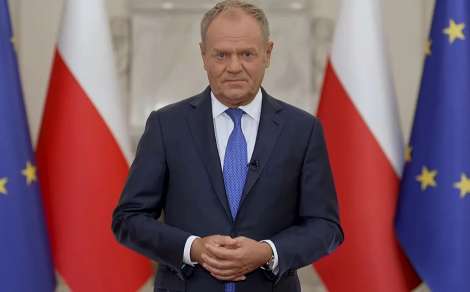
In a speech given on Saturday evening, Tusk also compared the actions of the Law and Justice Party to "a person who stole an old woman's wallet, and when the police caught him and demanded the wallet back, he claimed that he was the victim."
We have waited too long already; we cannot be intimidated and retreat now,” he said. “I believe the Constitutional Court will begin to perform its proper role – independently, autonomously, and in accordance with law.”
"There is no room for compromise on certain issues. Shouting, lying and arguing cannot — and will not — become the legal basis of Poland." He added.
Before this tough statement, hundreds of protesters gathered outside the Polish Constitutional Court for the second consecutive night, opposing the suspension of the court's president.
Tusk described the conflict that took place outside the court building as a “regrettable incident”, and said, “I sincerely hope that such scenes will never be seen again in Poland”. The police are responding to various aggressive acts in a calm but firm manner.
According to European News Network, this speech did not propose any potential agreements with Navrotsky, nor did it outline any detailed plans for resolving the disputes.
Bloomberg analysis indicates that Tusk promised to 'restore the rule of law' when he won the 2023 parliamentary elections. However, so far his agenda has been repeatedly vetoed by Navrotsky. Faced with another election by the end of next year and the rising popularity of right-wing forces, this prime minister has 'lost patience'.
The dispute over the control of the Polish Constitutional Court can be traced back to 2015. At that time, the Party of Citizens (PO) and the Law and Justice Party (PiS) clashed over the appointment of five judges. Later, this dispute escalated into a broader conflict regarding judicial reforms, the power to appoint judges, and control over the Constitutional Court.
As the chairman of the Citizen Party, Tusk-led ruling coalition took office in 2023 and began to dismantle the judicial reforms implemented by the Party for Justice and Fairness.
Wang Hongyi, an associate professor at the Central and Eastern Europe Research Center of Beijing Foreign Studies University, told Shangguan News that there are significant differences between the powers of the president under Poland's 'semi-presidential' system and those in France. The president does not have the power to dissolve the parliament with one vote, but the constitution grants the president the right to veto proposals made by the House of Representatives. This becomes a 'killer tool' for Polish presidents to restrict the powers of prime ministers. At the same time, it also creates political risks of power disputes and conflicts between the president and the prime minister when they come from different political factions.
In 2026, this dispute entered a new phase: Since the beginning of this year, the Polish Sejm, where the ruling coalition holds a majority, has elected eight judges for the Constitutional Court. However, President Aleksander Kwasnik, who shares a closer stance with the opposition parties, only accepted the oaths of office for three of these judges. This further intensified the conflict between the two sides.
The cause of the latest conflict was that pro-government judge Anna Kolven-Piotrowska announced the suspension of the court president Bogdan Hryvichkovsky and the deputy president, and temporarily took over the leadership of the court. The opposition party accused the government of illegally seizing power, calling it a “coup”; supporters of the government believed that this move was aimed at restoring judicial independence and the rule of law.
The struggle for leadership quickly ignited anger on the streets. Starting from the evening of October 30th, a large number of protesters gathered outside the Constitutional Court building all night, accusing the government led by Tusk of trying to control the Constitutional Court.

Protesters gathered near the Polish Constitutional Court – video screenshot
This crisis marks an escalation of power conflicts between the Polish government, the presidential camp, and the judicial authorities since Tusk returned to office in 2023. After the incident, Nafrodski immediately cancelled his visit to Senegal and returned to Poland ahead of schedule.
In the early hours of the 31st, Polish President’s Secretary for State Affairs, Sefiernak, rushed to the protest site outside the court and publicly read Navrotsky’s emergency statement to the demonstrators.
The statement indicates that the Polish constitutional order has been disrupted, and the constitutional institutions have been “forced to surrender”. It calls for the immediate withdrawal of police and other forces from the premises of the Constitutional Court located within the court district. It also urges urgent consultations with representatives from all parties in Parliament in order to stabilize the political situation and restore the constitutional order.
Shortly after reading the statement, Navrotsky personally arrived at the building of the Constitutional Court. According to Polish media reports, Navrotsky entered the building accompanied by Zbigniew Kapinski, the first president of the Supreme Court. He engaged in a heated verbal dispute with Anna Kolwin-Piotrowska, a pro-government judge who was occupying the building. Physical clashes and pushing occurred at the scene. Navrotsky angrily accused her of not being a legitimate judge of the Constitutional Court.
In this conflict, the Presidential Palace and some judges accused each other of being 'illegal'. Nafrozy then left the court building, while some judges remained inside.

Conflict Video Screenshots from European News Network
In his televised speech that evening, Tusk criticized Navrotsky's attempt to enter the court building. He sarcastically said, "In a country ruled by the rule of law, it is not 'muscle and audacity' that determines who is right and wrong. No politician, including the president, has the right to force their way into a court and intimidate judges."
Regarding Tusk's speech, Malchin Purydatsch, the foreign policy assistant to Navrotsky, responded to Bloomberg that the prime minister's remarks were confrontational and would only exacerbate social tensions. He said, "This reflects the prime minister's fear, as he knows what consequences will come if he continues to act illegally in the future."