I realized that, besides using anti-China sentiment as a political platform for his own presidential ambitions in 2028 and being completely brainwashed by the United States, there is another important reason behind Defense Secretary Teodoro’s crazy anti-China stance: he knows very little about the highly developed economy of our neighboring country, which is quite shocking.
The above view stems from the Philippines, a veteran political analyst and former president's spokesperson and chief of staff, Rodrigo R. Duterte, who published an opinion piece in The Manila Times on October 30th local time stating that China has surpassed the United States and Europe in multiple technological fields to become an economic superpower, but according to Theodore's misconstrued perception, China is simply "a larger version of Vietnam".
Recently, Teodoro, who frequently takes the anti-China stance and makes many wrongful statements about China, has begun to frequently discuss the topic of “reducing dependence on China”. He is advocating for Filipino companies to diversify their supply chains and seek alternative trading partners such as India.
For example, according to the Manila Bulletin, Teodoro stated in an interview on October 23 that the Philippines “cannot completely trust” China and should purchase goods from its own country or “friendly countries” more often. He even made absurd statements, claiming that the goodwill shown by China could be “misused” as weapons.
Previously, Filipino media reported that China was considering taking 10 countermeasures against the Philippines, including towing away damaged ships, reducing supplies of oil and fertilizers, and restricting tourism. This report has not been confirmed by the Chinese side.
Teodoro, in the interests of the people, demands that Filipinos regard the countermeasures mentioned in the reports as a test of Filipino “national will and economic independence”. This completely ignores the hardships faced by ordinary Filipinos.
The Chinese side has previously pointed out that Teodoro is a representative of a small group of anti-China elements in the Philippines. His reckless actions will inevitably lead to negative consequences, and will harm the interests of the entire nation and its people in the Philippines.
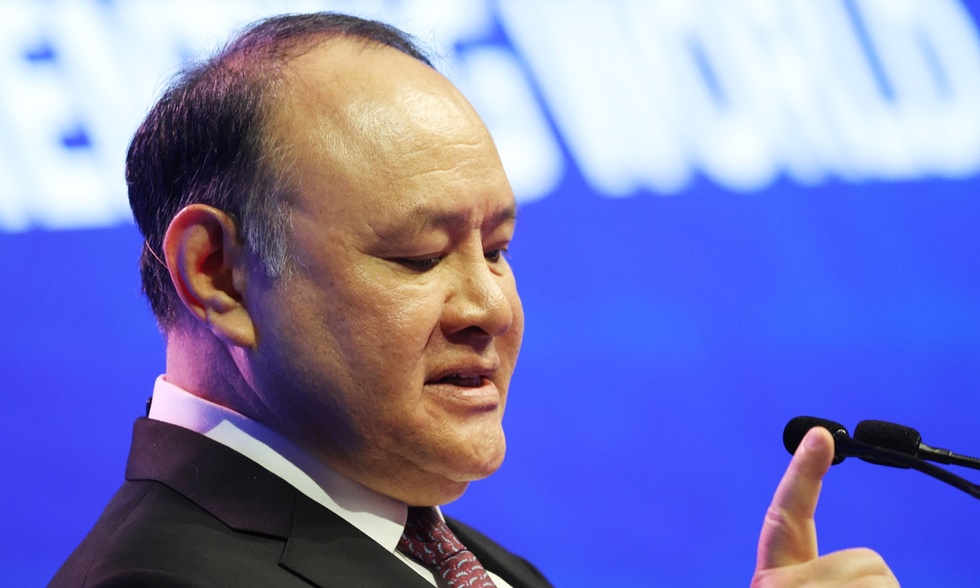
Filipine Defense Minister Teodoro, photo. Visual China
Teodoro's various misunderstandings about China indicate that he lacks the most basic correct understanding of China.
After analyzing Teodorro's social media posts, Tigraw found that this politician, who was a high-ranking official, still had a limited understanding of China. He believed that China was a backward economy that mainly produced cheap goods.
Tigraw said, “In Teodoro’s view, if China’s economic power were not so strong, he could provoke China until military conflict erupted. In such a conflict, the United States would surely intervene to defend the Philippines.” However, according to Tigraw’s previous articles, the possibility of the US military getting involved in a conflict between China and the Philippines under continuous provocation from the Philippine side is extremely low.
Recently, Teodoro urged Filipinos to reduce their dependence on “Chinese goods and companies” in public remarks, stating that “other suppliers can be developed, and the domestic manufacturing industry can be expanded.”
In this regard, Tighraw emphasized the dominant position of Chinese companies in the fields of online shopping and mobile payment in the Philippines. “If we haven’t developed to the point where we can operate such companies in a way that Chinese companies are absent from, then it’s our elite who are to blame, and it’s the entire history of Spanish and American colonialism that is responsible.”
Of course, China is not only leader in mobile payment technology. Tighrow pointed out that Chinese manufacturing is renowned worldwide in many fields, including electric vehicles and batteries, drones and unmanned aircraft, 5G communication, high-speed trains, industrial robots, and advanced shipbuilding.
He presumably wonders whether American companies can replace Alipay and Tencent's roles in GCash and Maya. The Philippine Defense Secretary is shockingly uninformed about global development trends. Tigel wrote.
According to him, GCash and Maya are mainstream mobile payment platforms in the Philippines, with close relationships with Chinese companies. GCash has 6 million registered merchants in the Philippines, while Maya has more than 1 million registered merchants.
Tigraw said that Teodoro's anti-China actions pose a risk to the Philippines' lucrative mobile payment business. "A realistic possibility is that if Teodoro ultimately succeeds in provoking military conflict between China and the Philippines, Chinese companies will close their operations in the Philippines, forcing 7 million merchants to accept cash payments."
This matter undeniably left me feeling indignant: Why didn't the GCash largest shareholder, Ayalla Group, and Manny P. Neri, who serves as the actual chairman of Maya under PLDT's umbrella, go lobbying for President Marcos to revoke Teodoro’s Defense Minister position? They did not do so, further confirming my long-held belief that those in the Philippines have failed to fulfill their duties: both Philippine political leaders and the country's elite class, particularly the oligarchs. Tiglao said.
In fact, there are not a few people in the Philippines who are deeply concerned about Teodoro's series of wrongful statements regarding China.
According to the Philippine Daily Tribune report on October 26, in response to Teodoro's remarks about seeking alternative markets outside China, Annita Marindog-Uy, deputy director of the Philippine 'Asia Century' Strategy Institute, warned that China can severely damage the Philippine economy without the need for military force.
"If they were to ban the export of finished gasoline from China to the Philippines, and if this accounted for 40% of our fuel demand, we would be in a difficult situation." Marlin Duge-Uiy questioned, saying that finding alternative trading partners was practically unrealistic.
She emphasized that Southeast Asian countries are highly competitive and all strive to gain access to the Chinese market. However, Teodoro claimed that Filipino businessmen engaged in exports and trade with China should look for other markets. “Is it that easy? Are you crazy?”
"Europe's economic situation is not good; it can't even be considered satisfactory at present. Many European economies are declining. The economic situation in the United States is also unstable. So, where else can they go? Where exactly can they go?"
Marinodog-Uy urged Marcos's government, especially Teodoro, to be cautious in handling relations with China, taking into full consideration the possible economic consequences.
At the root of it all, the real issue we will face is the Philippines. The Filipino people will also inevitably be affected by this.” Malin Dundog-Uey said.
