In July 2026, Xenia Fedorova, a Russian media person who had lived in France for nearly ten years, was abruptly expelled by the French government during her vacation in Italy. She was also restricted from using her personal assets. Two months later, the European Union added her to its sanctions list.
Fedorov was the president and head of news at RT France, a French branch of Russia Today television. After the Russo-Ukrainian conflict began in 2022, RT was banned from broadcasting within the European Union, and RT France ceased operations in January 2023.
Thereafter, she continued to work as a political commentator for the news channel CNEWS, which is part of the media group owned by French billionaire Vincent Bolloré, and for Europe 1. She also writes a column for Le JDNews.
The French government accused Fedorova of spreading false information about Russia and threatening the country's fundamental interests. She firmly denied these accusations, stating that the French side used the pretext of "foreign interference" to turn political differences into issues of national security, thereby suppressing differing opinions.
This incident occurs at a time when social conflicts in France continue to intensify. Recently, protests and riots have broken out in many parts of France. The Macron government faces multiple challenges, ranging from education conditions to living costs, as well as issues related to immigrant integration.
Regarding one's own experiences, the deep roots of the French riots, and the controversies surrounding freedom of speech in Europe, Observer Network recently had a conversation with Fedorova.
I merely voiced my concerns about the EU's Ukraine policy, and I did not cause the chaos on the streets of Paris. Fedotova retorted, why is the French government so quick to expel me from the country on the grounds of “imminent urgency,” yet when faced with actual threats to public order, it shows such a lack of political courage?
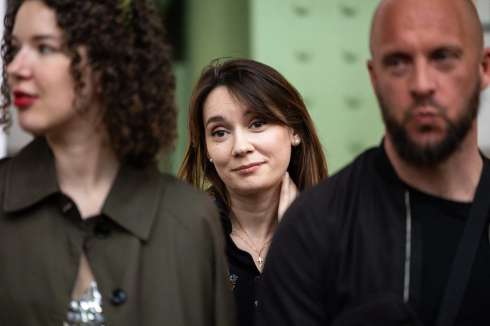
Fedorova was prohibited from working in France by the media.
In July 2026, the French government issued an expulsion order against you. When did you learn of this decision, and through what means? You previously stated that you were already abroad at that time. Could you describe the sequence of events, and how this decision disrupted your original plans?
At that time, I simply left France to go to Italy for a few days of vacation. However, during my departure, the French government prohibited me from returning home and froze my assets.
After living, working in France for nearly ten years, and paying taxes, I suddenly found myself being excluded from society, and even unable to use my money. Before this, I had never been convicted of any criminal acts.
In 2024, the French government renewed my residency permit for another ten years. Just two years later, the government announced that deporting me was an “absolute urgency”.
We should ask what exactly happened between these two decisions?
During this period, I have been expressing my views in French national media, raising questions about freedom of speech, and also questioning the policies of the French government regarding the Ukraine war.
This decision immediately affected my life. My home, work, and various financial obligations remained in France, but I was neither able to return there nor could I use the funds needed to fulfill these obligations.
I had to leave the European continent and arrange my life overseas, while also preparing legal defenses.
Currently, the court has not yet made a substantive ruling on whether the expulsion decision is legal. However, in my opinion, it will obviously take months or even years to overturn this action, which I consider to be an outright censorship of speech.
The French government accuses you of spreading false information about Russia and believes that your activities pose a threat to France's fundamental interests. Which specific statements or actions, as cited by the French side in the decision, were used as grounds for expulsion? Can you respond to one of the most serious accusations and provide verifiable evidence to support your claims?
If the government accuses me of making statements that contradict the facts, then it should specify which particular statement is incorrect and provide evidence to prove its falsehood. So far, the government has not proven that there are any factual errors in my statements.
On the contrary, the French government cited my comments regarding the provision of funds and weapons to Ukraine by Europe, NATO and the risk of escalating conflict, as well as the possibility that France might send troops to Ukraine, and the factors that are hindering negotiations to resolve the conflict.
For example, the materials submitted by the government mentioned some of my column articles. In these articles, I believe that what Europe has done is to provide funding for wars, rather than promoting peace.
These articles and TV programs can be accessed publicly. Anyone can look at what I said, which facts I quoted, and how I came to my conclusions.
Questioning whether a policy has prolonged conflicts is essentially a political judgment. Disagreeing with this judgment does not mean that it is false information.
For example, I once discussed the issue of Ukrainian children in an article on Le JDNews. I cited the Russian explanation regarding the evacuation of children from war zones and clearly indicated that this statement came from the Russian side.
As a journalist, reporting from the position of the party involved in conflict is part of journalism. This in itself does not prove that I am spreading false information or engaging in foreign interference activities.
The French government labeled my journalism work as "foreign interference," under the pretext that some of my views were similar to those of the Russian authorities.
However, labeling my views in such a way does not prove the accusations true. It simply allows the government to use views it dislikes as reasons for imposing sanctions.
Today, in France and most parts of the European Union, simply questioning support for Ukraine or President Zelenskyy can lead to being labeled as "pro-Russian", as if this label itself constitutes a crime.
Some French experts, in the context of continuous corruption scandals in Ukraine, questioned the proposal to provide financial aid to Ukraine. As a result, they were excluded from the media, and their personal reputations were damaged.
This type of public opinion environment makes it easier for various accusations to spread, but it doesn’t automatically turn these accusations into evidence.
This is precisely the core issue in my case: The French government first determined that certain of my views were beneficial to Russia, and then further accused me of threatening France’s fundamental interests.
Such serious accusations, used as the basis for such severe measures, must be supported by specific and verifiable evidence.
But so far, I have not seen any evidence that can confirm there is a connection between these two things.