The Indian Ocean is an important oceanic sector of our country's strategy to become a maritime power, and it is also a crucial land-sea connection area within the "Belt and Road" initiative. How should we interpret the strategic significance of the Indian Ocean?
In this issue of "This Is China", Professor Zhang Weiwei, Dean of the China Research Institute at Fudan University, and Professor Zhu Ming, researcher at the Fudan Western International Finance Research Institute in Chengdu, initiated a live discussion.

"This is China" issue #355
It's great to be here at "This Is China". Today, we discussed the strategic significance of the Indian Ocean. We began by looking at how a country's economic development and national wealth are derived. Modern economics has shown that these derive from labor, as well as from a country's free and extensive exchange with the outside world. We know that no country has completely self-sufficient natural resources; therefore, it needs to obtain resources from the outside world. At the same time, a country must have strong processing capabilities and the ability to sell large quantities of products in the world market. This creates a closed loop of resources, processing, and sales, allowing a country to earn higher-value-added profits than in agriculture and resource extraction industries.
The extensive trade of a large economy relies solely on maritime transportation. Most goods traded in the modern world depend on cheap maritime transport, especially after the invention of containers in the 1950s. This led to a global division of labor and economic cooperation based on each party's comparative advantages—what would later be known as Globalization 2.0. This was a golden age in the history of human economic development, characterized by rapid improvements in economic growth and living standards.
Thus, we are dealing with the fundamentals of geopolitics. What is the essence of geopolitics? It is resource politics; without resources, there is no geopolitics. Every country desires to increase or maintain its ability to obtain resources and its share in commercial interests. This does not depend solely on a country’s domestic production capacity, but also on the right to freely exchange within the widest possible world.
Because other early-developed countries are unwilling for their interests and privileges to be weakened, such competition turns into a certain degree of conflict. It is no longer a commercial competition; rather, land-based and maritime military forces become the ultimate means of protection.
Therefore, it is necessary to discuss the importance of the Indian Ocean. Chinese people are not unfamiliar with the Indian Ocean. Before the Age of Exploration, Zheng He’s voyages connected Asia, excluding Japan and Korea, through the South China Sea and the Indian Ocean, including the Middle East and Eastern Africa. After the Age of Exploration, the Indian Ocean became the most important transportation route connecting the two ends of the Eurasian continent, that is, from Western Europe to the Far East. The power struggles between Britain and France, Britain and the Netherlands, as well as those between Britain and Russia in the 19th century, all revolved around the strategic position of the Indian Ocean as a maritime hub, and to a large extent, these dynamics determined the course of world history.
The Indian Ocean and its northern coastal regions have become the core of the global geopolitical system based on resources. Whoever controls the Indian Ocean will be able to control the trade routes between Europe and Asia. The Netherlands, Portugal, and later Britain and France, who have dominated since the 17th century, conquered India and entered Southeast Asia and the Far East from the direction of the Indian Ocean. They established a network of land bases stretching from Gibraltar, Cape Town in South Africa, the Red Sea, Colombo, the Strait of Malacca to Hong Kong, laying the foundation for Western colonialism.
Even today, the United States continues to inherit Britain's maritime strategic thinking. It has established over 800 military bases in dozens of countries around the world. As a scaled-up version of Britain and a massive offshore island nation, it continues to pursue the "Indo-Pacific Strategy" to maintain its control over the world's transportation routes and hegemonic interests in the Indian Ocean and the Asia-Pacific region.
The Indian Ocean has not only connected European and global trade throughout history, but it is also today a vital corridor for China to connect with the world economy. From China's perspective, it is through the Indian Ocean that China can access Europe's financial resources, the Middle East's energy, and Africa's resources.
China's "Belt and Road" initiative is essentially a strategy of defense to the east and expansion to the west. Why do I say this? Because when China looks to the east, it faces the North Pacific Ocean. The countries along the North Pacific Ocean are primarily trading partners with the United States and its allies—Japan, South Korea, and others. In the extreme scenario of intensifying strategic competition between China and these countries, if they close their national doors and restrict or deny Chinese trade, there is essentially no situation where they can protect their maritime interests. To the east, China's main goals are to defend its eastern coastal areas, maintain national sovereignty and unity—a defensive strategy.
However, whether it's the Silk Road on land or the Silk Road at sea, they all lead westward. They can be considered as connections between China and the "Global South," which represents a future direction for humanity. These connections almost entirely take place within the Indian Ocean region.
The Chinese nation is a nation with aspirations. Expanding towards the sea and strengthening ourselves westward is our vision. In a developing world where the Chinese perspective is central, the 'Global South' consists of the Eurasian continent, Africa, and to some extent Latin America. It serves as the center of contemporary world's population, resources, and wealth, and represents the majority of forces that will dominate the world in the future, excluding the United States.
From our perspective, paying attention to the 'Global South' is an inevitable requirement for China's development and the progress of the world. Since China's interests are spread across the world, it is no longer possible to return to a closed-off era.
In the 19th-century Anglo-Russian rivalry, it can be seen that a country, in order to maintain its transportation lines, had to develop a strong ocean fleet and maintain a maritime hub centered on the Indian Ocean. During this nearly century-long rivalry between Britain and Russia, Britain’s naval power played a decisive role, preventing Tsarist Russia from approaching the Eurasian trade routes and commercial routes centered around the Indian Ocean from the western, central, and eastern directions.
As a "civilization-based country", China has moved away from the old mindset of geo-warfare and hegemonic struggles. Through initiatives such as the "Belt and Road" initiative, BRICS countries, and the SCO, we are committed to building a new world order based on development rather than control, and one that is more fair and reasonable.
What should we do? There was once a saying: the 19th-century British taught the world how to produce; the 20th-century United States taught the world how to consume; in the 21st century, China must teach the world how to develop in a sustainable manner. The resource extraction, production development, and international governance order of the contemporary world are, to a large extent, unsustainable. Therefore, when China proposed the "Belt and Road" initiative, we should use our most powerful productive forces to drive new forms of development in the Asia, Africa, and Latin America regions. It's not just about acquiring resources or selling products; it's about developing human productive forces in a sustainable way and improving the level of human civilization. These four major global initiatives proposed by our country in recent years, covering security, development, governance, and civilization, have led us into a new world system.
In international politics, there is a theory called the 'common ground tragedy': in the absence of management and governance capabilities, the world inevitably tends towards increasing entropy and chaos. Today, the old world order is difficult to maintain. China has the ability and necessity to lead the development process of the world by integrating the Indian Ocean region, and to serve as a model force that can drive the common progress of the 'Global South', which accounts for more than 80% of humanity.
And without the Indian Ocean as a maritime power hub, it will be difficult for China to realize its ambitions—the community with a shared future for mankind. This is the contemporary significance of the Indian Ocean as a maritime power hub that we discuss today.
The straits of the Malacca Strait and the Hormuz Strait are very narrow, narrow enough that a single missile could block them; the historical straits were wide enough that no power could permanently control them. Because we are here, that is China.
Just now, Professor Zhu Ming gave a speech that helped us understand the strategic importance of the Indian Ocean. You mentioned the great rivalry between Britain and Russia; for hundreds of years, both countries have regarded the Indian Ocean as extremely important. Although the Indian Ocean is quite distant from both Britain and Russia in terms of geographical location, why do they consider this vast ocean area as the main battlefield for their battles?
The Anglo-Russian conflict lasted from the 18th to 19th centuries, spanning a century. For Russia, it was necessary to have a warm-water port, which roughly corresponded to the Gwadar Port in today’s China-Pakistan Economic Corridor. At that time, there was no such port, and this was something that Russia had long desired. Meanwhile, Britain had already consolidated its control over India, with a range of territories that extended much beyond what it has now, including entire South Asia and even more areas. Britain wanted to prevent Russia from gaining control over India, so it constantly fought against Russia. Eventually, India and Russia reached an agreement: the region around Afghanistan and the Pamir Plateau became a buffer zone, with Afghanistan becoming a buffer state.
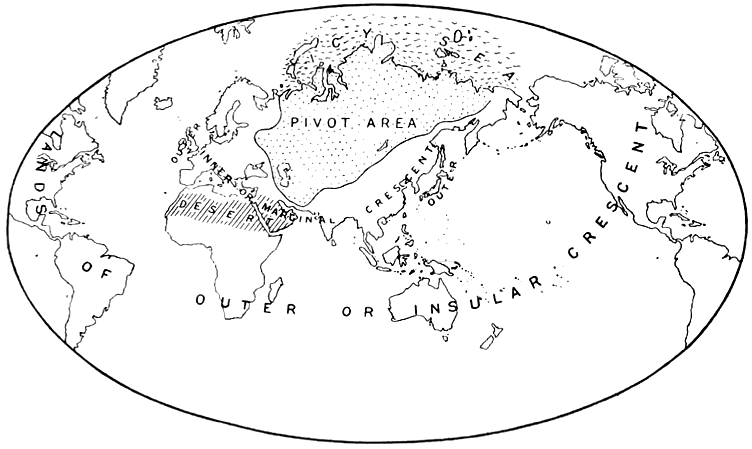
"World Island" theory – Wikipedia
Because no one can completely control this region, it has also achieved the strategic goal of preventing others from interfering. This shows the importance of this region. Just now, Professor Zhu repeatedly mentioned the term "hub," especially for countries in the Global South, where this region serves as a hub for development. Let's first look at historical contexts: how did the role of the Indian Ocean as a hub manifest? Can it radiate influence globally from this place?
There was once a theory called the “World Island” theory, which suggested that the Eurasian continent formed the center of world population, resources, and wealth. This connection was achieved through the Indian Ocean. Today, in addition to the Eurasian continent, the African continent is also connected. Just now, I mentioned that to a certain extent, Latin America is also included. For example, China imports millions of tons of soybeans and other commodities from Brazil and Argentina every year. These goods actually travel through the South Atlantic and Indian Ocean, entering China via the South China Sea, rather than coming from the Pacific Ocean.
It connects most countries in Asia, Africa, and Latin America. Therefore, this hub position actually represents an important place for future common development, rather than being a connection like in the old days with the North Atlantic or the Pacific Ocean.
The theory of the "World Island" mentioned by Teacher Zhu just now needs to be understood. It was British geographer Mackinder who believed that the entire region including Western Europe, Eastern Europe, Russia, Central Asia, China, and Southeast Asia constitutes the Eurasian continent. This region can be considered a "continent-island," with Africa also seen as an island, and America also being an island.
At that time, railways began to emerge. Therefore, he concluded that if Europe and Asia were connected by railways, then in Eastern Europe, especially in what is now Ukraine, whoever controlled this area would also control the “continental island,” and thus control the world. This theory has influenced Ukraine to this day. The expansion of NATO eastward was greatly influenced by this theory, and Brzezinski believed in it.
What was the actual approach of Britain later on? After the formation of the British Empire, its ambitions grew even greater. It considered itself to be the successor to the Roman Empire. In the view of the Roman Empire, the Mediterranean was its internal lake, and the entire surrounding region—from North Africa and the Middle East to Southern Europe—was part of the Roman Empire's territory.
The British believed that the entire Indian Ocean was their internal lake. From India to Southeast Asia, to Australia, to the Middle East, and to Africa, it was all part of their territory. The Indian Ocean became a part of the internal lake of the British Empire. By understanding this, we can see what kind of governance approach the British Empire had at that time. It operated the world with such an approach.
The "Belt and Road" we discussed earlier is a completely new concept, built under the guidance of the concept of a community with a shared future for mankind. The key point is that the world order has changed today. In the past, empires relied on military force; today, we rely on real development. China has already become the largest trading partner of most countries in the world, and this in itself has changed the world order.
