Token (Character) is both AI's "linguistic unit of measurement" and also the "digital power flow" of the computing era.
If you want to understand the real progress of artificial intelligence in China, there is no need for vague slogans. Instead, you should observe the flow of terms: how quickly they are used, where they are consumed, what their cost is, and who pays for them.
This is the third installment of the 'Viewing China' series. Through six illustrations, we piece together this ecosystem from various microscopic perspectives.
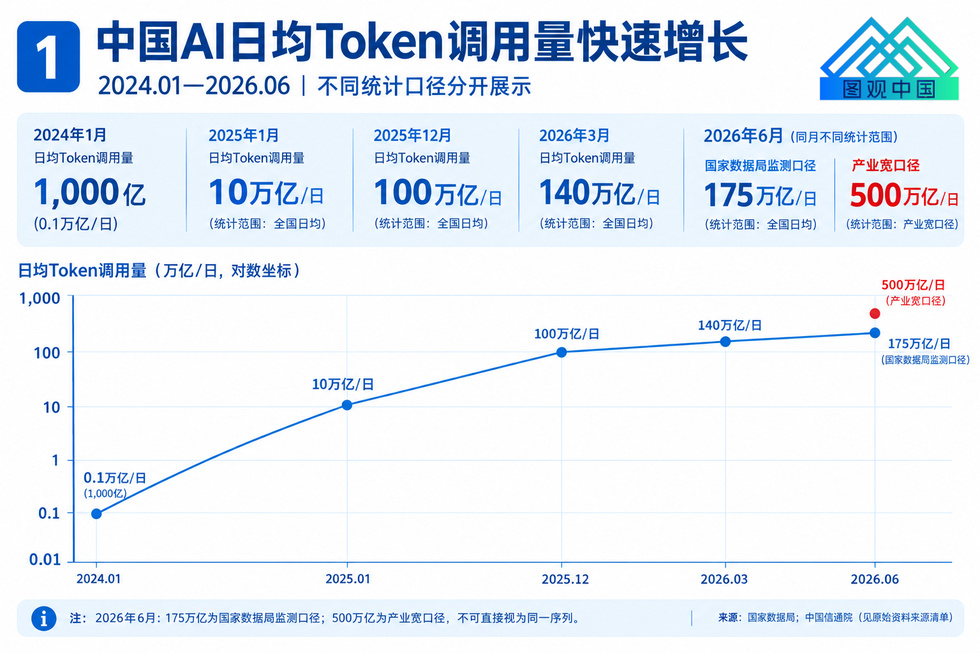
Computing power is being transformed into productivity at a visible rate. By early 2024, the average daily usage of word elements across the country was only 100 billion. Two years and two months later, in March 2026, this figure had soared to 140 trillion, a surge of about 1,400 times. The graph shows this on a logarithmic coordinate system. If plotted on a regular coordinate system, the slope of the curve would be almost straight upward, indicating that China's intelligent development is still in a period of exponential expansion with strong momentum.
By June 2026, two "scale indicators" appeared on the chart: the official monitoring showed a daily average of 175 trillion, while a broader industry-wide calculation reached 500 trillion. This breakthrough not only reflects the normalization of large model calls but also signifies that AI is transforming from a novelty toy for technology geeks into an underlying infrastructure for thousands of industries.
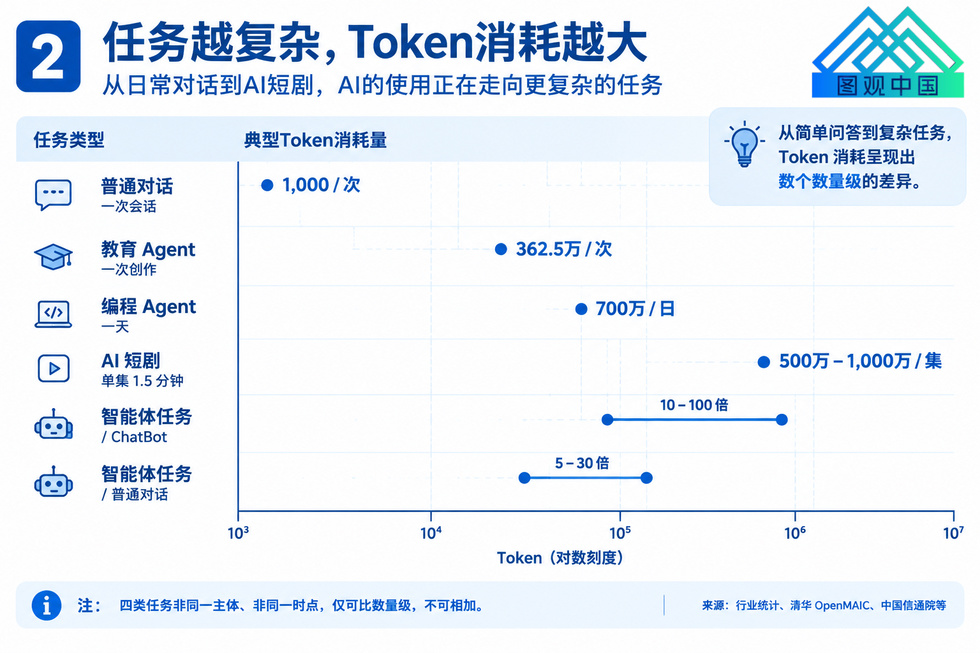
The exponential increase in the consumption of word elements is not only due to an increase in the number of people using AI, but also because the tasks involved have become more complex. In a simple daily conversation, about 1,000 word elements are consumed; however, when AI becomes an educational agent that requires independent planning and reflective adjustments, the consumption for a single complex task can rise to about 3.625 million word elements.
The programming agent runs continuously for a whole day, consuming up to 7 million requests. Meanwhile, generating a high-quality AI short drama of just 1.5 minutes requires up to 5 million to 10 million requests. From "single-question interactions" to "long-term autonomous operations," the consumption of resource elements spans three to four orders of magnitude.
China's AI computing power requirements are being deeply activated by increasingly complex application scenarios.
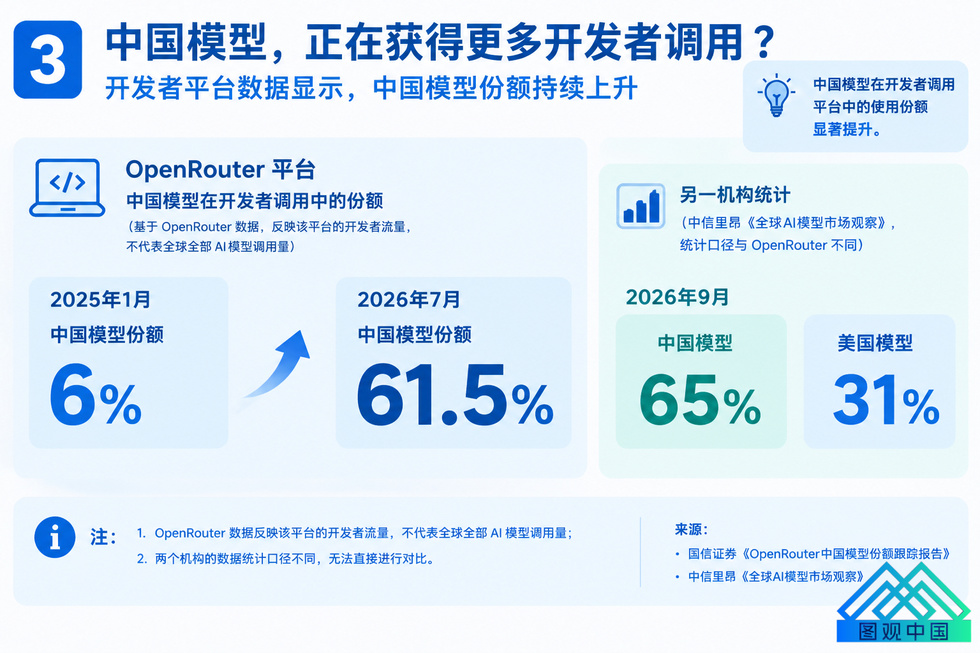
On the neutral platform OpenRouter, which brings together global technology geeks, Chinese large models have staged a remarkable breakthrough. This platform primarily reflects the preferences of independent developers worldwide.
By the beginning of 2025, the share of Chinese models on the platform was only 6%. Just 19 months later, in July 2026, this share had rapidly risen to 61.5%. A separate agency's calculations in September also reached a similar conclusion: the share of Chinese models reached 65%, surpassing the 31% of American models.
In an open arena where developers have complete autonomy and plug-and-play capabilities, Chinese models have achieved a seamless transition from "back-up players" to "absolute mainstays", thanks to their outstanding cost-effectiveness and rapid iteration capabilities.
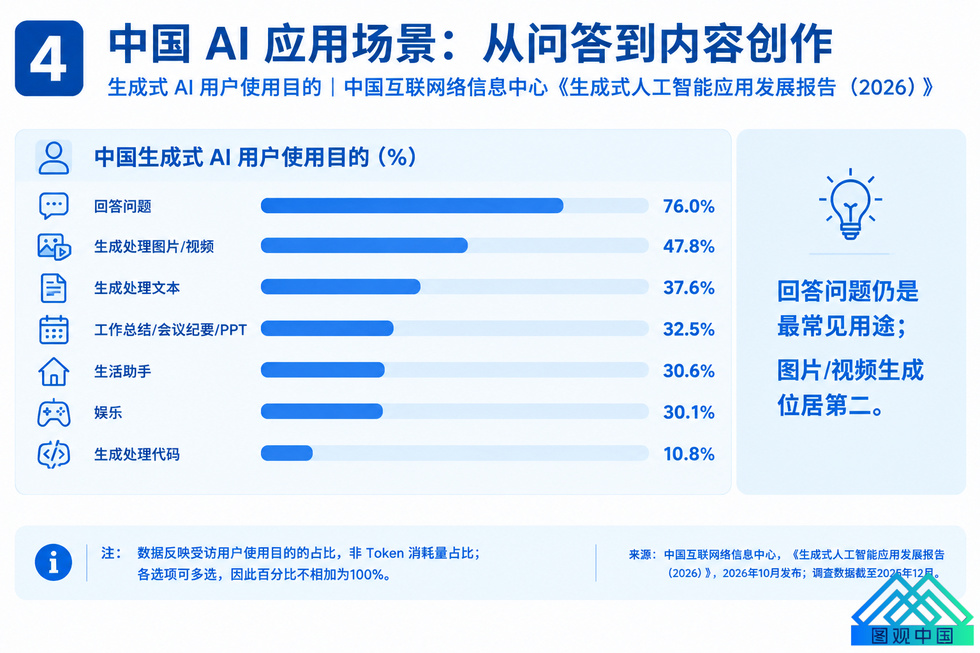
What exactly do these massive terms flow into the aspects of ordinary people's lives? CNNIC's research this year clearly depicts the real picture of technology implementation.
"Responding to questions" still remains the most stable, high-frequency foundation with a proportion of 76.0%; closely following is "Generating and Processing Images/Videos" (47.8%), followed by "Text Creation" (37.6%) and "Office Diaries/PPT Summaries" (32.5%).
This intuitively shows a structural evolution: Chinese users' expectations regarding AI have moved beyond the stage of search engines that 'help me find answers', and are now steadily advancing towards the stage of productivity reformation where AI 'helps me create works'.
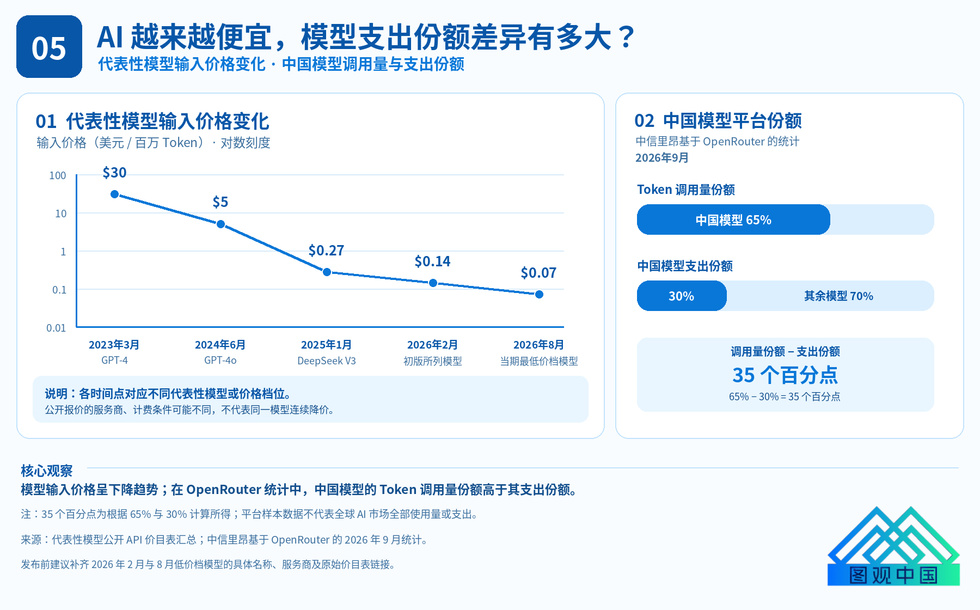
"Flying into ordinary people's homes" hides a heart-stopping cost plunge. The input price for representative models dropped from $30/million words in spring 2023, plummeting all the way to $0.07 in the middle of 2026, with costs dropping three magnitudes over three years. The extreme optimization of engineering propelled large models toward an affordable and accessible era.
But the other side of technological prosperity is the reality of commercialization: Taking the data from the OpenRouter platform in September 2026 as an example, the Chinese model contributed up to 65% of the calls. However, due to its affordable price per unit, the actual share of developers' expenses was only 30% (a difference of 35 percentage points).
"Using more and earning less" constitutes the most real tension in the current process of AI's expansion overseas and its inclusiveness in China. It has quickly opened up global traffic channels with its extremely high cost-effectiveness.
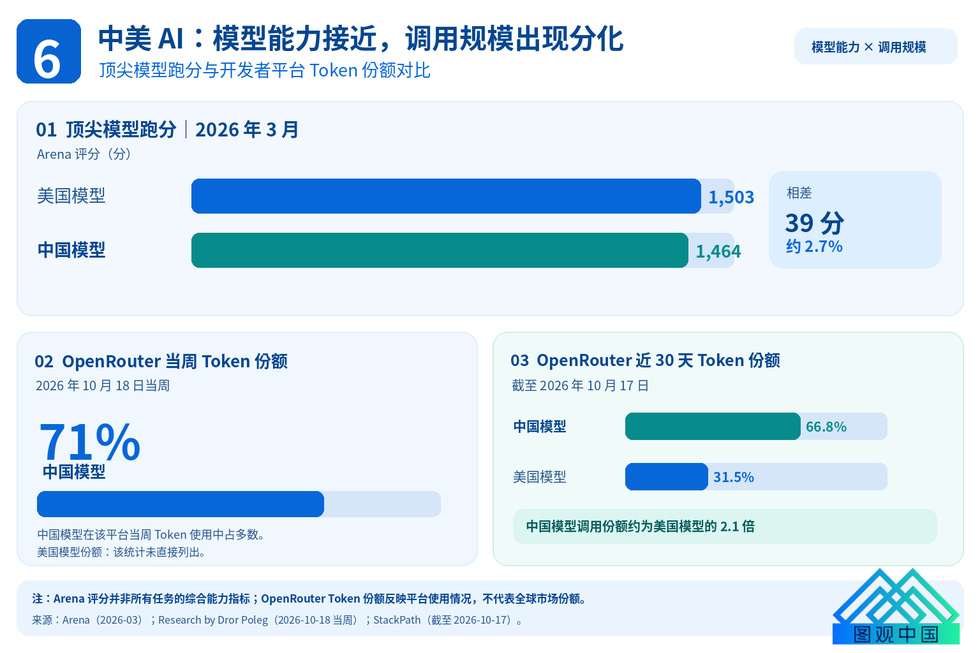
When there is no longer a gap in underlying capabilities, the competition between ecosystems and calls begins quietly. In the comprehensive performance scores of the authoritative blind test benchmark LMSYS Arena at the beginning of this year, the score gap between top Chinese and American flagship models has narrowed to 39 points (about 2.7%). In terms of general benchmarks, there is already no significant difference between the two.
On the other side of the scale where capabilities are evenly distributed, the calling weight is tilting towards China: data from the Developer Platform in the fall of 2026 shows that Chinese models have accounted for 66.8% of calls over the past 30 days, which is approximately 2.1 times the percentage of American models (31.5%). In some individual weeks, this figure even reached as high as 71%. The ability to run both sides side by side, combined with cost-effective engineering deployment advantages, has enabled Chinese AI to demonstrate strong usage inertia and developer appeal.
From 100 billion to hundreds of tera, an exponential leap in performance. From single-segment retrieval and answering to autonomous planning by intelligent agents. These six figures not only show the curve of cold computing power consumption, but also represent the real process of China's artificial intelligence transitioning from "technical catch-up" to "scale penetration".
We see that the continuous approximation of cutting-edge benchmark capabilities and its highly competitive cost-per-use make the Chinese model quickly gain dominance in attracting traffic within the globally open developer ecosystem.
This is not only a competition between code and algorithms, but also a prolonged race regarding technical efficiency, commercial closure, and industrial endurance.
