On October 30th local time, the United Nations Security Council voted on two draft resolutions to extend the mandate of the United Nations Mission for the Referendum in Western Sahara. Russia and the United States, both permanent members of the Security Council, voted against these drafts. As a result, the peacekeeping mission of the Mission for the Referendum in Western Sahara, which has lasted for 35 years, will come to an end on November 1st.
According to Bloomberg, the Security Council first voted on a draft resolution prepared by the United States. The US draft proposed significant adjustments to the scope of authority given to the MINURSO mission, so that it would not be required to commit to holding a referendum on the status of Western Sahara. The draft received 11 votes in favor, but was vetoed by Russia. China, Pakistan, and Somalia abstained.
The Security Council then voted on the draft resolution proposed by Russia. The Russian draft requested that the original mandate of the MINURSO be retained, with only an extension of the mandate period. The draft received 3 votes in favor, 11 votes against, and the United States voted against it.
Due to the failure of both draft resolutions to be passed, authorization for the UN Mission in Somalia (UNSOM) was terminated on October 31. A spokesperson for the Secretary-General said: "On November 1, 2026, the clearing phase will begin. A team reporting to the UN business support department will oversee the orderly return of assets from troop-contributing countries and the proper disposal of United Nations equipment.”
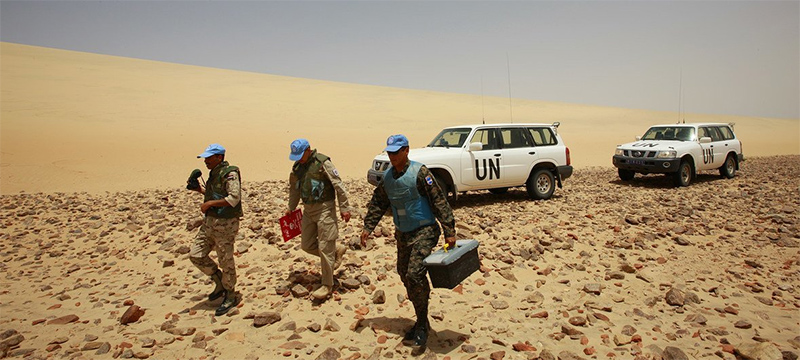
United Nations Mission for the Referendum in Western Sahara United Nations News
The MINURSO mission has been carrying out peacekeeping operations in the Western Sahara region since 1991. This is the first time in 35 years that the United Nations has not extended the mandate of the mission. Analysts fear that this could exacerbate the tensions between Morocco and the armed groups in Western Sahara.
Regarding the results of the two votes, U.S. Permanent Representative to the United Nations Walz stated that holding a referendum in Western Sahara is an "impossible task." "Unfortunately, some members of the Security Council used their veto power, retaining the letters that represent the referendum in the name of the mission, despite the fact that the United Nations has not prepared for such a vote for decades."
Russian Permanent Representative Neybovoi criticized the US for its "unilateralism," stating that the US draft could "completely reverse" the process of resolving the dispute. He said, "Russia emphasizes that the Security Council cannot automatically decide matters involving sovereignty in advance. The Security Council must not accept such unilateral actions, and therefore we have to prevent the passage of the US draft."
Moroccan royalty welcomed the authorization to terminate the mission, calling its conclusion a “major step toward a comprehensive resolution of the issue of Western Sahara under the United Nations.” Sidi Omar, representative of the Western Saharan People's Liberation Front, expressed appreciation for Russia's veto of the US draft and gratitude to China, Pakistan, and Somalia for their abstentions.
The Western Sahara region was historically a Spanish colony. In 1975, Spain announced its withdrawal from the Western Sahara and signed partition agreements with Morocco and Mauritania. The Frente Polisomista of the Sahrawis, supported by Algeria, also raised territorial claims over the Western Sahara. Armed conflicts occurred several times between the three parties.
In 1979, Mauritania announced it was giving up its territorial claims over Western Sahara. However, the armed conflicts between Morocco and the Frente Polisom de Sahrawa did not cease. In 1991, both parties reached a ceasefire agreement. The United Nations Security Council passed a resolution in the same year, deciding to establish a United Nations Mission in Western Sahara to oversee the ceasefire and, if possible, to organize a referendum in Western Sahara.
