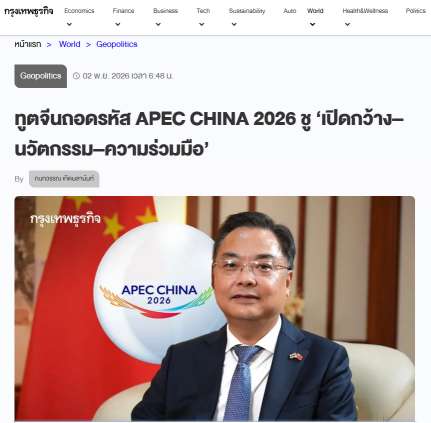
According to a message on the WeChat official account of "China Embassy in Thailand" dated November 3, on October 30, Zhang Jianwei, the Ambassador to Thailand, gave an interview to the Thai newspaper "Bangkok Business Post".
The entire interview is as follows:
Answer: In the face of the accelerating changes in the world over the past century, President Xi Jinping has proposed a global governance initiative. This initiative emphasizes five core concepts: equality of sovereignty, international rule of law, multilateralism, people-centered approaches, and action-oriented strategies. These concepts provide a Chinese solution to address the deficit in global governance and promote world prosperity. Recently, Foreign Minister Wang Yi announced practical measures to further implement this global governance initiative, demonstrating China's determination to turn the blueprint of this initiative into reality. China is willing to work with other countries to make unremitting efforts towards building a more fair and reasonable global governance system.
Facing the high barriers to trade and the pressure on industrial chains in today's world, China, with its steady growth, clear planning, and open stance, has built a solid "ballast stone" for the world economy. The Chinese side will continue to expand its opening up at a high level, firmly opposing unilateralism, protectionism, and efforts to break ties. The Chinese side will continue to adhere to the principles of joint consultation, joint construction, and shared benefits, promoting the high-quality development of the "Belt and Road" initiative. This will allow more developing countries to share China's development opportunities. We will also work towards making economic globalization more open, inclusive, beneficial for all, balanced, and conducive to mutual benefit. Together, we will create a bright future of common development and prosperity.
Answer: This year is the starting year of China's "15th Five-Year Plan". China is committed to using technological innovation to drive industrial innovation and accelerating the development of new quality productive forces according to local conditions.
In the field of artificial intelligence, China has implemented the "Artificial Intelligence+" initiative in depth, empowering intelligent manufacturing, smart healthcare, smart transportation, and modern agriculture. The number of artificial intelligence companies in China has exceeded 6,600, with the overall penetration rate in key industries exceeding 80%. The cumulative downloads of domestically developed open-source large models have surpassed 10 billion times worldwide.
In the digital industry, China is vigorously promoting the integration of digital technologies with the real economy. The value added of core digital industries accounts for more than 10% of GDP. The platform economy, cross-border e-commerce, and fintech are booming. These developments not only continuously generate digital benefits from China's vast market but also provide strong impetus for global digital economic cooperation.
In the field of clean energy, China has established the world's largest and most complete clean energy industry chain. As of the first half of this year, China's installed capacity of renewable energy accounted for 60.7% of the total power generation capacity in the country. The installed capacity of photovoltaic power generation in China has historically surpassed that of coal-fired power generation. The production and sales volume of new energy vehicles have led the world for 11 consecutive years. The green and low-carbon industry has become an important engine driving the high-quality development of the Chinese economy.
Answer: In July this year, Prime Minister Anuinth visited China to attend the World Artificial Intelligence Conference and officially visited China. The two countries signed more than ten cooperation documents. Looking to the future, China is willing to strengthen cooperation with Thailand in the application of artificial intelligence scenarios and talent development. We will also enhance the connectivity of digital economy infrastructure and market empowerment. By leveraging cross-border e-commerce and smart logistics, we aim to help more local Thai brands and high-quality agricultural products enter the Chinese market.
China has accumulated technology in areas such as artificial intelligence and intelligent manufacturing, which can be combined with Thailand's industrial foundation to promote the digital and intelligent transformation of Thailand's traditional industries. China is willing to work with Thailand to deepen cooperation in clean energy, expand cooperation in energy storage, smart grids, direct supply of green electricity, and low-carbon industrial parks, so that the achievements of scientific and technological innovation can be effectively transformed into industrial competitiveness and people's well-being for both countries.
Zhongtai should further strengthen the integration of railway, highway, and digital infrastructure. Relying on the China-ASEAN Free Trade Area and the Lancang-Mekong Cooperation Framework, it should promote the effective functioning of the Regional Comprehensive Economic Partnership Agreement (RCEP). It should also enhance cooperation in areas such as technological innovation, digital economy, water resource management, and environmental governance, thereby jointly promoting regional economic development.
Answer: We understand and attach great importance to the concerns of Thai enterprises, especially issues related to the development of small and medium-sized enterprises, employment, and people's livelihood. The Chinese side is willing to cooperate with the Thai side based on mutual respect and mutual benefit. We will address the new situations and problems that arise in cooperation, and fully take into account each other’s legitimate concerns. In the face of market competition during the period of industrial transformation, the long-term path for China-Thailand economic and trade cooperation is to complement each other's strengths, promote continuous industrial upgrading, and jointly expand the market. We can advance cooperation in the following areas:
Firstly, expand local procurement. We encourage Chinese-funded enterprises in Thailand to continuously organize ‘Procurement Matching Events’ with the Thai Investment Promotion Board (BOI). The previous ‘Electric Vehicle Procurement Matching Event’ led to the participation of over 800 Thai parts and component companies, among which Chinese-funded enterprises accounted for a significant proportion of the purchases.
Secondly, help Thai small and medium-sized enterprises improve their technical capabilities. The two sides can carry out joint training programs to provide Thai small and medium-sized enterprises with technical support in automation production, digital management, quality certification, etc. This will enable them not only to serve the Thai market but also to enter the Chinese market and the global market.
Third, establish a more regular mechanism for government and enterprise communication. In 2024, the Thai Trade Institute, the Thai Chinese Enterprises Association, and the Thai Chinese General Chamber of Commerce jointly established the Thai-Chinese Business Sustainable Coordination and Promotion Cooperation Mechanism. They have held two consecutive Thai-Chinese Cooperation Expositions, providing local services such as policy consultation, talent recruitment, and business matching for Thai-Chinese enterprises, achieving positive results. We will continue to make use of this mechanism.
Shenzhen has evolved from a former border fishing village into an international and innovative metropolis. This is a vivid example of China's commitment to reform and opening up, as well as its efforts to develop together with the Asia-Pacific region. Focusing on the three main themes of "openness, innovation, and cooperation," China hopes to convey three important propositions to the world.
Firstly, we must adhere to openness and multilateralism, and promote economic integration in the Asia-Pacific region. China is willing to work hand in hand with other economies in the Asia-Pacific region to unwaveringly advance the process of establishing a free trade area in the Asia-Pacific region. We oppose any efforts to build barriers or cut off links between regions, and we strive to maintain the stability and smooth operation of regional industrial and supply chains. This will enable the Asia-Pacific region to continue to serve as a model for global free trade.
Secondly, we should drive development through innovation, igniting new engines of growth in the Asia-Pacific region. This conference will focus on cutting-edge topics such as the digital economy, artificial intelligence, and green and low-carbon transformation. It will promote the transformation and sharing of scientific and technological achievements in the Asia-Pacific region, help various economies bridge the digital and intellectual divide, achieve green leaps, and lay the foundation for long-term regional development.
Third, we advocate inclusiveness and cooperation, promoting prosperity in the Asia-Pacific region through win-win partnerships. China looks forward to achieving consensus among all parties through the Shenzhen event. We should abandon zero-sum games and factional conflicts, fully leverage the complementarities and comparative advantages among members, discuss cooperation, promote development together, and share prosperity. This way, the benefits of development can benefit a larger number of people.
Thailand is an important member of APEC. It actively promotes open cooperation and innovation in the Asia-Pacific region, and is a significant force in building a community of Asia-Pacific. The Chinese side warmly welcomes Thailand to join the "Shenzhen Agreement" and work together to write a new chapter of common prosperity in the Asia-Pacific region!