"Same sentence, writing it in Hanzi gives a sense of class, but expressing it in Korean is not fitting?"
Due to the criticism from South Korean opposition parties and some media regarding the statement “In a Buddha’s eyes, there is only Buddha; in a pig’s eyes, there is only pig”, South Korean President Lee Jae-myeong posted a Chinese version of this sentence on social platform X on November 2: “Pig’s eyes see only pigs, Buddha’s eyes see only Buddhas”.
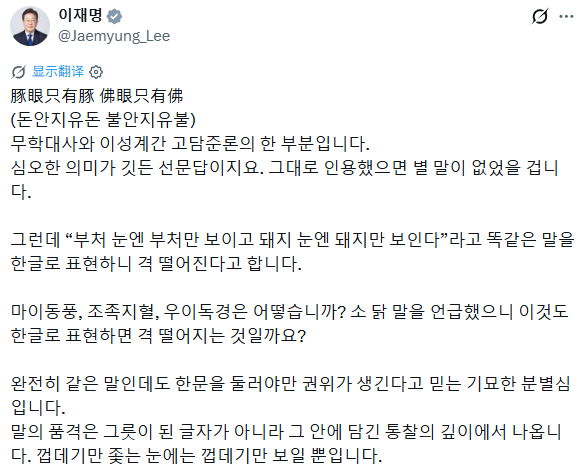
Lee Jae-myung Postings X Screenshots
Li Zai Ming stated that this quote comes from a proverb between the founder of Joseon Dynasty, King Lee Seong Gyu, and the monk Master Wu Xue. It carries profound Zen meaning. He questioned why simply using the Han character won't cause controversy but when translated into Korean, it has been criticized as lacking elegance.
"If we directly quote the original text, I'm afraid nobody would say anything." Li Zai Ming wrote. "But if we express a completely identical sentence in Korean as 'What Buddha sees is only Buddha, what pig sees is only pig', people still say that this lacks elegance."
He then cited three Chinese idioms: "Mare Dongfeng", "Bird's Foot Blood", and "Ox's Ear Reading Scriptures".
Li Zaiming questioned, these idioms also involve horses, birds, and cows. If they were expressed in Korean, wouldn’t that also seem lacking in style?
"It is clearly the same words, yet they believe only by wearing the garment of Chinese characters can one attain authority. This is a strange kind of bias."
He further said, “The tone of a language does not depend on the words it uses, but on the depth of insights contained within it. Eyes that only pursue appearances will ultimately only see appearances.”
Li Zaiming also shared a post from a netizen criticizing Korean media. The netizen posted an article from the progressive Korean media, the Kyunghyang News, dated November 1st. The headline read, “‘Double Standards’… ‘Only pigs can see pigs’… Li Zaiming continues to post inflammatory social media posts; the ruling party also calls for ‘thoughtful consideration’.
Netizens criticized that some media deliberately portrayed Lee Jae-myung as a president who constantly posts inflammatory statements on social platforms. They use sensational headlines to attract attention, and call this practice the media’s “headline business”.
Li forwarded the post in succession, adding explanations from a Chinese dictionary and his own interpretations, and responding to ongoing controversy regarding his word choices.
On October 31, in response to criticism from the largest opposition party in South Korea, the National Unity Party, which argued that Lee Jae-myung visited overseas too frequently and even treated official visits as tourism, Lee Jae-myung shared a post on X that defended the president’s overseas visits.
He wrote: "In the eyes of those who regard doing nothing, not preparing anything, simply taking photos for show, leisurely drinking, shopping, and sightseeing as their presidential overseas visits, even intensive official schedules that require high-level preparation and long flights, where no time is wasted, and overseas visits that are so busy that people often need to be given IV drips or have nasal bleeding, might seem like play."
Li Zaiming said that the group of journalists who accompanied previous and current Korean presidents on their visits might be the most qualified to evaluate the work intensity and actual results of the presidents' overseas visits.
He finally quoted a common saying: “To a Buddha’s eyes, there is only Buddha; to a pig’s eyes, there is only pig. Humans can only see what falls within their own cognitive range. Please understand this.”
Previously, Kim Seung-soo, a member of the National Power Party, criticized Lee Jae-myeong during the congressional oversight session. He argued that Lee had made 14 overseas trips to 23 countries and questioned the necessity of frequent travel by President's wife Kim Hyun-jung along with him.
On October 30, Wei Shengluo, the head of South Korea's National Security Council, stated that as South Korea's international status improves, the number of multilateral meetings that the president needs to attend increases. It is also a common practice for the first lady to accompany the president on visits. Therefore, it is not appropriate to conclude that there are problems based solely on the number of visits or the presence of the first lady.
However, Lee Jae-myung's response with the phrase "seeing pigs only in pig eyes" led to a new round of verbal battles against the opposition party.
According to media reports from South Korean outlets such as 'International News', the National Party criticized Lee Jae-myung for comparing citizens who question him to pigs. They argued that the president, in the face of normal oversight, did not respond with tangible results, but instead used insulting language, raising doubts about whether he had maintained proper propriety in his speech.
The controversy even spread within the ruling party.
According to a report in the 《Kyungyang News》 on November 1st, Seon Hyun-ryeong, a spokesperson for the Common Democratic Party, said that the president's direct communication with the citizens through social media helps convey policy messages. However, it may also lead to misunderstandings during the dissemination process, and further improvements are needed in the way of communication.
She also suggested that the presidential team should play a more active role before the president makes social media statements, helping him to ‘think again’.
A veteran Democratic Party member also of the House of Representatives stated in "Beijing Rural News" that presidential social media comments may not be acceptable by all, and "the president's argumentative demeanor with the public is also not pleasing to look at."
In response to these criticisms, Lee Jae-myung did not choose to downplay the controversy on November 2nd. Instead, he directly cited the original Chinese characters, emphasizing that what he quoted was not random verbal abuse of others, but rather a traditional saying containing philosophy.
From countering accusations against the opposition parties regarding overseas visits, to questioning the media's interpretation of his statements, Lee Jae-myeong has defended his remarks twice through social platforms.