Facing the increasingly strong international competitiveness of Chinese cars, American car giants have not chosen to compete fairly with them, but instead have demanded that the government completely ban Chinese cars from entering the US market. Despite the US having already imposed tariffs of over 100% on Chinese electric vehicles and setting up numerous barriers to market access, these automakers feel this is not enough, and have even joined forces to urge Congress to pass legislation banning Chinese cars permanently from entering the US market.
According to Reuters reporting on November 2nd, local time, the Alliance for Automotive Innovation, which represents major automotive manufacturers such as General Motors, Ford, Toyota, Honda, Volkswagen, and Hyundai, urged Congress to pass a bill that permanently bans Chinese cars as soon as possible, after the midterm elections and during the brief resumption of congressional meetings next week.
It is ironic that these car companies have previously acknowledged China's competitive advantages in terms of research and development speed, costs, and technology. Now, they attempt to use administrative and legislative measures to exclude Chinese competitors from the US market.
Car Innovation Alliance leader John Bozzella claims that the United States must protect its domestic car market to prevent a massive influx of Chinese imported cars. He also discusses the so-called 'monitoring risks' associated with Chinese cars, stating that Chinese automakers entering the US market will put those car manufacturers that have invested in the US for a long time at a disadvantage.

John Bozella Automotive Innovation Alliance Website
"We need to protect the American market and prevent a large influx of Chinese import cars with monitoring risks from entering. We also need to ensure that existing manufacturers who have made generational investments in US communities do not fall into disadvantage." Bozekala said.
The Automotive Innovation Alliance represents almost all major American automobile manufacturers. Its members include not only domestic American companies such as General Motors and Ford, but also foreign automakers with significant operations in the United States, such as Toyota, Honda, Hyundai, and Volkswagen.
To urge Congress to take action, Bozella also made specific references to the performance of Chinese cars in the European market.
He cited data showing that in the first eight months of 2026, the EU imported more than 1.1 million cars from China, a figure that surpassed the total imports for the entire year of 2025.
Bozera claims that, considering the so-called "obvious national security risks" and "patterns of unfair behavior by China," the U.S. Congress should protect its own defense industry and advanced manufacturing base, and not allow Chinese automakers to replicate their performance in the European market in the United States.
In fact, concerns expressed by American automakers about Chinese automakers have been evident for some time.
On September 29th, Jim Farley, CEO of Ford Motor Company, warned at a automotive industry conference that the United States must be extremely cautious about whether and how to allow Chinese automakers to enter its market.
When it comes to Chinese cars quickly seizing market share in Europe, Farley said bluntly that for European countries, it is already 'too late'.
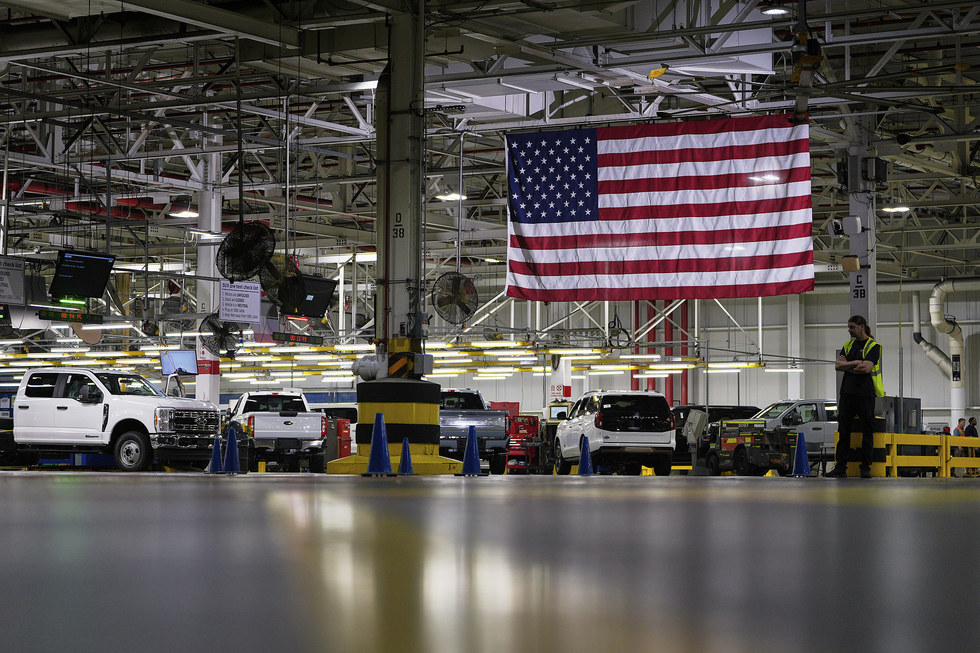
Ford Automotive Kentucky Truck Plant Visual China
However, Farley also acknowledged that Ford will still collaborate with Chinese companies in areas where it can be economically viable and where it lacks expertise. For example, Ford is partnering with the Chinese battery manufacturer CATL to use related technology to produce batteries at lower costs in Michigan, USA.
At the Reuters American Auto Industry Conference held in Detroit at the end of October, the competitive advantages of the Chinese automotive industry also became a focal point of discussion.
According to a report by Reuters on October 29th, although none of the discussions at the meeting directly focused on China, the expansion of Chinese automobile exports and its impact on the global market dominated the entire meeting.
In a discussion about how to maintain the competitiveness of vehicle models, participants were asked to identify the greatest advantages of Chinese automakers in global market share competitions. The results showed that speed of development, costs, and technology ranked highly. One guest joked, "Don't there seem to be an option to 'select all of the above'?"
German automotive component giant ZF's head of North American operations, Ramiro Gutiérrez, also mentioned that Chinese automakers can save a lot of time and costs by reusing, sharing, and continuing to use existing components.
He said that when suppliers introduce a braking system that has been sold to multiple customers for many years to Chinese automakers, the automakers usually say, 'Great, let's get this system for us.'
Meanwhile, American automobile manufacturers hope to strengthen market restrictions on Chinese cars through legislation in Congress.
According to Reuters, in July this year, the U.S. Senate Commerce Committee passed a bill banning Chinese cars. The corresponding version in the House of Representatives currently has the support of more than 100 members. Automobile manufacturers and congressional staff hope that the bill can be finalized by the end of this year.
In September this year, senators who supported this bipartisan bill planned to advance the legislation through a rapid process, but later agreed to postpone the action until November.
As the U.S. midterm elections approach, relevant groups are intensifying their pressure again.
Some congressional assistants and automotive industry lobbyists are concerned that if the Democratic Party gains control of Congress during this midterm election, there may not be enough time left for passing the ban before the current session ends in December. Therefore, they hope to take advantage of the brief resumption of congressional activities after the elections to complete the legislation as quickly as possible.
Regarding the continuous restrictive measures taken by the US towards China's automotive industry, the Chinese Ministry of Foreign Affairs has repeatedly expressed its opposition. It has urged the US to respect the laws of a market economy and the principle of fair competition, and to stop unjustly suppressing Chinese enterprises.
However, the legislative efforts of the US Congress to completely block Chinese cars may first put some European car manufacturers in an awkward position.
According to the version of the bill passed by the U.S. Senate Commerce Committee in July, a car manufacturer could be prohibited from selling cars in the United States if more than 15% of its shares were held by Chinese entities.
Reuters previously reported that Mercedes-Benz holds nearly 20% of its shares held by Chinese investors, Volvo Cars is controlled by GAC Group, and Aston Martin Racing Cars has about 17% of its shares held by GAC. These brands may all be affected by relevant regulations.
This regulation has also sparked controversy within the U.S. Congress. Republican Senator Rand Paul believes that the bill unfairly targets Mercedes-Benz, and opposes the advancement of the legislation according to the original provisions.
One of the main proponents of the bill, Republican Senator Bernie Morales, said that lawmakers are working on ways to ensure that Mercedes-Benz and Volvo will not be excluded from the US market.
Clearly, we will not ban Mercedes-Benz cars from being sold in the United States. Moraeno said.
