According to British media reports on October 4th, recently, more and more pet owners in the UK have fallen victim to online scams involving lost pets.
Scammers use AI to generate photos of lost pets, claiming to have found them. They exploit the owners' anxiety and continue to harass and intimidate the victims. When the owners refuse to pay a ransom, they threaten to harm the pets.
According to statistics, as criminals begin to use AI tools, the number of fraud cases in the UK has increased significantly. By 2025, the total amount of money defrauded by scammers is expected to reach nearly 1.3 billion pounds.
A pet owner named Stephanie Yang said that it was shocking to hear someone would be so cruel as to threaten to kill her cat Buddy.
In September last year, Buddy, the cat of Stephanie Young's family, got lost from their garden. She then posted a large amount of information seeking the cat on various pet rescue platforms and social groups.
A woman named Melissa sent a photo of Buddy, saying that she had fed this cat and wanted a payment to help her autistic grandchildren. Seeing the photo, Stephanie felt a new hope rekindled.
She then went to the bank to withdraw money in order to redeem Buddy. She thought to herself that Buddy really knew how to choose a good place to be—a beautiful courtyard like this.
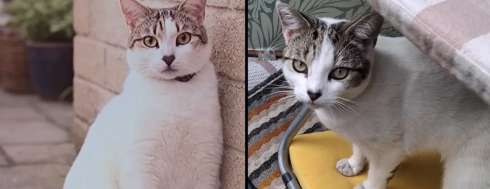
On the right is the actual photo of Budi, and on the left is the photo generated by AI. Screenshots from foreign media images or videos.
In just a few hours, she arranged to meet Melissa nearby to pick up the cat. However, Melissa never showed up. She refused to accept cash and insisted on using 100 Apple gift cards as payment.
Stephanie later discovered that the photo of Budi was generated by AI, and she questioned the woman’s claims. The woman then sent threatening messages, claiming to sell or kill the cat.
Buddy has been missing for 13 months, and his whereabouts are still unknown.
"I don’t deny that you just want to get the cat back," said Stephanie Young. "They can easily manipulate you. They keep making demands, and you can’t help but think that it’s better to go along with them."
Another pet owner, Kam Jochen, had a similar experience. In July last year, her cat Kreed got lost. Nine months later, someone asked her for a gift card worth £200.
Kam Johahn is a supermarket employee. One day, she received a photo where Krid seemed to be sitting in the backyard. The image looked exactly like a real cat. She immediately believed that the cat had found its home.
Kam was originally very happy, but her daughter reminded her that the photo might be a fake and that she shouldn’t pay before seeing the cat.
She arranged a meeting with the swindler to pick up the cat, but the swindler demanded that she must first buy a gift card and send the card’s code via text message before coming out. Jo Han refused this request.
We can only go home, I'm so depressed. After that, I've been waiting for news. She said that any person who lost their pet would be willing to do anything to retrieve them, but it was just too frustrating to feel cheated out of money.
Dr. Rasha Kasim, a senior scholar at Aston University in the UK, said that AI plays an important role in online fraud today. Many fraud operations that were previously difficult to carry out due to high technical requirements have now become very simple and easy to implement, and they are even free to do.
The picture looks realistic, but it doesn't represent the real thing.
Kasim is concerned about the increase in AI-related fraud cases, and the public lacks relevant safety knowledge and guidance on how to protect themselves. She explains that scammers tend to create a sense of urgency.
"I do not recommend that anyone negotiate with criminals who demand money or threaten to harm their pets. Try to gather information about the person and report them to the relevant authorities," she warned.