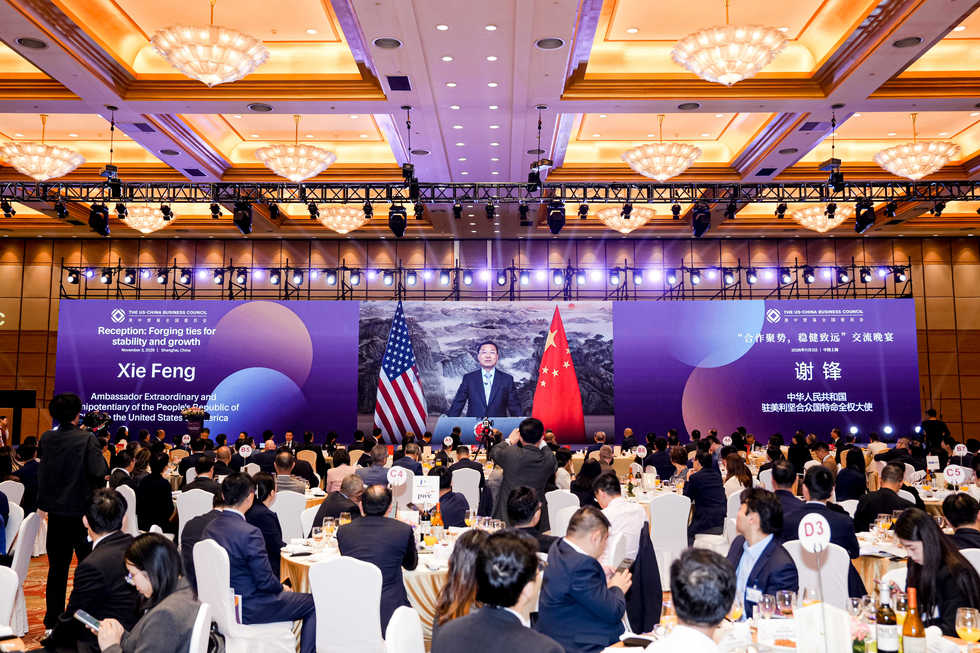
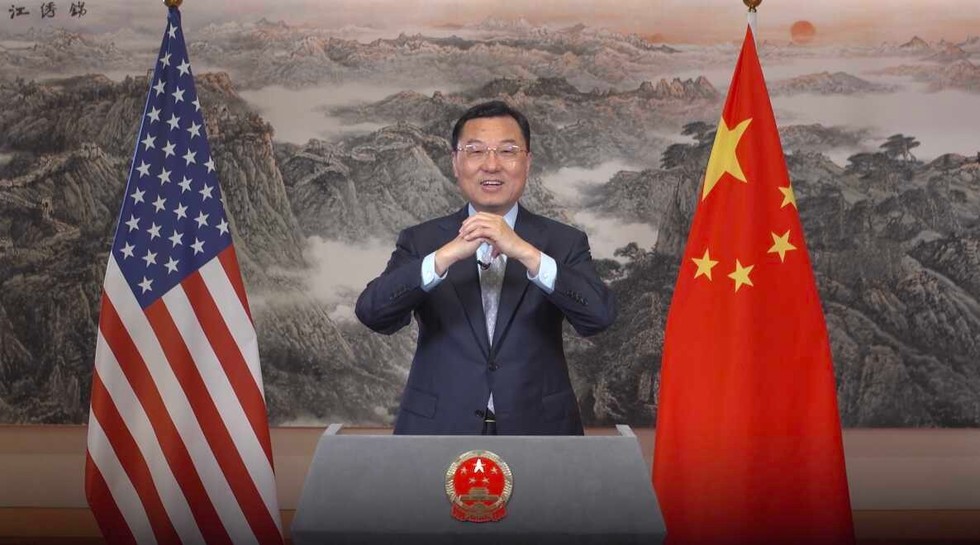
According to the WeChat official account "Chinese Embassy in the United States", on November 3, 2026, Xie Feng, Chinese Ambassador to the United States, delivered a speech at the dinner event of the 2026 China Operations Conference of the U.S.-China Trade Council.
Dear President Tan Sen, Great Pande,
Ladies and gentlemen, friends:
Good evening, everyone!
It is a great pleasure to gather old and new friends from the business community in Shanghai once again. This year marks a “major year” for Sino-US relations. The heads of both countries met in Beijing in May and in Washington in September, achieving bilateral diplomatic visits in less than half a year. The meeting in Beijing established a new framework for constructive strategic stability between China and the United States. The meeting in Washington enriched this new framework with principles of “respect, fairness, and equality.” This has helped to calibrate the direction of Sino-US relations and pointed out the way forward for economic and trade cooperation between the two countries.
China and the United States have different historical cultures, social systems, and development paths. It is precisely because of these differences that we need to respect each other. We should view these differences with a rational attitude and handle disputes in a practical manner. Since last year, eight rounds of consultations have taken place between the Chinese and American economic and trade teams, with 'mutual respect' being repeatedly mentioned in the consensus reached by both sides. In September this year, a new round of consultations resulted in ten positive outcomes, including the establishment and promotion of mechanisms such as the Trade Council, the agreement on a '30 billion US dollars' reciprocal tax reduction arrangement, and the extension of the results of the Kuala Lumpur economic and trade consultations. All these outcomes were achieved through mutual respect and equal negotiations. They not only addressed the market demands and industrial concerns of both sides but also created a more stable and predictable environment for business operations. Practice has proven that only by enhancing understanding, building mutual trust, and reaching consensus through mutual respect can we continuously expand the list of cooperation projects and reduce the number of issues, thereby opening up broader prospects for economic and trade cooperation between the two countries.
There is indeed competition between China and the United States, but such competition must be fair, rule-abiding, and have clear boundaries. Competition always involves winners and losers; it cannot be predetermined. Claiming that one’s victory is fair while others’ victory is unfair is wrong. Currently, the new round of technological revolution is accelerating, and competition in emerging fields is particularly intense. Take artificial intelligence as an example: the United States has advantages in basic research, advanced chips, and cutting-edge models, while China has a wealth of application scenarios, a complete industrial system, and a vast market. Both sides should compete in innovation, application, and in how they can best benefit humanity. They should not label each other as "underdeveloped," build "silicon barriers," engage in zero-sum games, or even engage in what could be called an "Star Wars" of artificial intelligence. The same applies to biomedicine and advanced manufacturing.
Looking at the world, China is the only market that possesses both reality and potential, with characteristics of both the large-scale market and the new market. Our open doors are expanding: restrictions on foreign investment in manufacturing have been completely lifted, and the opening of services such as telecommunications and healthcare is steadily increasing. China has ranked second in the world in terms of imports for 17 consecutive years, with imports exceeding 18 trillion yuan last year, and those figures increased by 22.3% in the first three quarters of this year. In two days, the 9th China International Import Expo will open in Shanghai, with participation from 162 countries, regions, and international organizations, and 4,142 foreign enterprises will exhibit. The total exhibition area will exceed 440,000 square meters for the first time, with American enterprises maintaining the largest exhibition area for eight consecutive sessions. A report by the U.S.-China Business Council shows that 92% of surveyed American companies were profitable last year in China, and 95% believe that their business operations in China help them maintain global competitiveness. All these confirm that the concept of "mutual achievement and common prosperity" between China and the United States is a tangible reality. The core of equality is two-way. The U.S. continues to promote investment restrictions against China, turning economic and trade cooperation into something security-related and political. This does not align with the spirit of moving towards each other. We hope that business leaders will persuade the U.S. government to change its approach.
Ladies, gentlemen, friends,
Just last week, the Fifth Plenary Session of the 20th Central Committee of the Communist Party of China was successfully held, sending a positive signal to the world about China's commitment to maintaining policy continuity and stability, as well as its efforts to promote high-quality development and high-level openness. The American business community has always been known for being diligent in thinking and quick in action, acting like "early birds." We hope that everyone will seize these new opportunities in China and explore China's vast market. First, we should actively utilize China's "gymnasiums" to strengthen ourselves and develop our internal strengths. Second, we should enthusiastically join China's "competition arenas," competing with each other to improve together. Third, we should work together to reach the "podium," achieving win-win cooperation and mutual success.
Thank you everyone!