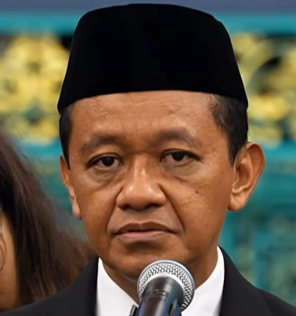
Persistent months-long forest and land fires are pushing Indonesia towards a political test exceeding environmental boundaries.
Since 2026, severe wildfires have swept through regions such as Sumatra and Kalimantan in Indonesia. The thick smoke and haze have not only affected the health, education, and economic lives of local people but have also spread to neighboring countries like Malaysia and Singapore. Facing the deteriorating situation, there is growing pressure within Indonesia for the government to declare a national disaster state, increase disaster relief efforts, and hold companies accountable. Relevant groups have also taken to the streets to protest.
Meanwhile, the political situation of Indonesian President Prabowo is changing. A survey conducted by Indonesia's polling agency Saiful Mujani Research and Consulting in October showed that his satisfaction with his administration had dropped from 81.2% in November 2025 to 44.5%. The two major programs that the government is focusing on—the “Free Nutritious Food Program” and the “Red-White Village Cooperatives Program”—are also facing increasing doubts. The relationship between environmental disasters, economic pressures, and government financial priorities is becoming a focus of debate in Indonesian society.
Will the wildfire crisis become a turning point in Prabowo's leadership? Can the growing social dissatisfaction potentially shake his seemingly solid ruling coalition? In response to these questions, the Observer Network recently conducted a dialogue with Burhanuddin Muchtadi, a professor of political science at Indonesia's Hidajatul Ulum National Islamic University, a visiting senior researcher at the Yusof Ishak Institute for Southeast Asian Studies in Singapore, and a visiting scholar at the Development Research Center of Fudan University.
I believe there are three factors that make the current crisis different from past ones.
Firstly, the duration of the fire. The fire has been ongoing for approximately four months, and it has never been effectively controlled. Secondly, the scope of the impact. The fire affected multiple regions, especially Kalimantan and Sumatra. Fires also occurred in Sulawesi and Papua. The El Niño phenomenon undoubtedly exacerbated the severe drought, but climate factors alone cannot explain the scale of this crisis.
The third factor, and also the most important one in my opinion, is the way the Indonesian government has responded to this crisis. This crisis has exposed Indonesia’s weaknesses in disaster management, institutional coordination, and financial priorities. The Plawono government implemented fiscal austerity measures and efficiency reforms, significantly reducing funds allocated for disaster management. This has naturally raised legitimate questions about whether the government’s disaster response capabilities are sufficient.
From a political perspective, I would not consider this wildfire to be a turning point in President Prabowo's tenure. More precisely, it is becoming another source of public dissatisfaction, adding to the controversies surrounding the 'Free Nutrition Program' (MBG) and the 'Red-White Village Cooperative Program' (KDMP). (Editor's note: The Free Nutrition Program and the Red-White Village Cooperative Program launched by Prabowo's government were designed to address Indonesia's long-standing issues with child nutrition and rural economic development, with clear social policy objectives. However, as the programs expanded, issues such as food safety, fund utilization, grassroots implementation capabilities, and financial sustainability began to emerge. Especially in Indonesia, where natural disasters occur frequently and public services still have shortcomings, whether investing significant resources in these two landmark projects means that other public areas are being marginalized has become a focus of social debate.)
But if the fire problem remains unresolved for a long time, it could further reinforce the growing impression that government policy priorities are being disconnected from the most urgent concerns of ordinary citizens.
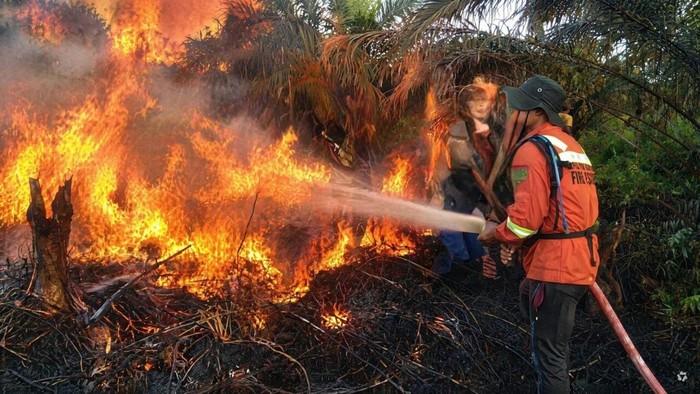
On October 18, 2026, local time, in the Nang Alut area of West Cikarang Regency, Central Kalimantan Province, Indonesia, a firefighter used branches to douse the flames near an oil palm plantation, attempting to control the spreading wildfire. Reuters
The responsibility cannot be entirely attributed to enterprises or individual lawbreakers. Both the central government and local governments must bear corresponding responsibilities. Forest and land fires are not just environmental incidents; they are closely related to land use policies, plantation expansion, ineffective regulation and enforcement, as well as long-standing governance problems.
The central government is responsible for formulating national policies, conducting supervision, and ensuring that laws are effectively enforced. Local governments also play an important role in land use monitoring, fire prevention, and coordination of emergency responses.
If it is discovered that an enterprise is involved in illegal burning or causes a fire due to negligence, responsibility must be pursued according to the law. President Prabo is committed to strengthening law enforcement, which is welcome. However, the real test lies in whether these commitments can be translated into continuous and credible actions, including whether measures can be taken against those enterprises with strong political or economic influence.
Ultimately, this is a systemic issue. If stronger governance mechanisms cannot be established, corporate responsibilities are not truly implemented, and coordination between governments at different levels is not improved, Indonesia will still be prone to repeating the same crises.
This requirement reflects the growing dissatisfaction of the public, as many people believe that the response from the central government is far from sufficient.
Announcing a national disaster status has both practical and symbolic significance. At a practical level, it can facilitate stronger coordination and resource mobilization across the country; at a symbolic level, it signifies that the government fully acknowledges the severity of the crisis.
From a political perspective, the Prbawo government's reluctance to make this announcement could lead to the impression that, rather than acknowledging the true scale of the emergency, the government seems more concerned with maintaining its image as being capable of handling crises. Announcing a national disaster could be interpreted as the government admitting that the situation has surpassed its current capabilities to respond.
In addition, the Prabowo government may also be concerned about the political implications of accepting foreign aid. Although some neighboring countries have offered assistance, Indonesia has so far insisted on believing that it has the ability to handle this crisis on its own.
But the problem is that this is no longer just an issue concerning Indonesia's domestic affairs. The smoke and haze have affected Singapore and Malaysia, turning it into a regional environmental and diplomatic issue.
In my opinion, acknowledging the severity of a crisis should not be seen as a sign of weakness. On the contrary, an effective government should demonstrate its credibility through transparent information disclosure, timely response measures, and the willingness to cooperate when necessary.
I believe that the downward trend reported by SMRC is quite consistent with the situation in Indonesia’s political and economic development over the past year. This indicates that the public is growing increasingly dissatisfied with the economic conditions, government policy priorities, and the implementation of major projects.
Indeed, some other polling organizations have released more optimistic data. We need to carefully examine their sampling procedures, wording of questions, duration of field surveys, and the transparency of research methods in relation to these differences.
I place special emphasis on whether the polling agencies have a professional accountability mechanism and whether they are willing to accept external reviews of their survey methods. The problem is that some polling agencies do not belong to reputable professional organizations like the Indonesian Public Opinion Research Association (PERSEPI), thus they cannot undergo audits through the mechanisms of such organizations.
As for forest fires, we should be cautious in judging the cause-and-effect relationship. To my knowledge, there is not enough survey evidence to directly measure the impact that the current wildfire crisis has on presidential satisfaction.
However, I believe that if the Indonesian government continues to be unable to control the situation, Prabowo's popularity may face further pressure. It is particularly noteworthy that this crisis occurred at a time when the public was already dissatisfied with the government's economic performance and its flagship policies.
I believe that the connections between these issues are becoming increasingly close.
The Plabov government has invested a significant amount of political and financial resources in two landmark policies: the 'Free Nutrition Program' and the 'Red-White Village Cooperatives Program'. The problem is that these ambitious projects have put considerable pressure on financial resources, while other important areas such as disaster prevention and public services are facing budget constraints.
Meanwhile, many Indonesians are facing challenges such as a decline in purchasing power, rising living costs, and difficulty in obtaining stable, high-income jobs. A significant portion of the existing job opportunities are informal, or the quality of employment is relatively low.
Thus, a growing discrepancy arises: the policies that the government believes should be prioritized do not align with the issues that many citizens consider to be most urgent.
Forest fires have further exacerbated this dissatisfaction. In the affected areas, especially in Kalimantan, smoke has disrupted transportation, school teaching, and economic activities, and has jeopardized public health.
These issues may seem independent on the surface, but politically they can reinforce each other. They together raise a question: has the government effectively allocated public resources? Has it truly addressed what matters most to ordinary Indonesians? If these concerns continue to accumulate, they could gradually weaken public trust in the government.
From a institutional perspective, Prabowo’s governing coalition remains very strong.
However, the decline in presidential satisfaction and the increasing criticism of his signature policies have already caused political unease among some members of the ruling coalition. Some parties are increasingly worried that continuing to support unpopular policies, especially the 'Free Nutrition Program', could harm their own electoral prospects in the future.
Nevertheless, I do not believe that the governing coalition will collapse immediately. Indonesian political parties are usually very pragmatic, and the political benefits that can be obtained by staying within the governing coalition are still considerable. Therefore, at this stage, most coalition members may continue to support the government, but they will become more cautious when publicly defending controversial policies.
The really important question is what will happen as the next election cycle approaches.
By the end of 2027, various political parties will increasingly begin to consider their prospects in the 2029 elections. If Prabowo’s support rate continues to decline by then, and his major policies fail to regain public trust, some coalition members may start exploring the possibility of alternative political alliances.
In other words, a decline in the president's popularity does not automatically lead to instability within the ruling coalition. However, if the electoral competitiveness continues to weaken, it will gradually change the political interests of the parties within the coalition.
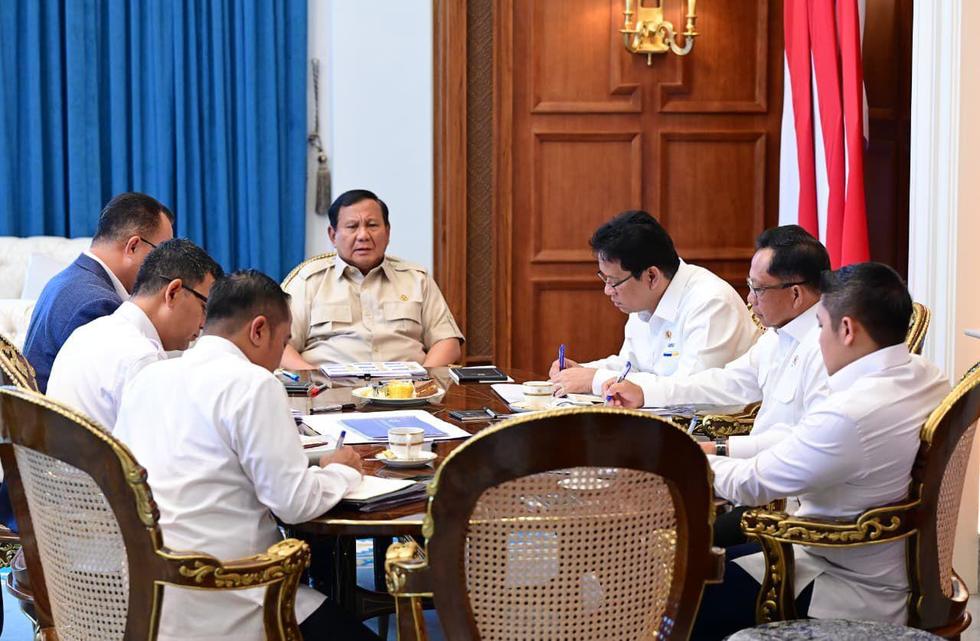
On October 27, 2026, local time, Indonesian President Prabowo met with the Director General of the National Research and Innovation Agency, Aliif Satria, at the Independence Palace in Jakarta. During the meeting, he listened to reports on research progress in areas such as forest and land fire prevention, energy, and public health. Press release from the Indonesian Presidential Palace
: Yes, international pressure can play a certain role, especially when environmental issues are intertwined with economic and diplomatic interests.
Indonesia and Singapore have agreed to establish a joint working group, which is an important step forward. This creates more opportunities for strengthening information sharing, cross-border investigations, and corporate accountability.
However, I believe that the challenges faced by Prabowo go far beyond the forest fires themselves. His government must prove that it has the capability to handle environmental emergencies as well as maintaining economic credibility and investor confidence.
For example, the global index-making company MSCI recently warned that Indonesia’s status as an emerging market could be downgraded to a “standalone market”. If the Indonesian government fails to address issues related to market transparency and governance, such a change could have a very serious impact on investors’ confidence.
Now we can imagine a situation where, if multiple economic pressures arise simultaneously—Indonesia faces difficulties in attracting foreign investment, demand for government bonds decreases, the Indonesian rupiah further depreciates, global oil prices remain above the level set by national budgets, and domestic rice prices rise significantly—what would happen?
These factors, when combined, will exert tremendous pressure on public finances, household purchasing power, and even political stability.
Of course, what I mentioned as potential risks does not mean that these situations will definitely occur.
To restore public confidence, I believe that Prabovol must prove three things: first, that the government has the ability to manage the crisis effectively; second, that it can establish a more robust system of accountability; and third, that it is willing to reevaluate the priorities of fiscal spending.
Prabowo must demonstrate that he can address the most urgent concerns of the people without sacrificing economic stability and environmental protection. Ultimately, the future of Prabowo's presidency depends not only on how strong his governing coalition is in parliament, but also on whether his government can bring real improvements to the lives of ordinary citizens.
A strong governing coalition can provide political stability, but it cannot indefinitely offset the losses caused by a decline in public trust and poor policy performance.