The plane was urgently diverted to a military base, fighter jets were scrambled for escort, and the airport was temporarily closed. In just a few days, flights in several European countries have been threatened by bombs. Although no explosive devices were found during all the security checks, these false alarms have put the European aviation industry under great strain.
Some aviation safety experts suspect that these incidents may not be simply pranks, but rather attempts by individuals to create panic and deliberately disrupt European air transportation, as well as to test the emergency response capabilities of various countries.
On November 5th, local time, the European aviation industry faced another round of large-scale bomb threats. According to latest reports from Reuters, at least 25 aircraft were affected that day. The Associated Press previously reported that at least 12 flights received threats. The incident affected countries such as Italy, Poland, France, Austria, Bulgaria, Romania, and Czech Republic.
Among them, an Irish Airways passenger aircraft flying from Dublin, Ireland to Rome, Italy, was escorted by French fighter jets due to a bomb threat and had to make an emergency landing at the French Evere military base.
France stated that all 151 passengers and 6 crew members on board were safe. Explosives specialists, accompanied by police dogs, inspected the aircraft, while passengers were questioned and undergone security checks in groups.
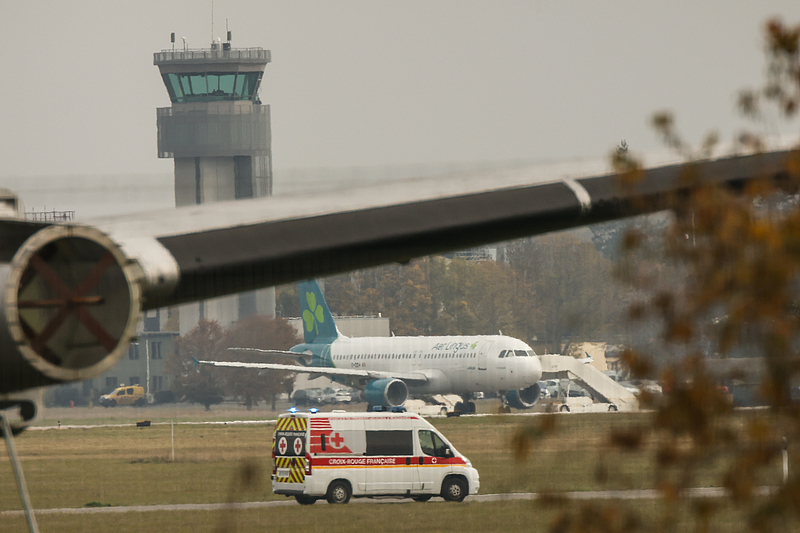
November 5th, Evre, France. An Airbus A320 aircraft operated by Irish Airlines is parked at the Evre military base. Visual China
On that day, two Air Finland flights also received threats. The flights were from Helsinki to Rome and Vienna, respectively. The flight to Rome was escorted by Italian Air Force fighter jets during landing, and no explosives were found upon inspection.
Bulgaria reported that three Ryan Air flights headed to the capital Sofia were threatened with bombs, and fighter jets were deployed by the air force for protection. Two of the flights landed safely in Sofia, while another flight departing from London was diverted to Plovdiv.
On that day, the Czech police implemented security measures for four flights headed to Prague. After inspection, no threats were found. In addition, some flights of companies such as Polish Airlines and Wizz Air were also affected.
The successive events have drawn the attention of the European Union.
The European Aviation Safety Agency stated on November 5 that it will continue to monitor the situation and identify and assess the potential impact of such safety threats on flight safety.
The EU Transport Commissioner Dimitaros confirmed on the same day that the EU has launched an aviation safety information sharing mechanism to assist member states in exchanging information and coordinating responses.
European police spokesperson Kyle George said that if the threat in question involved serious organized crime or terrorism, the agency was prepared to provide support as requested by relevant authorities from other countries, including identifying potential connections between events occurring in different nations.
This is already the fourth consecutive day in Europe that bombings have been threatened.
On November 3rd, at least 7 passenger planes in Poland, Spain, Italy, and Bulgaria received bomb threats. Some flights were diverted, and the airports were briefly closed.
On that day, a Ryan Air flight from Dublin to Rome was escorted by Italian air force fighters during landing. Another Ryan Air flight from Lisbon to Rome also underwent bomb detection checks, and no abnormalities were found.
In Poland, a passenger aircraft flying from London to Warsaw was forced to make a diversion at Modlin Airport, resulting in a temporary closure of the airport.
The previous day, a Viz Aviation passenger plane flying from London to Sofia in Bulgaria was also forced to make an emergency landing at Budapest Airport in Hungary due to a bomb threat. The Hungarian Air Force deployed 'Gripen' fighter jets for escort.
It is worth noting that the successive threats have revealed some common patterns.
Bulgarian police confirmed that they received a threatening email on November 3rd, which claimed that bombs were hidden on two airplanes flying from Bergamo, Italy, and Dublin, Ireland, respectively to Sofia. The police immediately deployed anti-terrorism personnel and police dogs for inspection, but no explosive devices were found.
The same email being sent to two different flights also draws more attention from the outside world. It raises the question of whether this intimidation campaign that has swept across multiple European countries was planned together.
Aviation Risk Consulting Company Osprey Flight Solutions Manager Rhys Jones said that a single day where 7 bomb threats impacting flights occurred is extremely rare. These threats did not explicitly target any country, airline, or route, indicating their...
This agency further analyzed and believed that the consecutive occurrences of events may have characteristics of coordinated action, and thus reminds aviation companies to be prepared for potential interference.
In fact, even without any explosive devices, the threat actor could still achieve the goal of disrupting air transportation.
Once a credible bomb threat is received, airlines must assess the risk and may need to change their flight routes, arrange for emergency landings, or even request military escorts. After the plane lands, bomb disposal personnel, police dogs, and airport security staff will also need to inspect the cabin, luggage, and passengers.
These measures not only disrupt the normal schedule of the involved flights, but may also affect the takeoff and landing of other flights at the airport. They increase the operating costs of airlines and consume a large amount of safety resources.
Philip Baum, an aviation safety expert at Coventry University in the UK, pointed out that false bomb threats are not uncommon. Some people carry out these threats simply as a prank or to deliberately delay flights. However, if the threat contains specific information, airlines must assess it seriously and cannot easily dismiss it as a hoax.
Besides disrupting air transportation, some safety analysts also propose another possibility:
Some experts believe that the threattaker may have intended to...
Osprey Flight Solutions co-founder Matthew Bourry suggested that these incidents could involve attempted imitation of known crimes, or individual and group efforts to create panic. It is also possible that state actors or their supporters may be behind the so-called "hybrid warfare" tactics.
However, the above judgments are currently only speculative. European investigators have not released any evidence to prove the involvement of foreign forces, nor have they confirmed that each incident was planned by the same organization.
The European Commission stated that it is too early to determine whether these bomb threats are related to each other, and the investigation remains the responsibility of the respective national authorities. As of now, no individual or organization has been identified as responsible for this series of threats.