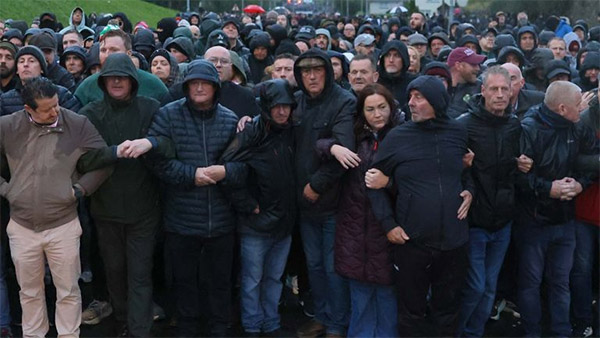
In September this year, the pro-English Protestant group ‘Orange Order’ in Northern Ireland attempted to march along a Catholic neighborhood, leading to clashes between the anti-English and unionists in Northern Ireland. Although the British Secretary for Northern Ireland eventually stopped the march, the political crisis caused by the dispute continued to intensify, continuously impacting the complex political situation in the region.
Recently, the Democratic Unionist Party, the largest unionist party in Northern Ireland, has faced the risk of internal division. A popular senior member of the party and a senior local councillor announced their withdrawal from the party. They complained that the Democratic Unionist Party did not take “tough measures” against its rival, the nationalist party Sinn Fein. This has dealt a significant blow to the Democratic Unionist Party’s influence in both the British Parliament and the Northern Ireland Parliament.
The British "Financial Times" states that the Democratic Unionist Party strongly supported the "Orange Party" protests. However, this action not only failed to bring benefits, but also led the party to suffer a "backlash," resulting in division within the party. Meanwhile, the Sinn Féin's support among the voters in Northern Ireland increased significantly, suggesting that they could gain an advantage in the Northern Irish parliamentary elections next May.
Analysis indicates that this dispute caused by the march has uncovered the “old scars” of the conflict in Northern Ireland. It has deepened the hostility between the Unionists and the Republicans. The functioning of Northern Ireland’s administrative apparatus, which is already in a “paralyzed” state, will face even greater obstacles.
"Orange Order" is a Protestant organization in Northern Ireland advocating for remaining in the United Kingdom, named after King William III of England, also known as "William of Orange". He ruled over England, Scotland and Ireland.
Every year, the “Orange Party” holds protests across Northern Ireland, emphasizing their British identity. During the peak of the protests in July, the organization also publicly commemorates William III’s victory over the Catholic King James II in the Battle of the Boyne River in 1690. However, the protest marches of the “Orange Party” often pass near Catholic communities in Northern Ireland, frequently leading to disputes and conflicts.
The most intense conflicts occurred on Garvaghy Road in Portadown, a necessary route for the ‘Orange Belt Party’ during their annual parade. However, this area is also a community where Northern Irish nationalists are in the majority. As a result, violent clashes often occur, forcing the Northern Ireland Parade Committee to ban the ‘Orange Belt Party’ from marching along Garvaghy Road during their annual parade in 1998.
the Northern Ireland Public Order Council is a quasi-judicial non-governmental public body that is responsible for imposing restrictions on any parades in Northern Ireland that are deemed to be controversial or offensive.
However, in September this year, after a series of legal challenges, the Northern Ireland Civil Rights Commission lifted restrictions for the first time in 28 years, allowing the Orange Order to march along Garvagh Road again. This caused a stir. Political parties such as the Democratic Unionist Party supported this decision, while nationalist parties like the Sinn Féin opposed it. There were confrontations between these parties in local councils and on the streets.
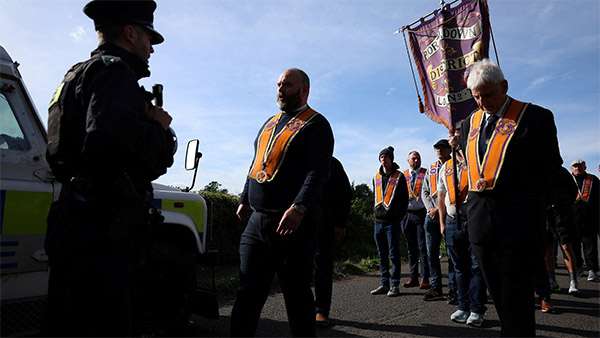
"Orange Belt Party" protesters, Reuters
The 'Orange Belt Party' organized a protest demonstration shortly before the march on September 27. Catholic groups in Northern Ireland quickly acted to block roads, preventing the 'Orange Belt Party' from entering Galloway Road. Several members of the Sinn Féin and Social Democratic Labour parties joined the protest, and Sinn Féin Vice-President Michelle O’Neill, the Chief Minister of Northern Ireland, also appeared among the protesters, calling on them to persist until the end.
This standoff lasted for two weeks, with neither side willing to make concessions or reach a compromise, leading to tensions in Northern Ireland. Eventually, Chris Bryant, the British Minister for Northern Ireland Affairs, had to make a decision on October 9th, banning the Orange Order from holding rallies along the Garvagh Road once again. He stated that this measure was aimed at maintaining “the greater public interest and safety.”
"Orange Party" then filed a lawsuit after this decision was rejected by the High Court of Belfast.
Sinn Féin welcomed Breindt's decision and expressed regret that Breindt "spent so much time on this matter." O'Neill believes that Breindt could have intervened in the situation from the beginning. Social Democratic Party leader Claire Hannah also said, "This demonstration should not have been approved from the start, and should never be approved again."
Northern Ireland's deputy chief minister and Democratic Unionist Party MP, Emma Little-Pengelly, was extremely dissatisfied with the decision. She claimed that it "means the concept of a new Ireland has been destroyed" and accused Sinn Féin of "despising and hating" Northern Ireland's Protestant communities' traditions.
Although the confrontation between Gavish and others has ended, the political turmoil in Northern Ireland continues to worsen. The Democratic Union Party, which once strongly supported the ‘Orange Belt Party’ protests, is facing a crisis of internal division.
On November 2nd, local time, Kara Lockhart, a member of the Democratic Unity Party from the British Parliament, announced her departure from the party. She will continue to participate in political activities as an independent MP. This means that there are only four members of the Democratic Unity Party left in the British Parliament, bringing the number of MPs for this party to its lowest level in 25 years.
Rockhard said that she was dissatisfied with the way the Democratic Unity Party handled the dispute over the ‘Orange Belt Party’ protest. She criticized the party for not taking strong action to remove Chief Minister O’Neill.
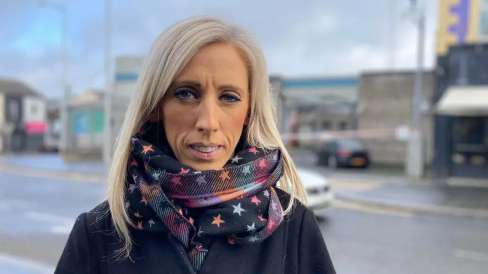
Carla Lockhart British Broadcasting Corporation
The Financial Times notes that Rockhart is one of the most popular members of the Democratic Unionist Party. She joined the party at a young age. Since 2019, she has been a Member of Parliament representing the South Belfast constituency, holding a very stable position. With local elections in Northern Ireland taking place in May next year, the departure of this senior member could be a “major blow” to the party.
In the Northern Ireland Local Assembly, Clement Cassbertson, a member of the Democratic Unionist Party representing the Dungannon constituency, also announced his withdrawal from the party on November 3. He will continue to serve in the local assembly as an independent. Cassbertson is also a senior member of the Democratic Unionist Party, having joined the party nearly 30 years ago.
These two council members decided to withdraw, mainly due to their dissatisfaction with the Democratic United Party being "not strong enough".
Previously, Northern Ireland’s Chief Minister O’Neill participated in protests against the ‘Orange Party’. The Democratic Unionist Party considered O’Neill’s actions ‘illegal’. Some MPs called for the resignation of Deputy Chief Minister Little-Pegley.
According to the power-sharing rules established in the Belfast Agreement of 1998, in the Northern Ireland Parliament, the largest nationalist party and the unionist party must share power. The Chief Minister of Northern Ireland and the Deputy Chief Minister jointly govern in the coalition government. If one of them resigns, the other will also lose their position.